Iran Calls for Global Accountability Over Wartime Environmental Damage
Iran’s president urges global accountability for wartime environmental damage as he links peace, climate justice and renewable energy at COP31.
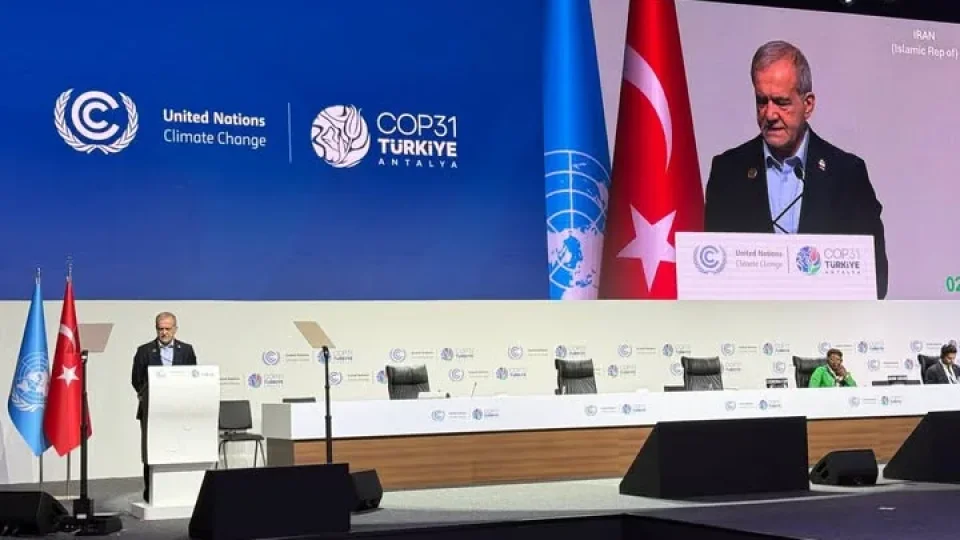
Iranian President Masoud Pezeshkian has called for stronger international mechanisms to document environmental damage caused by military action and hold those responsible accountable. Speaking at the leaders’ summit of the 31st United Nations Climate Change Conference (COP31) in Antalya, Türkiye, on Wednesday, November 11, Pezeshkian said peace was essential to protecting the environment. He argued that wars targeting land, water, air and natural resources can leave environmental consequences that persist for generations.
Referring to what he described as recent United States and Israeli acts of aggression against Iran, the president said the strikes had caused extensive human and economic losses as well as serious environmental damage. Citing assessments, Pezeshkian said attacks on fuel facilities in Asaluyeh had released approximately 500,000 tonnes of pollutants, while strikes on fuel-storage facilities around Tehran had released about one million tonnes of carbon dioxide.
He said fuel consumption, explosions, infrastructure destruction and widespread fires could undermine years of climate and environmental-protection efforts. Pezeshkian also referred to attacks on protected areas and environmental ranger stations, describing them as shared assets that must be preserved for present and future generations, reports IRNA.
The president called for stronger mechanisms to document, prevent and ensure accountability for environmental damage resulting from armed conflict. He also urged the international community to connect climate commitments made during peacetime with responsibilities during war, and to develop mechanisms to compensate for environmental losses caused by military aggression. Pezeshkian reportedly said Iran had continued to develop renewable energy despite sanctions and restrictions on access to international finance and technology. According to IRNA, the country’s renewable-power capacity had risen from about 1,250 megawatts to more than 6,150 megawatts over the past two years.
He added that clean electricity generation had exceeded 4.5 billion kilowatt-hours this year, preventing an estimated 2.5 million tonnes of carbon dioxide emissions.
“The Earth belonged neither to one nation nor to one generation, but was a trust that must be passed on safely to future generations,” Pezeshkian said. He described peace as a prerequisite for environmental protection and environmental protection as a prerequisite for lasting peace.