'Salaries, Housing, Prices': Spain’s First General Strike In 14 Years Puts Cost Of Living In Focus
Spain’s first general strike in 14 years puts housing, wages and living costs at the centre of a high-stakes election campaign.
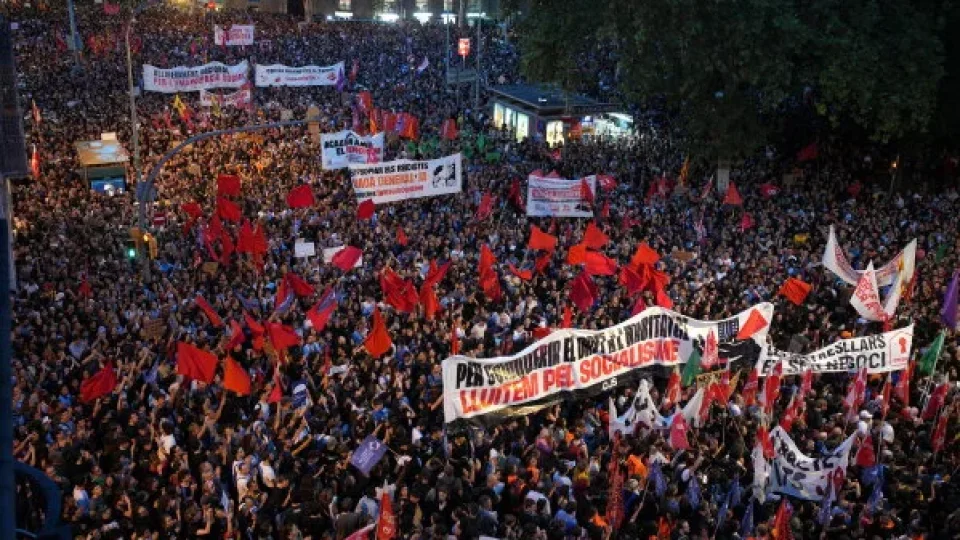
Millions of workers across Spain joined the country’s first general strike in 14 years this week, disrupting transport, ports and factories in a nationwide protest over housing costs less than three weeks before a general election. The 24-hour stoppage, called by Spain’s two largest unions and backed by tenants’ groups, put affordable housing, wages and living costs at the centre of a campaign that could determine whether Prime Minister Pedro Sánchez remains in power.
The strike, held under the slogan “Salaries. Housing. Prices” on Wednesday, was initially called by tenants’ associations and later backed by the Workers’ Commissions (CCOO) and the General Union of Workers (UGT), as per reports. It was the first general strike jointly backed by the two unions since 2012.
Spain’s housing crisis has become one of the country’s most politically charged issues. Rents have risen sharply over the past decade, while housing campaigners say speculative investment, short-term tourist lets and weak tenant protections have made secure and affordable homes increasingly difficult to find.
A Nationwide Stoppage
The unions reported substantial early participation in several sectors. UGT and CCOO said 90% of workers in the automotive and port sectors joined the stoppage, along with 85% in the meat industry, 82% in waste collection and 75% in the energy sector.
The action disrupted public transport, ports, factories and other services across the country. Spain’s electricity grid operator, Red Eléctrica, recorded a 7.5% fall in power use during the early hours of the strike, although that was lower than the fall recorded during the last general strike 14 years earlier.
Participation was not uniform. The unions said support was strongest in coastal regions including Catalonia and Andalucía, where housing pressures have been particularly acute.
Housing at the centre
The strike was propelled by anger over rising rents and evictions. It gained momentum after the eviction of 87-year-old Maricarmen Abascal from a Madrid home where she had lived for more than seven decades; she reportedly died in hospital weeks later.
Housing campaigners are demanding a crackdown on speculative property investment, the elimination or restriction of tourist lets, and stronger protections for renters, including automatic lease renewals. The unions are also seeking greater government intervention in the housing market and a new agreement on the minimum wage, reports AP.
Sandra Mora of the Madrid Tenants’ Union said the action was intended to show the political power of workers and renters. “It’s extremely important to remind people that we, the workers, who are also renters or who also pay mortgages, are the ones with the power to halt production and bring the economy to a standstill,” she told Spanish broadcaster RNE.
Protests and clashes
Large demonstrations took place in Madrid and Barcelona, despite heavy rain and storm warnings. NPR reports that Government officials estimated that 120,000 people joined a demonstration in Madrid, while organisers claimed 400,000 attended in Barcelona; local police put the Barcelona figure at 55,000.
The protests were largely peaceful for much of the day, but clashes broke out in Barcelona in the evening. Masked protesters set fire to rubbish bins, smashed shop windows and clashed with police, who used tear gas. Dozens of people were reported to be arrested across the country in connection with minor incidents.
The BBC reported that some disturbances occurred near Passeig de Gràcia, close to Plaça de Catalunya, while local media reported attempts to enter shops and looting. The reports should be treated as accounts of isolated incidents rather than a description of the entire demonstration.
A Political Test
The strike comes before Spain’s general election on 29 November. Prime Minister Pedro Sánchez called the snap election after right-wing parties blocked emergency legislation intended to limit evictions and ease rent pressures.
Sánchez has sought to use the strike to return attention to housing and social policy. In a video posted on X, he praised past labour achievements including the eight-hour working day, pensions and public healthcare, saying: “It wasn’t easy, but they changed Spain.”
The opposition has reportedly framed the stoppage differently. The conservative People’s Party (PP) and the far-right Vox party argue that the unions are trying to help Sánchez remain in office. PP spokesperson Miguel Tellado said: “This strike is not a general strike; it is an electoral strike. It is not against the government in power, but rather against the government to be.”
What Unions Want
CCOO general secretary Unai Sordo said collective bargaining alone could not solve a housing market in which costs had risen by as much as 12% annually. “There is one issue that is fracturing the country, and that is the difficulty many people face in accessing housing,” he told Cadena Ser.
The unions have called for wage increases of between 4 and 7%, rent controls, an end to speculation and the creation of 1.5 million protected homes. CCOO also called for stronger public pensions and greater investment in social security.
Business groups have rejected the framing. Miguel Garrido, vice-president of the Spanish Confederation of Business Organisations (CEOE), said the action was political rather than labour-related and was closely linked to the early election.