‘That’s On Me’: Vance Explains ‘Indentured Servants’ Remark, Brings Up Indian In-Laws
JD Vance on H1B Visa Holders: US Vice President JD Vance clarifies his “foreign indentured servants” remark, saying his criticism targeted companies exploiting H-1B visa workers, not immigrants.
US Vice President JD Vance has sought to clarify his “foreign indentured servants” remarks about H-1B visa holders, which drew strong condemnation from India, saying his criticism was directed at American companies and the visa system rather than immigrant workers. Speaking at a CBS News town hall on Saturday, Vance acknowledged that his choice of words had been imperfect after an attendee questioned his description of foreign workers on employment-based H-1B visas.
“To the extent that my rhetoric has been imperfect here, that's on me,” Vance said.
He argued that some companies exploit the H-1B visa system by laying off American employees and hiring foreign workers who have limited freedom to challenge workplace decisions because losing their jobs could also jeopardise their right to remain in the United States. “That's a criticism of a company who brings a person in, who sometimes will literally lay off an American worker, bring somebody else in, and knows that person, if they complain, if they get too uppity at work, if they have a disagreement with their boss, they couldn't just lose their job, … they can be shipped back to their country of origin,” he said.
“And I think that gives employers way too much power,” he added.
Vance also argued that a successful nation requires shared values, a common language and unified civic traditions to maintain social cohesion and a sense of community. “My goal here is not to dehumanise any immigrant,” he said, while maintaining that large-scale immigration could change the country in profound ways, even when those arriving were good people.
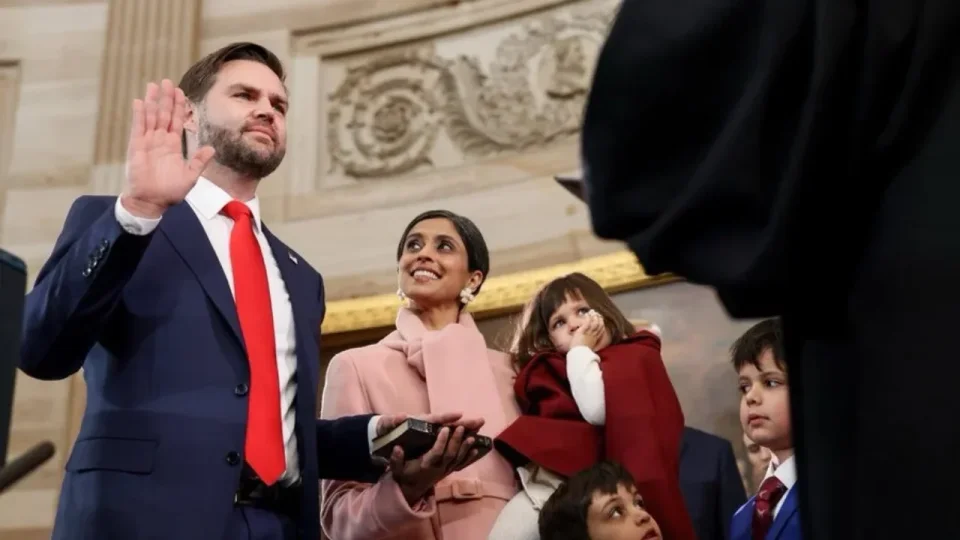
The US Vice President invoked his family ties to India to underscore his position, saying he respected immigrants who contributed to the country. Vance is married to Usha Vance, whose parents immigrated from South India. “You know where my family comes from, and I love my mother-in-law and father-in-law who immigrated from South India, and obviously their daughter, born in the United States of America, is now the second lady, and I’m very proud of her, and I love her very much,” he said.
“I will tell you that nobody's perfect, certainly not me. But my goal here is not to dehumanise any immigrant, and in fact, I love a number of immigrants,” Vance added.
Vance Targets Microsoft Over Green Card Sponsorships
Vance had earlier criticised Microsoft for allowing companies to sponsor green card applications, or permanent residency, for H-1B visa workers through the Permanent Labour Certification (PERM) programme. He accused the technology company of replacing American workers with foreign employees and announced the suspension of its participation in the programme.
“Our message to Microsoft and to any other foreign or domestic corporation is quite simple. We obviously want you to thrive in the United States of America. We want people to invest in the United States of America, particularly the American technology sector... We want you to continue to grow and to employ a lot of people, but we want you to employ American workers,” Vance had said.
He added: “And so our message to Microsoft is, you're a great American company, but you've got to hire great American workers. You cannot lay off American workers and then replace them with foreign indentured servants.”
Earlier this month, the US government subsequently suspended PERM programme access for eight companies, including three American firms, Capgemini, Microsoft and Adobe, and five Indian IT companies: Cognizant, Infosys, Tata Consultancy Services (TCS), Wipro and HCLTech. The move affects these companies' ability to file new PERM applications, a key step in the employment-based green card process for eligible foreign workers. The suspension has raised concerns among H-1B visa holders seeking permanent residency in the United States.