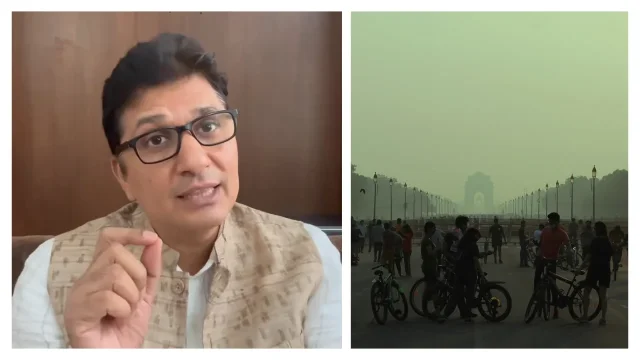
Delhi's Pollution Levels Ease, AQI at 219; What Brought Relief?
Delhi AQI Today: Delhi records third consecutive day of cleaner air and lower AQI, but this relief may be temporary.
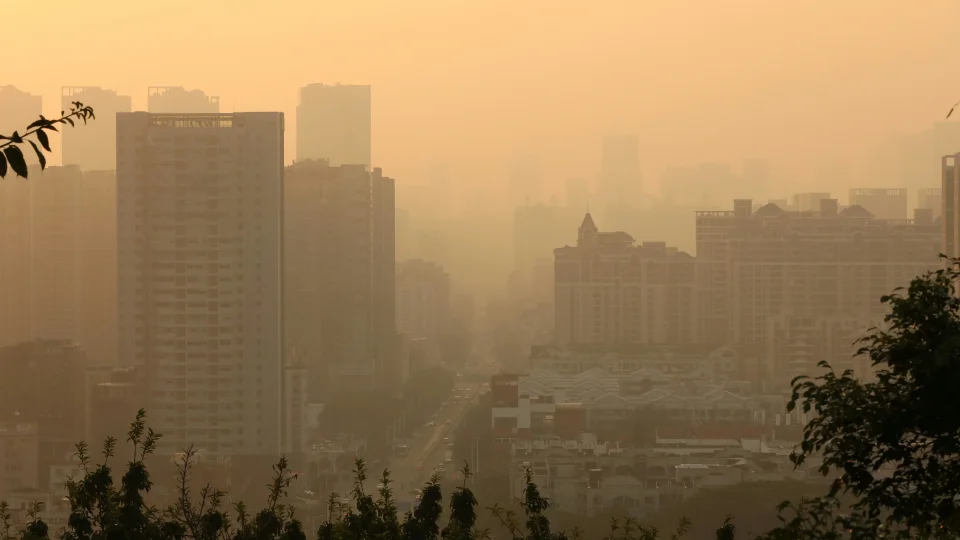
Delhi’s air quality improved for the third consecutive day on Tuesday, with the city’s overall AQI recorded at 219, according to Delhi government data. The improvement, however, remained uneven: 10 monitoring stations still reported “very poor” air.
What the Data Shows
According to CPCB data at 8 am, Delhi’s average AQI was 238, down from 275 on Monday and 290 on Sunday. The city remained in the “poor” category, which covers AQI readings between 201 and 300.
Several locations continued to record very poor air. ITO registered an AQI of 342 at 6 am, while Sirifort and Jaffarpur each recorded 349; Delhi University’s North Campus stood at 317, and IIT Delhi and CRRI Mathura Road at 307 each, reports India Today. Lodhi Road was among the cleaner areas at 192, followed by Major Dhyan Chand National Stadium at 198 and Nangloi at 208. In the wider National Capital Region, Gurugram recorded an AQI of 300, while Faridabad, Greater Noida, Noida and Ghaziabad were at 184, 179, 195 and 195 respectively.
Latest weather update posted by Commission for Air Quality Management (CAQM) was on Monday evening, on X, formerly Twitter.
#AQI of #Delhi on 16.11.2026 at 4:00 PM (पिछले 24 घंटों का औसत) | RG93bmxvYWRzL0FRSV9CdWxsZXRpbl8yMDI2MTExNi5wZGY= #GoGreenBreatheClean https://t.co/D3cbCHu6sD
— Commission for Air Quality Management (@CAQM_Official) November 16, 2026
Why Air Quality Improved
Air quality has improved reportedly because of a drop in temperatures. According to the India Meteorological Department (IMD), Delhi experienced its coldest day of the month on Monday, with a daytime high of 27.5°C and a seasonal low of 14.8°C.
Pollution Sources
PM2.5 remained the predominant pollutant, according to the Air Quality Early Warning System (AQEWS). Biomass burning, including stubble burning, domestic solid biofuel, dung cakes and wood, was the largest contributor to Delhi’s PM2.5 pollution, accounting for 37.1 per cent on Sunday, according to real-time source-apportionment data cited by India Today.
Secondary organic aerosols contributed 22 per cent, vehicular emissions 17.2 per cent and secondary inorganic aerosols 9.6 per cent. Waste burning, mixed combustion, mineral dust and ash, firecrackers and industrial emissions accounted for 5.5, 4.3, 2, 1.6 and 0.6 per cent respectively.
Forecast: Relief May Be Brief
The AQEWS forecast a marginal decline in PM2.5 and PM10 concentrations on November 17 and 18, but warned that air quality could slip back into the “very poor” category. The system further expected very poor air to persist for the subsequent six days.
A weakening ventilation index was projected, from 16,000 square metres per second on November 15 to 15,000 on November 16, 7,500 on November 17 and 6,000 on November 18, as per the Air Quality Early Warning System. A ventilation index below 6,000 square metres per second, combined with average wind speeds under 10 kmph, is considered unfavourable for pollutant dispersion.
No “Severe” AQI in November
Delhi recorded no “severe” air-quality days, AQI above 400—between November 1 and 15 this year, the first time since CPCB began calculating the AQI in April 2015. The fortnight’s average AQI was 343, compared with 367 last year and 343 in 2022.
Delhi recorded three “poor” days and 12 “very poor” days in the first fortnight of November, with the highest 24-hour AQI of 382 on November 6. Experts cited by TOI attributed the absence of severe days to favourable meteorological conditions, restrictions under the Graded Response Action Plan and Delhi’s winter framework, and comparatively low stubble-burning contribution.
However, it has also been reported that there are concerns over monitoring and data gaps. On Diwali night, CPCB reportedly did not share readings for several hours at many stations where PM concentrations exceeded 1,000 micrograms per cubic metre; those missing values were not included in the 24-hour average AQI. An analysis by the Centre for Research on Energy and Clean Air, cited by TOI, estimated that including such readings at 1,000 micrograms per cubic metre could have raised Delhi’s average PM2.5 level from 269 to 400 micrograms per cubic metre on Diwali.
What Lies Ahead
As per the historical records, Delhi typically has severe air quality in December and January. It is reported that the second half of December has approximately been the year’s second-most polluted fortnight, with an average AQI of 346, followed by January 1–15, with an average of 329.3 between 2016 and 2026.