From France to India, How Left-Wing Networks Are Shaping the New Wave of Youth Protests
From France and Belgium to Spain, Albania and India, youth-led protests are challenging governments over austerity, housing costs, corruption and electoral accountability. Left-wing parties, trade unions and student groups have played visible roles in several movements, but do the similarities point to a wider network or reflect distinct local grievances?
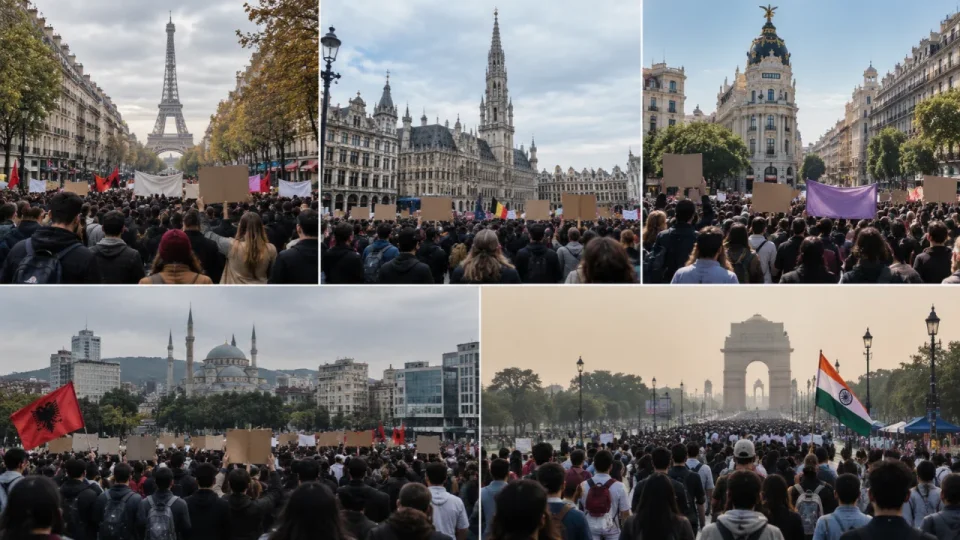
Protests involving students, young people, trade unions and civil society groups have intensified across several countries in recent weeks, with demonstrators challenging governments over education, living costs, housing, corruption and public accountability. The protests have different national contexts and immediate triggers. However, the involvement of established unions, political groups and student organisations raises questions about how grassroots grievances become organised political movements, and how campaign messages travel across borders.
France has witnessed a major wave of student-led demonstrations that broadened into protests against rising living costs and declining public services. In Belgium, students joined trade unions opposing government budget cuts. Spain has seen renewed mobilisation over housing affordability, while student-led demonstrations in Albania have called for the prime minister's resignation.
In India, the Cockroach Janta Party (CJP) and the All India Students’ Association (AISA) have mobilised against alleged irregularities in electoral rolls and demanded action against Chief Election Commissioner Gyanesh Kumar.
France: Student protests expand beyond education
France has been at the centre of the latest wave of unrest. Student demonstrations began with demands for better school conditions, including concerns over teacher shortages and deteriorating facilities. They subsequently expanded to encompass inequality, public spending, living costs and police conduct.
On October 8, tens of thousands of students and other demonstrators gathered in cities including Paris, Marseille and Lyon, according to Le Monde. Protests continued to draw large crowds, with some marches ending in clashes.
On October 17, widespread demonstrations against rising living costs and declining public services. While many participants marched peacefully, some groups looted shops, set fires and attacked public buildings and police. The government blamed violent incidents on far-left extremists and criminals, while allegations of police violence also came under scr0
The report also examined organisations it associated with US-born businessman Neville Roy Singham, who has been linked by previous investigations to a network of left-wing media and activist groups. These are reported associations and allegations; they do not, on their own, establish that the protests were directed or financed by a single international network.
Belgium: Trade Unions and Students Challenge Austerity
Belgium has also seen demonstrations against the government's economic policies. On October 9, thousands of trade union members, students and public-sector workers marched in Brussels against planned budget cuts and socio-economic reforms. The demonstration was organised around opposition to measures that unions argue could place additional pressure on workers, pensioners and lower-income households. Students also raised concerns about education costs and access to higher education.
The protests were not exclusively youth-led: trade unions played a central organisational role, while student groups joined the mobilisation. Some clashes occurred between protesters and police. Belgium's three main trade unions have since called for another major demonstration in Brussels on November 23, opposing austerity measures and the erosion of purchasing power.
Spain: Housing Crisis Fuels a Growing Protest Movement
In Spain, the focus has been on housing costs, rents and evictions. Young people have been particularly affected by rising prices and difficulties securing affordable accommodation. On October 2, The Guardian reported that opposition lawmakers had voted down emergency housing measures proposed by the country's Socialist-led coalition, as demonstrations over the housing crisis gathered momentum.
Housing activists and tenants' groups have organised protests and efforts to prevent evictions. Major unions UGT and CCOO have also announced support for a general strike over housing affordability, with the date yet to be finalised in reporting published on October 5. Unlike demonstrations centred on a single political figure, the Spanish mobilisation is rooted in a long-running economic concern: the widening gap between housing costs and what many workers can afford.
Albania: Student Protests Call for the Prime Minister to Resign
In Albania, student-led demonstrations have escalated amid anger over corruption, unemployment and education standards. Protesters have called for Prime Minister Edi Rama to step down. The protests had continued for a ninth day on October 22, spreading from Tirana to other cities. Clashes included attacks on government buildings and confrontations with police, who used tear gas, water cannon and rubber bullets.
Rama rejected calls for his resignation and argued that the unrest threatened Albania's ambitions to join the European Union (EU). The government has also alleged that outside interests were involved, but such claims should be distinguished from independently established evidence. The immediate demands in Albania are therefore different from those in France or Belgium, even as all three countries have experienced demonstrations involving younger participants.
India: CJP and AISA Protest over Electoral Rolls
In India, CJP and AISA have mobilised against alleged irregularities in the Special Intensive Revision (SIR) of electoral rolls and demanded the removal of Chief Election Commissioner Gyanesh Kumar. On October 16, the two groups called for a flag-hoisting programme at Connaught Place in Delhi. the groups condemned police action against protesters and described the demonstration as part of their ongoing campaign over the electoral-roll revision process.
The participation of a student organisation alongside a political protest group illustrates how established activist networks can help organise demonstrations and carry a campaign beyond its initial participants. It does not, by itself, establish a connection between these Indian groups and the organisations identified in reporting on France.
Similar Grievances do not Prove a Single Global Movement
Across these countries, the issues range from school conditions and austerity to housing, corruption and electoral accountability. The role of unions, student federations and political groups is visible in several cases, as is the use of social media and international news coverage to publicise demonstrations.
But the evidence needs to be separated from the interpretation. Organisations sharing political language, amplifying one another's messages or supporting similar causes do not necessarily demonstrate centralised planning, foreign financing or common command. Establishing a direct international link would require more specific evidence, such as documented financial transfers, organisational agreements, communications or joint planning records. Until then, the strongest factual conclusion is that protests rooted in distinct domestic grievances are being organised and amplified by a mixture of local movements and established political networks, with some groups also drawing attention to events beyond their own countries.
The key question is not simply whether left-wing organisations are present. It is how they participate, what evidence exists of coordination, and where political solidarity ends and operational links begin.