Maharashtra AQI Worsens Post-Diwali: Inland Maharashtra Chokes as Post-Diwali Smog Hits 'Very Poor'
Maharastra AQI: 13 inland cities in Maharashtra outpaced Mumbai in post-Diwali pollution; Pimpri Chinchwad plunge into 'very poor' air quality as stagnant winds trapped toxic smog.
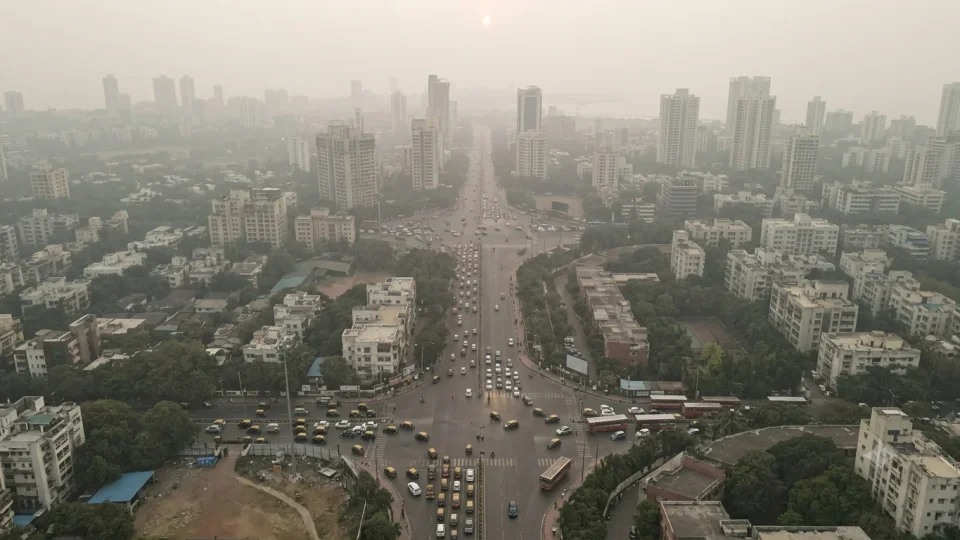
Maharashtra’s inland cities recorded worse post-Diwali air than Mumbai, with Pimpri Chinchwad crossing the ‘very poor’ threshold and 13 cities in the state falling in the ‘poor’ or ‘very poor’ categories on November 9. According to the Central Pollution Control Board (CPCB) dashboard at 4 pm on November 9, Pimpri Chinchwad recorded an AQI of 301, while Pune stood at 288 and Nagpur at 268; Mumbai remained in the ‘moderate’ category at 172.
What Happened
The deterioration followed Diwali celebrations on November 7 and 8. The CPCB’s post-Diwali monitoring period began on November 9, and its dashboard showed PM2.5 as the prominent pollutant in the affected Maharashtra cities.
Pimpri Chinchwad was the only city to enter the ‘very poor’ band, with an AQI of 301. Nanded recorded 296, Pune 288, Malegaon 273, Nagpur 268, Jalna 266, Parbhani 246, Jalgaon 243, Nashik 234, Akola 230, Belapur 218, Chhatrapati Sambhajinagar 211 and Chandrapur 202.
Mumbai’s citywide AQI was 172 at 6 pm on November 9, according to the CPCB, though eight monitoring locations recorded ‘poor’ air. Bandra East’s Kherwadi area was the worst at 265, followed by Bandra Kurla Complex at 232, Sewri at 229 and Deonar at 228.
Why Inland Cities Fared Worse
The year-on-year comparison was stark: Pune’s AQI rose from 115 on October 22, 2025, the day after Diwali, to 288 on November 9, 2026, while Pimpri Chinchwad increased from 154 to 301. Malegaon rose from 123 to 273 and Akola from 109 to 230; Nanded, already at 216 last year, rose by about 37 per cent.
Atmospheric scientist Gufran Beig of the National Institute of Advanced Studies told The Indian Express that Mumbai benefited from sea breeze and easterly winds associated with an anticyclonic circulation over the Himalayas, which helped disperse pollutants. He said inland centres such as Pune, Pimpri Chinchwad and Nagpur lacked that advantage, while El Niño-related slower winds allowed firecracker emissions to linger.
Former NEERI scientist Tuhin Banerjee further said that rising sea temperatures had contributed to stagnation. At the same time, local emissions, including firecrackers and industrial activity, particularly in Chandrapur, compounded the problem.
Authorities’ Response
Maharashtra Pollution Control Board Joint Director (Air) Satish Padval said the statewide deterioration was mainly caused by firecracker bursting. He said the MPCB had directed municipal bodies, tehsils and district collectors’ offices to impose an immediate ban on firecracker bursting, and had instructed the state police to act against those bursting crackers in public places.
Thane district collector Shrikrishna Panchal imposed a ban on rockets and similar aerial firecrackers across the district until January 8, 2027, citing public safety. The Brihanmumbai Municipal Corporation issued a comparable order for Mumbai until November 25; the restrictions covered the Mumbai region except Vasai-Virar and Panvel.
The action followed a surge in fire-related emergencies: the Mumbai Fire Brigade received 142 fire calls on November 8, of which 137 were linked to fireworks, according to BMC data cited by The Indian Express. All 44 calls received by the Thane Fire Brigade until Sunday night were attributed to firecrackers.
Why This Happened
The immediate trigger was Diwali firecracker emissions, but the episode exposes a wider vulnerability of Maharashtra’s inland urban belt: without coastal wind circulation, pollution from fireworks, industry and other local sources can remain suspended for longer. The data suggest that Mumbai’s comparatively lower citywide reading should not obscure severe local pollution pockets within the metropolitan region, nor the sharper deterioration across Pune, Pimpri Chinchwad, Nagpur and other inland centres.
Official Updates
The authoritative official record available is the CPCB’s real-time air-quality portal and AQI bulletin system; the CPCB states that its portal provides live AQI and continuous PM2.5 and PM10 tracking.
The Bombay High Court’s order in the Diwali firecracker matter directed authorities to ensure firecracker use only between 6 am–7 am and 8 pm–10 pm on November 7 and 8, prohibited bursting within 300 metres of hospitals and notified silence zones, and required a complete ban to be restored from November 9.
🔷शहरी आपत्ती व्यवस्थापन प्राधिकरण, बृहन्मुंबई यांच्याकडून बृहन्मुंबई महानगरपालिका हद्दीत रॉकेट व तत्सम आकाशात उडणाऱ्या फटाक्यांचा वापर करण्यास पूर्णतः प्रतिबंध करण्यात येत आहे. 🔷नागरिकांनी नियमांचे आणि निर्देशांचे काटेकोरपणे पालन करावे, असे आवाहन करण्यात येत आहे. #Mybmcupdates @CPCB_OFFICIAL @mpcb_official @EnvironmentMaha @mybmcSWM @MumbaiPolice
— माझी Mumbai, आपली BMC (@mybmc) November 9, 2026