We Build Fast. We Build Proud. But Do We Build to Last?
India does not have an infrastructure problem. It has an infrastructure integrity problem. And the distinction matters enormously. By Sanjai Jalla India's infrastructure ambition is real- and so is the reckoning waiting beneath its freshly paved roads and ribbon-cut bridges. Every collapsed bridge tells two stories. The first is the tragedy you see- the rubble, the grief, the headlines that last 48 hours. The second is the one we rarely discuss: the quiet accumulation of compromises made long...
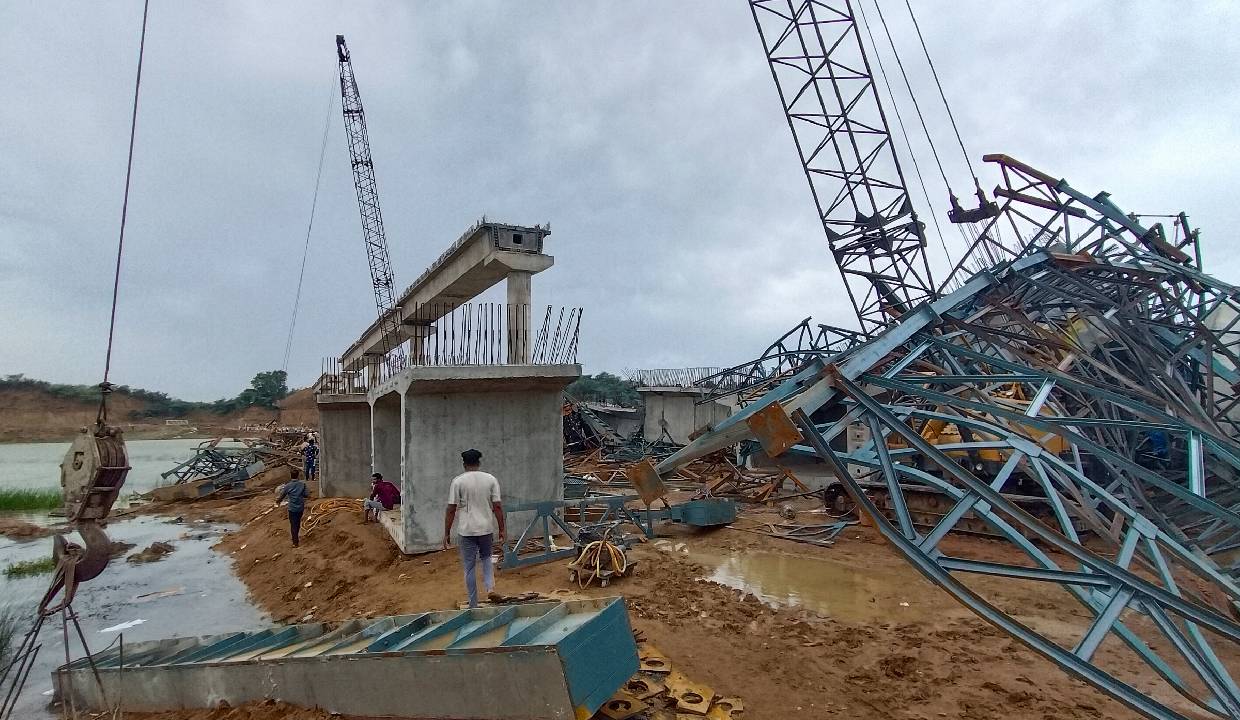
India's infrastructure ambition is real- and so is the reckoning waiting beneath its freshly paved roads and ribbon-cut bridges. Every collapsed bridge tells two stories. The first is the tragedy you see- the rubble, the grief, the headlines that last 48 hours. The second is the one we rarely discuss: the quiet accumulation of compromises made long before the first crack appeared. As someone who works at the intersection of urban planning and policy, I have spent years watching India celebrate its infrastructure milestones. What I don't see celebrated is the discipline, oversight, and institutional honesty that make those milestones mean something decades from now.
Let me be direct: India does not have an infrastructure problem. It has an infrastructure integrity problem. And the distinction matters enormously.
The Evidence We Keep Burying: High-Profile Collapses Are Not Anomalies. They Are Symptoms.
The names and dates pile up with a frequency that should alarm every policymaker, engineer, and citizen:
March 2016: Vivekanand Flyover Collapse, Kolkata
A total of 26 died when an under-construction flyover buckled in a crowded area. The contractor, awarded the project through the lowest-bid system, had systematically cut corners on materials and safety protocols. An IIT Kharagpur investigation called it a direct consequence of cost-cutting- not an act of God.
May 2018: Varanasi Flyover Collapse
When a large concrete segment of an under-construction flyover fell onto moving traffic below, 18 lives lost. Investigations pointed to engineering oversight failures and inadequate site safety management- in one of India's most politically symbolic cities. Between 2018 and 2022 alone, official data indicates over 8,500 people lost their lives due to the collapse of public infrastructure across India. In 2024, media records suggest 48 bridge collapses- more than the government's official five-year count of 42.
Each failure was followed by a familiar choreography: shock, condolences, an inquiry committee, a few suspended officials, and then- silence. Until the next one.
The System Behind the Failures:
This Is Not About Bad Engineers. It's About Bad Systems. The most dangerous myth circulating in policy corridors is that these collapses are the result of individual negligence- a crooked contractor here, a careless site supervisor there. They are not. They are the predictable output of a system designed, however unintentionally, to reward speed and optics over safety and longevity.
The lowest-bid culture is perhaps the original sin. Public procurement frameworks in India are heavily weighted toward L1- the lowest financial bidder. Quality, track record, and technical capacity are secondary filters at best. Contractors win by cutting costs; the cuts come from material quality, skilled labour, and curing time. The building stands long enough for the ribbon-cutting. What happens next is someone else's problem.
Election timelines masquerade as project timelines. Infrastructure projects in India increasingly operate on a five-year political clock. Inaugurations are campaign assets. A bridge announced by one administration must be opened by the current one- ready or not. The political cost of a delayed inauguration is immediate and visible. The structural cost of a premature one is deferred, diQuse, and- too often- fatal.
Third-party audit mechanisms are weak and easily captured. India's National Building Code exists. Bureau of Indian Standards specifications exist. What doesn't reliably exist is an independent, empowered inspectorate with teeth- one that can halt projects, penalise developers, and isn't subject to informal pressure from project-linked interests.
And then there is corruption- the word we circle around, but rarely say out loud.
Let me say it plainly: it is not a footnote to India's infrastructure problem. It is load-bearing. The mechanism is well-documented. Contractors submit what are known as "suicide bids"- abnormally low tenders, never intended to be profitable on paper. Once the contract is secured, collusive consultants and compliant site supervisors approved inflated claims, ghost works never executed, and "extra items" invented after the fact.
What begins as a loss recovers into a windfall- with the public exchequer absorbing every rupee of the gap. This is not a fringe phenomenon. It is a pattern that runs through India's infrastructure sector with documented consistency.
In Bihar, investigators have found projects where bridges were funded, approved, and documented- but built so inadequately that they collapsed before inauguration, or not built at all. Contractor mafias and kickbacks allow politically connected firms to use substandard materials for higher profits. The CAG has flagged the Bharatmala Pariyojana-
India's flagship highway programme- for irregularities including contractors selected onfalsified documents, work awarded without approved project reports, and the diversion of over ₹3,598 crore from escrow accounts.
The Dwarka Expressway project cost inflated 14x from its original sanction. This is not alleged. It is audited and tabled in Parliament. The Transparency International Corruption Perceptions Index 2024 placed India at 96th out of 180 countries, with a score of 38- stagnant over the last decade. That stagnation is not accidental. It is the equilibrium point of a system where political patronage, contractor dependency, and bureaucratic complicity have found a comfortable, self-sustaining arrangement.
The buildings get built. The money changes hands. The concrete cracks. And everyone moves on.
"Corruption in India's infrastructure is not a bug in the system. It is a feature- one that collapses the distance between public investment and public safety, and fills the gap with private gain."
What the World Has Figured Out: Global Models That India Can- and Must- Learn From
This is not a uniquely Indian challenge. Every rapidly industrialising country has faced a version of this reckoning. What separates those that course-corrected from those that didn't is institutional will- the decision that structural integrity is non-negotiable, even when it slows things down. South Korea's example deserves particular attention. The Sampoong Department Store collapse of 1995. 502 dead, caused by construction violations that inspectors had flagged and owners had overridden- was a national trauma. But it became a national turning point (AAPDA MEIN AVSAR- an Indian Context). Seoul didn't just prosecute individuals; it restructured the entire system of liability, oversight, and professional accountability. That is what genuine institutional response looks like.
The United States oQers an equally instructive case. After the Silver Bridge over the Ohio River collapsed in 1967, killing 46 people, the U.S. did not merely investigate. It legislated. The National Bridge Inspection Standards, enacted in 1971, created a mandatory inspection cycle for every public highway bridge in the country- over 618,000 structures - with federal funding withheld from states that fail to comply. More than five decades later, that programme is considered an international benchmark. The lesson: genuine accountability needs a financial trigger, not just a moral one.
China, for all its contradictions, mandates by law that every major construction project employ an independent supervision engineer- a professional whose job is to serve neither the contractor nor the owner, but the integrity of the structure itself. Firms with poor safety records are blacklisted from future state contracts, nationally.
India has analogous provisions on paper. The gap is not legislative. It is institutional will. India has had its Sampoong moments. Morbi should have been one. What we are waiting for is the turning point that follows. The Path Forward:
We Can Build Fast and Build Right. But Not Without These.
I am not arguing against ambition. India's infrastructure gap is real, its backlog is generational, and its investment in roads, rail, ports, and urban systems is long overdue.
But the question was never whether to build- it was always whether we build in ways that honour the public trust embedded in every rupee spent.
Here is what genuine course-correction requires:
1. A National Infrastructure Inspectorate- Independent by Design:
Not a committee under the Ministry of Roads. A constitutionally or statutorily insulated body, empowered to halt projects, publish findings, and impose penalties- insulated from the project-awarding ministry. Singapore's BCA is the template.
2. Reform Procurement Away from L1 Dominance:
Introduce quality-and-cost scoring (QCBS) as the mandatory standard for all public infrastructure tenders above a threshold. A contractor with a collapse history should be ineligible- not merely inconvenienced.
3. Structural Warranties with Real Teeth:
Mandate defect liability periods- currently nominal on many projects- and back them with performance bonds that are actually invoked. If a bridge collapses within ten years, the contractor pays. Not the exchequer.
4. Decouple Inauguration from Certification: No public infrastructure asset should be inaugurated before receiving independent structural sign-oQ. Make this a legislative requirement. Politicians who inaugurate uncertified structures should bear personal liability- not just optics.
5. A National Public Infrastructure Failure Database:
Transparent, searchable, live. Every collapse, every investigation finding, every contractor sanction- in the public domain. Sunlight is the best disinfectant for a system that currently relies on short memories. India's infrastructure story deserves to be one of genuine pride- not just pride in what was built, but in how it was built, and how long it will stand. A nation that builds a hundred highways but buries their failures in inquiry reports is not building its future. It is mortgaging it. We owe citizens more than landmarks. We owe them structures that outlast the governments that built them- and the news cycles that once celebrated them.
The writer is an alumnus of the Faculty of Management Studies (FMS), Delhi, a Strategic Advisor, and an expert in environmental governance, sustainability, and the management of planetary crises.

The writer is an alumnus of the Faculty of Management Studies (FMS), Delhi, a Strategic Advisor, and an expert in environmental governance, sustainability, and the management of planetary crises.