1973 Law: Can Congress Stop Trump’s Iran War?
By Mahima Katal As the United States' military conflict with Iran extends beyond two months, a constitutional battle is unfolding in Washington over who has the authority to continue the war: Congress or the President. At the centre of the debate is the War Powers Resolution of 1973, a law enacted after the Vietnam War to prevent presidents from engaging in prolonged military conflicts without congressional approval. With lawmakers moving resolutions aimed at limiting President Donald Trump's...
By Mahima Katal
As the United States' military conflict with Iran extends beyond two months, a constitutional battle is unfolding in Washington over who has the authority to continue the war: Congress or the President.
At the centre of the debate is the War Powers Resolution of 1973, a law enacted after the Vietnam War to prevent presidents from engaging in prolonged military conflicts without congressional approval. With lawmakers moving resolutions aimed at limiting President Donald Trump's military actions against Iran, the controversy has reignited questions about the balance of power between the executive and legislative branches.
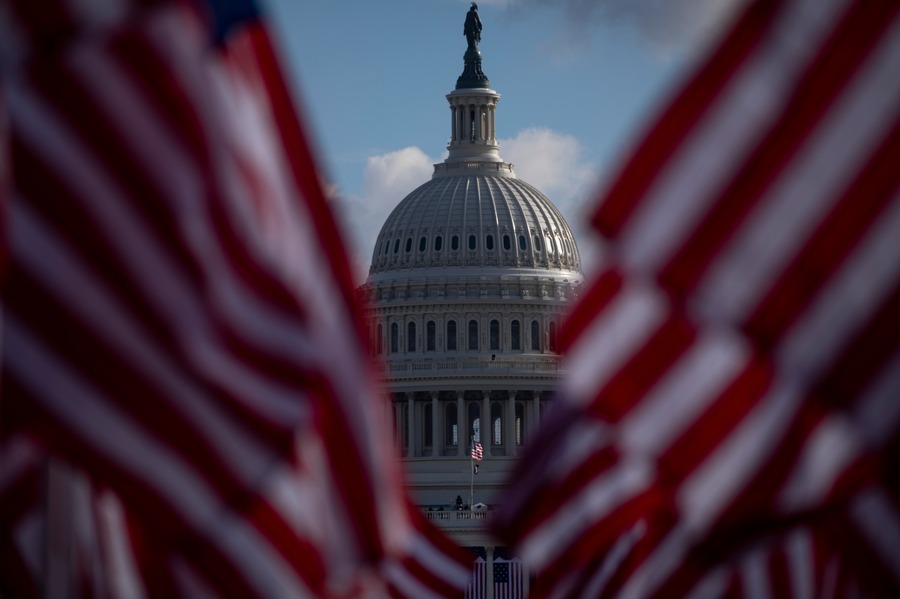
American flags frame a view of the Capitol building.
What Is the War Powers Resolution?
The War Powers Resolution, also known as the War Powers Act, was passed by Congress in 1973 over President Richard Nixon's veto. The law was designed to reassert Congress's constitutional authority over decisions related to war after years of military engagement in Vietnam without a formal declaration of war.
Under the law:
The President must notify Congress within 48 hours of introducing US forces into hostilities.
Military operations may continue for up to 60 days without congressional authorisation.
A further 30-day period may be used for withdrawal.
Beyond that period, military action generally requires approval from Congress.
The legislation reflects the Constitution's division of powers, where Congress has the authority to declare war while the President serves as Commander-in-Chief of the armed forces.
Why Has Iran Brought the Law Back Into Focus?
The ongoing military campaign against Iran has pushed the administration beyond the War Powers Resolution's 60-day timeframe without obtaining explicit congressional authorisation.
In response, lawmakers in both chambers have advanced War Powers resolutions directing the President to withdraw US forces from hostilities against Iran unless Congress formally approves continued military action.
The debate is not merely about Iran. It concerns a broader constitutional question that has existed for decades: can a President sustain military operations through executive authority alone, or must Congress have the final say on prolonged warfare?
Congress Pushes Back
Congress has recently taken some of its strongest steps yet to challenge continued military action.
The House of Representatives approved a resolution directing the withdrawal of US forces from unauthorised hostilities against Iran, while the Senate voted to advance a similar measure.
These votes are significant because they represent formal congressional opposition to the continuation of the conflict without legislative approval. For supporters of the resolutions, the issue is not partisan but constitutional.
They argue that Article I of the Constitution gives Congress—not the President alone—the power to decide whether the nation remains at war.
Can Congress Actually Stop the President?
The answer is legally complicated.
On its face, the War Powers Resolution requires the President to terminate military hostilities after 60 days unless Congress has declared war or provided specific statutory authorisation.
However, successive administrations, Republican and Democratic alike, have questioned whether Congress can constitutionally restrict the President's authority as Commander-in-Chief through the War Powers Resolution. As a result, presidents have often interpreted the law narrowly or disputed its application to particular military operations.
Supreme Court of the United States.
Another complication arises from the Supreme Court's 1983 decision in INS v. Chadha, which held that Congress generally cannot create binding legal consequences through actions that bypass the Constitution's lawmaking process. Legal scholars have therefore debated whether some enforcement mechanisms within the War Powers Resolution remain constitutionally sound. Consequently, the dispute is not simply about whether the 60-day period has expired but also about whether Congress possesses effective tools to enforce its constitutional role in decisions relating to war.
Even so, congressional resolutions opposing military action remain legally significant. While such measures may not automatically compel a President to withdraw forces, they serve as formal evidence that Congress has not consented to the continuation of hostilities. Such expressions of opposition can strengthen Congress's institutional position, undermine claims that lawmakers have acquiesced to the conflict, and potentially influence how courts assess future disputes over war powers.
Why the Congressional Votes Still Matter
Despite these legal limitations, the House and Senate votes carry considerable constitutional and political weight.
Even if President Trump vetoes a joint resolution or Congress fails to secure the numbers necessary to override that veto, the votes themselves demonstrate clear congressional opposition to the military campaign. Legal scholars have argued that such opposition weakens executive branch claims that Congress has implicitly accepted or authorised the conflict.
The votes also create a clearer constitutional disagreement between the legislative and executive branches, potentially increasing the likelihood of judicial scrutiny should legal challenges arise.
What Happens Next?
The next major step lies in the Senate, where lawmakers are expected to consider final action on the proposed resolutions.
If both chambers approve a joint resolution, it would likely reach President Trump's desk, where a veto is widely expected. Congress would then need a two-thirds majority in both chambers to override it.
Regardless of the outcome, the confrontation has revived a longstanding debate over the limits of presidential war powers and the continuing relevance of the War Powers Resolution more than five decades after its enactment.
Why This Matters Beyond Iran
The dispute highlights one of the most important unresolved constitutional questions in American governance: who ultimately decides when the United States goes to war?
For supporters of congressional oversight, the Iran conflict is a test of whether Congress can reclaim powers that have gradually shifted to the executive branch over decades of military interventions.
For defenders of broad presidential authority, modern national security threats often require swift military action that may not allow time for lengthy congressional deliberation.
As the Commander-in-Chief of the United States Armed Forces, President Donald Trump holds ultimate operational command over all branches of the US military.
As the conflict continues, the Iran debate is shaping into more than a foreign policy dispute. It has become a test of whether the War Powers Resolution remains an effective constitutional check on presidential military power or whether that authority now rests primarily in the hands of the Commander-in-Chief.