Against China’s Pacific Challenge: Australia-US Defence in Focus After WWII
US and Australian defence leaders deepen Pacific military cooperation as China’s growing regional presence reshapes the strategic balance.
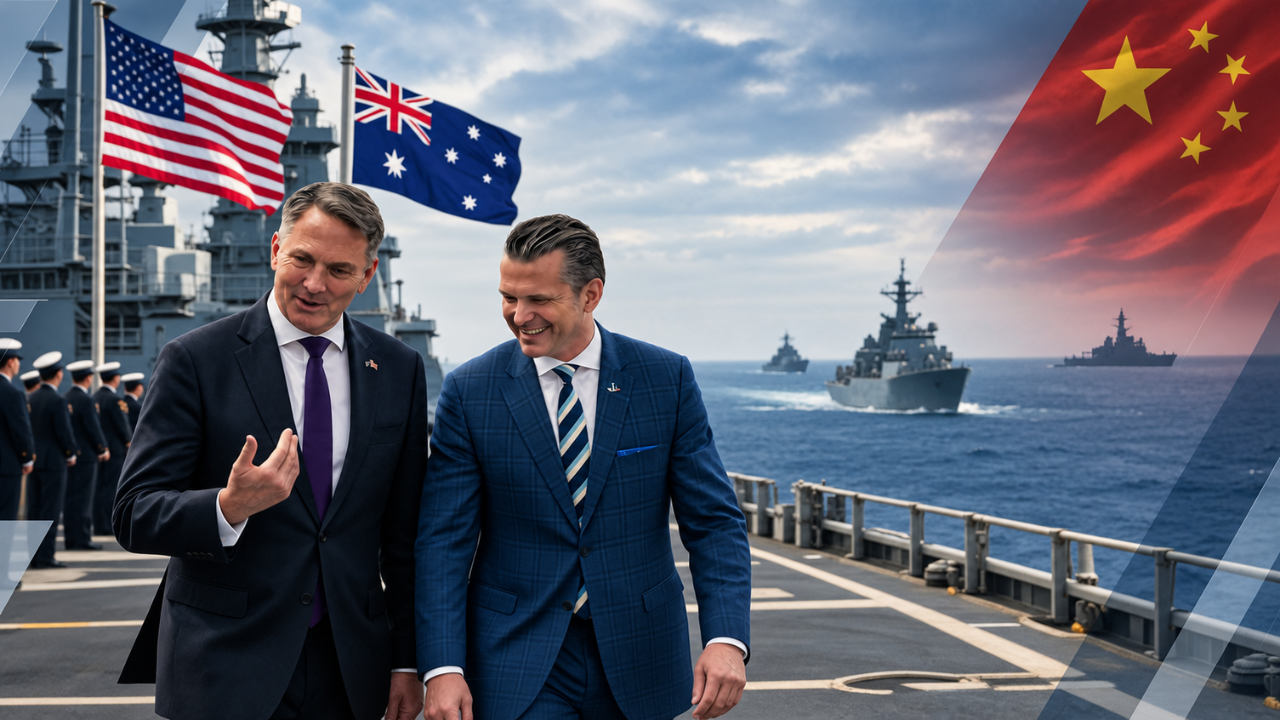
Australia and the US are deepening Pacific defence cooperation as China expands its military presence, reviving the strategic importance of their WWII alliance.
By Pranjal Gupta
New Delhi, September 3: At a recent meeting in Washington, Australia recalled how nearly a million American service personnel used the country as a base to project military power northwards and fight Japan during the Second World War in the Pacific theatre. Top defence leaders from both countries - US Secretary of War Pete Hegseth and Australian Deputy Prime Minister and Minister for Defence Richard Marles - announced plans to strengthen defence ties in the Pacific, where China has been increasingly active in recent years.
Australia highlighted its longstanding alliance with the US by recalling the countries' cooperation during WWII, while the US acknowledged Canberra's understanding of the importance of maintaining a favourable balance of power in the region. The two nations said they wanted to ensure peace, security and prosperity across the Pacific. The meeting was marked by several defence commitments that could further contribute to tensions between China and other regional powers.
US and Australian defence leaders deepen Pacific military cooperation as China’s growing regional presence reshapes the strategic balance.
According to the US Department of War, both leaders agreed to accelerate efforts related to force posture at Australian bases. During World War II, Australia served as a crucial forward base for US-led Allied counter-offensives against Japan in the Southwest Pacific — the same broad strategic direction that now places Australia and China in focus.
The two nations also plan to strengthen cooperation in combined logistics and improve interoperability through joint military exercises.
Alongside these commitments, the US and Australia discussed progress on defence-industrial cooperation aimed at developing shared capacity for guided weapons and next-generation military capabilities.
"The Secretary and Deputy Prime Minister also spotlighted advancements in the AUKUS partnership and welcomed the recent arrival of U.S. Navy sailors in Western Australia to support the commencement of Submarine Rotational Force – West activities in 2027," the US Department of War said in an official statement.
China's Rare Submarine-Launched Missile Test
In July, China conducted a rare test of a submarine-launched ballistic missile in the Pacific Ocean, which Beijing described as a routine part of its annual military training programme.
Senior Captain Wang Xuemeng, a spokesperson for the People's Liberation Army (PLA) Navy, said the submarine "launched a strategic missile carrying a dummy warhead toward relevant high seas of the Pacific Ocean, which landed precisely within the designated waters".
The missile travelled over the exclusive economic zones (EEZs) of the Federated States of Micronesia, Nauru, Kiribati and Tuvalu and landed near the EEZ boundary of either Kiribati or Tuvalu, according to a CNN report citing a regional source.
Reacting to the launch, the US State Department said, "Beijing's rapid and opaque nuclear weapons buildup is of great concern to the region and the world", the media report added.
Meanwhile, Australia openly criticised China over the move. Australian Prime Minister Anthony Albanese raised concerns about China's recent launch of an intercontinental ballistic missile (ICBM) into the South Pacific during his meeting with Prime Minister Narendra Modi, Foreign Secretary Vikram Misri said in July.
"This was raised by the Australian Prime Minister and there was a certain amount of concern expressed about this development. The Prime Minister mentioned that we see the Indo-Pacific as an area where we would like to see peace, security and stability. Australia and India have shared interests and shared objectives in this regard, and we will continue not only to exchange our perspectives but also intensify our cooperation in various areas to ensure that peace, security and stability in the Indo-Pacific continues to be maintained," Misri said.