ASEAN Ministers Demand Hormuz Reopening as South China Sea Clash Tests Manila Talks
ASEAN foreign ministers meeting in Manila call for a Hormuz ceasefire as a Second Thomas Shoal clash and stalled code of conduct talks test the bloc's sovereignty principles. New Delhi, July 21: The foreign ministers of the Association of Southeast Asian Nations convened in Manila on Tuesday for three days of talks that will test the bloc's founding commitment to consensus and non-intervention against a backdrop of two simultaneous crises bearing directly on regional sovereignty and economic...
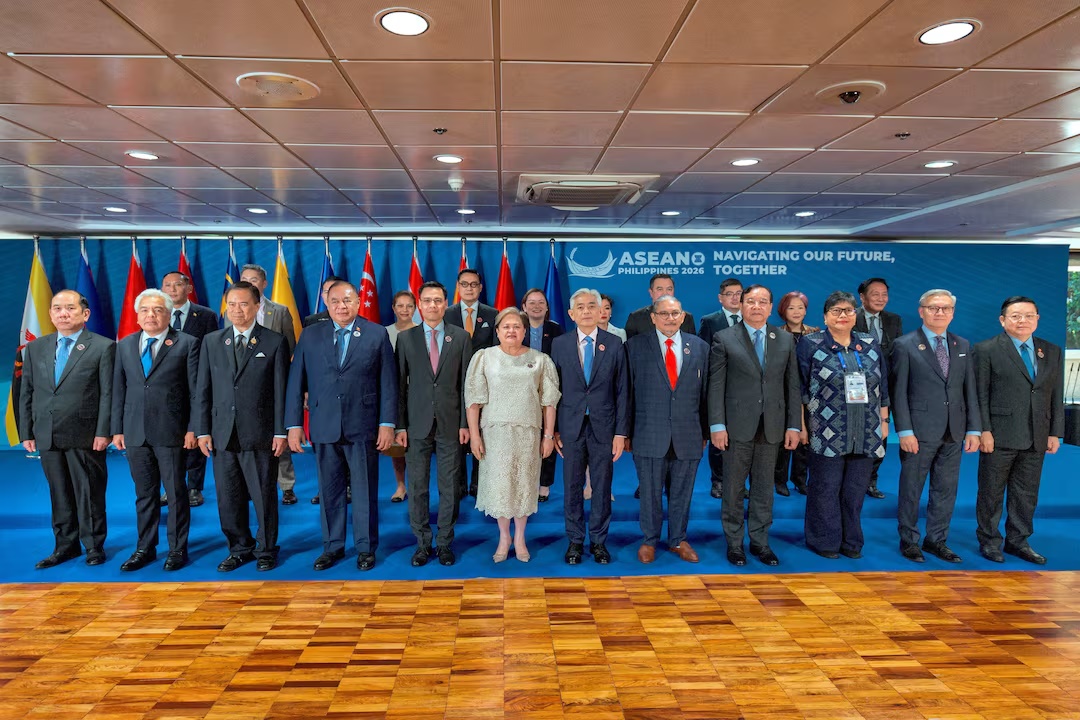
ASEAN foreign ministers meeting in Manila call for a Hormuz ceasefire as a Second Thomas Shoal clash and stalled code of conduct talks test the bloc's sovereignty principles.
New Delhi, July 21: The foreign ministers of the Association of Southeast Asian Nations convened in Manila on Tuesday for three days of talks that will test the bloc's founding commitment to consensus and non-intervention against a backdrop of two simultaneous crises bearing directly on regional sovereignty and economic security: the resurgent war between the United States and Iran, now in its tenth consecutive night of strikes, and a violent altercation between Philippine and Chinese vessels at Second Thomas Shoal that has reopened one of the most contested legal questions in the South China Sea.
ASEAN Foreign Ministers' Meeting at the Philippine International Convention Center on July 20, 2026 in Pasay, Metro Manila, Philippines.
The ministers' joint statement calling for an immediate halt to fighting in the Middle East and the full and safe reopening of the Strait of Hormuz situates ASEAN's intervention within the framework of customary international law governing straits used for international navigation, a regime codified under Part III of the United Nations Convention on the Law of the Sea. The Strait of Hormuz, through which a significant share of global oil and gas shipments transit, falls squarely within this regime, and the war's disruption of transit rights there is not merely a humanitarian or economic concern but a challenge to the freedom of navigation principle that underwrites the maritime order ASEAN states depend upon for their own energy imports. The bloc's reliance on Middle East oil and gas, and the price and supply shocks that followed the conflict's outbreak, gave the statement's language on Hormuz an unusually direct economic stake rather than the abstract solidarity that often characterises ASEAN pronouncements on conflicts outside the region.
The ministers' broader affirmation of the obligation of states to resolve disputes peacefully and to respect sovereignty and territorial integrity draws on Article 2(3) and Article 2(4) of the UN Charter, principles ASEAN has long invoked as the normative foundation of its own regional order under the Treaty of Amity and Cooperation. The reaffirmation reads, in this context, less as commentary on a war fought thousands of kilometres away and more as an implicit reassertion of the same principles the bloc will need against a nearer and more immediate provocation: the altercation at Second Thomas Shoal, where the Philippine military has accused China's coast guard of injuring a Filipino sailor after personnel aboard a motorboat struck him with a wooden baton and damaged his vessel. China's coast guard has, in turn, blamed Philippine personnel for initiating the confrontation, a pattern of competing factual narratives that has recurred at the shoal for years without resolution through any binding third-party mechanism, notwithstanding the 2016 Permanent Court of Arbitration ruling that rejected the legal basis for China's expansive maritime claims under the so-called nine-dash line.
That unresolved tension frames Wednesday's scheduled meeting between ASEAN ministers and Chinese Foreign Minister Wang Yi, at which the two sides are expected to take stock of negotiations toward a code of conduct for the South China Sea, a nonaggression instrument under discussion for roughly two decades that both parties have said they intend to conclude within the year. The Second Thomas Shoal incident is likely to sharpen, rather than derail, that timeline, underscoring for ASEAN negotiators the practical cost of continuing without a binding framework while placing pressure on Beijing to demonstrate that the code of conduct process retains substance. Philippine President Ferdinand Marcos Jr., who summoned Chinese Ambassador Jing Quan for a meeting Tuesday afternoon without disclosing details, has separately invoked a national energy emergency in March to guard against the fuel and supply shocks flowing from the Iran war, a domestic legal measure that illustrates how the two crises, though geographically distant from one another, are converging on the same set of governmental tools: emergency economic powers on one front, and diplomatic and prospective legal recourse on the other.
The presence in Manila of US Secretary of State Marco Rubio, Russian Foreign Minister Sergey Lavrov, and Chinese Foreign Minister Wang Yi for Wednesday's ASEAN Regional Forum, followed by Thursday's East Asia Summit involving eighteen countries, raises the possibility of the highest-level US-China contact since Presidents Donald Trump and Xi Jinping met in Beijing in May, a meeting that had addressed the Iran war, trade, and Taiwan.
Neither government has confirmed any bilateral meeting on the Manila sidelines, and the absence of a formal channel between Washington and Beijing on the Iran conflict, even as both attend the same multilateral forums as Moscow, points to the limits of ASEAN-centred diplomacy as a venue for resolving disputes whose principal parties lie outside the region.
What the Manila talks can offer is not resolution of either crisis but a test of whether ASEAN's procedural architecture, built for consensus among ten to eleven member states with divergent bilateral relationships with Beijing and Washington, can still produce statements with enough legal and normative weight to matter, at a moment when both the law of the sea and the law of armed conflict are being tested well beyond Southeast Asia's shores.