Can Police Resort to Lathi Charge Against Student Protesters? The Question That Halted Parliament
Parliament stalled for a second day as the Opposition sought accountability for Monday's lathi charge on protesting students in Delhi. The episode tests settled doctrine, unlawful assembly, prior warning, proportionate force, that courts have long used to constrain police action against dissent. New Delhi, July 21: Parliament's Monsoon Session ran aground for a second consecutive day on Tuesday, as both Houses were adjourned within minutes of convening over the police crackdown on the...
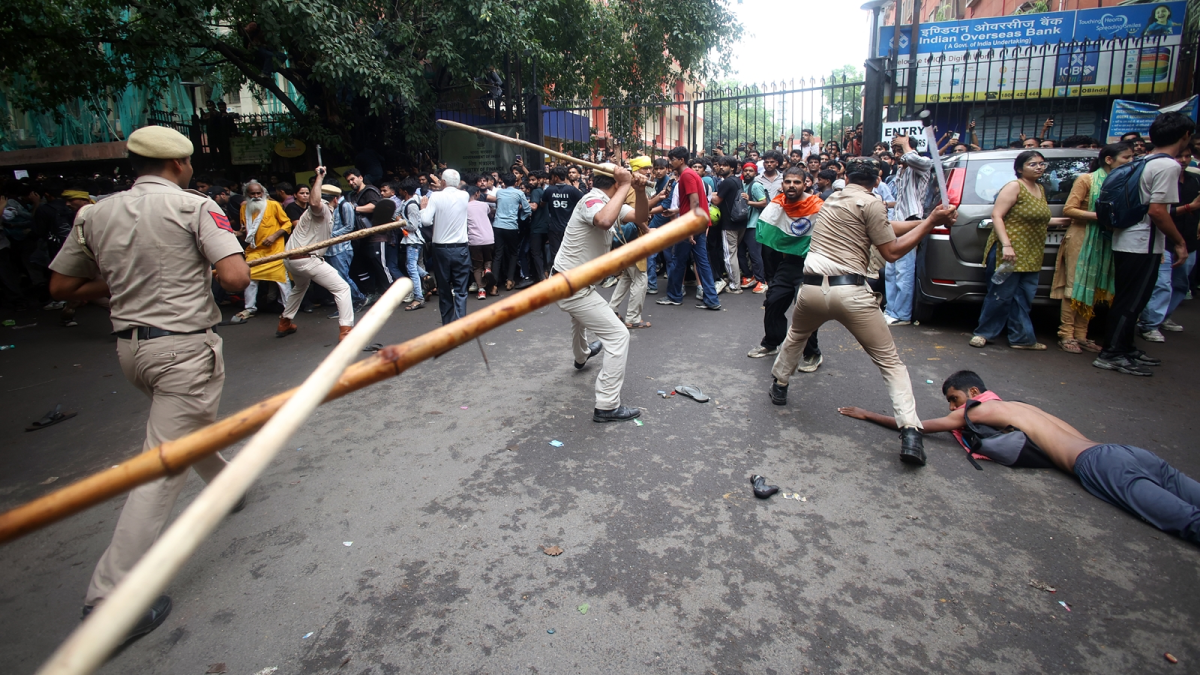
Parliament stalled for a second day as the Opposition sought accountability for Monday's lathi charge on protesting students in Delhi. The episode tests settled doctrine, unlawful assembly, prior warning, proportionate force, that courts have long used to constrain police action against dissent.
New Delhi, July 21: Parliament's Monsoon Session ran aground for a second consecutive day on Tuesday, as both Houses were adjourned within minutes of convening over the police crackdown on the Cockroach Janta Party-led demonstration in the national capital a day earlier. In the Rajya Sabha, Leader of the House Mallikarjun Kharge had barely begun speaking on the lathi charge and tear gas shelling used against protesting students before the House broke into a din and was adjourned till noon.
Leader of the Opposition in the Lok Sabha, Rahul Gandhi, subsequently led a delegation of Opposition MPs to Speaker Om Birla seeking a discussion on what he described as the "brutality unleashed on students" during Monday's protest march, telling reporters that the Speaker had said he required government permission before allowing such a discussion. The Opposition's demand for accountability, however, is not merely a political grievance, it revives a legal question that Indian courts have grappled with for decades and never fully resolved: under what conditions, if any, may the police lawfully use lathi charge against a crowd of protesters, and what happens when that force is used against students exercising a constitutional right to assemble and dissent.
The immediate provocation for Monday's crackdown was a demonstration by the Cockroach Janta Party, a protest movement built around grievances over examination mismanagement, marching towards Parliament. Security forces responded with tear gas and lathi charge, and reports of the day's toll, dozens of protesters injured, several in critical condition, have hardened the Opposition's insistence that the Union Home Minister appear before the House to answer for the police action. Congress MP Manickam Tagore said as much on the floor, noting that the Opposition had sought to raise the lathi charge during Question Hour and been denied the opportunity. The government's response so far has been procedural rather than substantive: Kiren Rijiju, briefing the media after the NDA's parliamentary party meeting, focused on the underlying examination controversy, the conduct of a re-examination and steps to prevent future paper leaks, without directly addressing the conduct of the police on the ground.
That the legality of the police action itself has become the site of parliamentary contestation is significant, because Indian law's treatment of lathi charge has always been considerably more constrained than its routine deployment would suggest. The term "lathi charge" itself appears nowhere in the Code of Criminal Procedure or the Indian Penal Code. What the statutory scheme actually provides for is the dispersal of an "unlawful assembly," a term defined under Section 141 of the IPC to mean a gathering of five or more persons whose common object falls within a specific set of categories, overawing the government by criminal force, resisting the execution of law, committing mischief or criminal trespass, or compelling a person to act against their legal rights.
A crowd of protesting students, marching towards Parliament to press grievances about examination integrity, does not self-evidently fall within any of these categories merely by virtue of assembling in large numbers or marching towards a sensitive location. The Delhi Police's claim, reported in coverage of Monday's events, that protesters engaged in "large-scale violence" and vandalised property would need to be established as a matter of fact before the assembly could be lawfully classified as unlawful in the first place, a threshold determination that itself becomes contested territory whenever the police and the protesters offer irreconcilable accounts of who initiated the violence.
Even where an assembly is properly classified as unlawful, the procedural safeguards built into the Code are exacting. Section 129 of the CrPC permits dispersal only on the order of an executive magistrate or the officer in charge of a police station, and Section 144 permits a District Magistrate to direct such action only where it will prevent obstruction, injury, danger to life, or a breach of public tranquillity, again presupposing a prior determination that the assembly poses such a threat.
Courts have repeatedly read a three-part test into these provisions: there must first be an unlawful assembly with the object of committing violence, that assembly must then be ordered to disperse, and only upon its refusal to disperse despite such orders may force be used.
The Punjab and Haryana High Court articulated this sequence in Karam Singh v. Hardayal Singh, and the Delhi High Court in Police Commissioner v. Yash Pal Sharma went further, holding that even where the police are entitled to use force, only "reasonable force" is authorised, and that this constraint flows directly from the fundamental right to freedom of speech and expression under Article 19(1)(a) and (b) of the Constitution. Where security forces move directly to lathi charge and tear gas without a documented sequence of warning and refusal to disperse, a sequence that live reporting of Monday's protest does not appear to establish, the action sits uneasily against this settled doctrinal architecture, whatever operational justification the police may later offer.
The Supreme Court's most considered treatment of the issue remains its judgment in Anita Thakur v. Government of Jammu and Kashmir, a case in which the petitioners were themselves found to have protested violently, pelting stones at the police, and were nonetheless awarded compensation because the police had continued to use force well after the mob had been brought under control. The Court's reasoning in that case is instructive precisely because it did not turn on whether the protesters had been peaceful, they had not been, but on the principle that force, once justified, remains bound by a continuing requirement of proportionality that does not lapse merely because the initial resort to force was lawful. The Court was explicit that excessive force, even against a genuinely violent assembly, constitutes a violation of human rights and dignity, and it attributed recurring police excesses in India to inadequate training in managing situations where authority is challenged. This reasoning maps uncomfortably well onto the pattern Opposition MPs are now describing in Parliament: not merely a contested initial classification of the assembly as unlawful, but reports of injuries, including, per some accounts of Monday's events, a child struck during the operation, that would be difficult to justify under any theory of proportionate, minimum necessary force, the standard that Kerala's own Police Manual codifies by directing that lathi blows avoid the head and other vulnerable areas of the body.
International standards echo this domestic doctrine rather than displacing it. The UN's 1990 Basic Principles on the Use of Force and Firearms by Law Enforcement Officials direct that force against unlawful but non-violent assemblies be avoided altogether, or restricted to the minimum extent necessary where avoidance is not practicable, a standard that becomes directly relevant if the protesters' claim of a peaceful march to Parliament, rather than the police's claim of unruly violence, is borne out by subsequent investigation.
None of this settles, as a matter of concluded law, whether Monday's specific police action was lawful, that determination depends on facts that remain contested between the Delhi Police and the protest organisers, and on findings no court has yet made. But it does explain why the Opposition's demand for a parliamentary discussion, and its insistence that the Home Minister answer for the operation, is not simply a political manoeuvre grafted onto an unrelated examination controversy.
The legal framework governing lathi charge in India has always been narrower and more conditional than its practice suggests, built around sequential requirements of unlawful assembly, prior warning, and proportionate response that courts have found wanting in case after case, from the 2019 CAA protests to the 2021 Karnal lathi charge on farmers that preceded a fatality. Whether the Monsoon Session's repeated adjournments produce an actual accounting of Monday's events, through a Home Ministry statement on the floor of the House, an independent inquiry, or eventual judicial scrutiny, will determine whether this episode is treated as another entry in that unbroken pattern, or as the occasion on which Parliament finally extracted a specific, fact-based justification for the force used against a specific set of protesters.