Drought Reveals Bodies of Two German Soldiers Lost Since WWII, 80 Years Later
Record-low Danube water levels have exposed the remains of two German soldiers and wartime relics in Budapest, more than 80 years later.
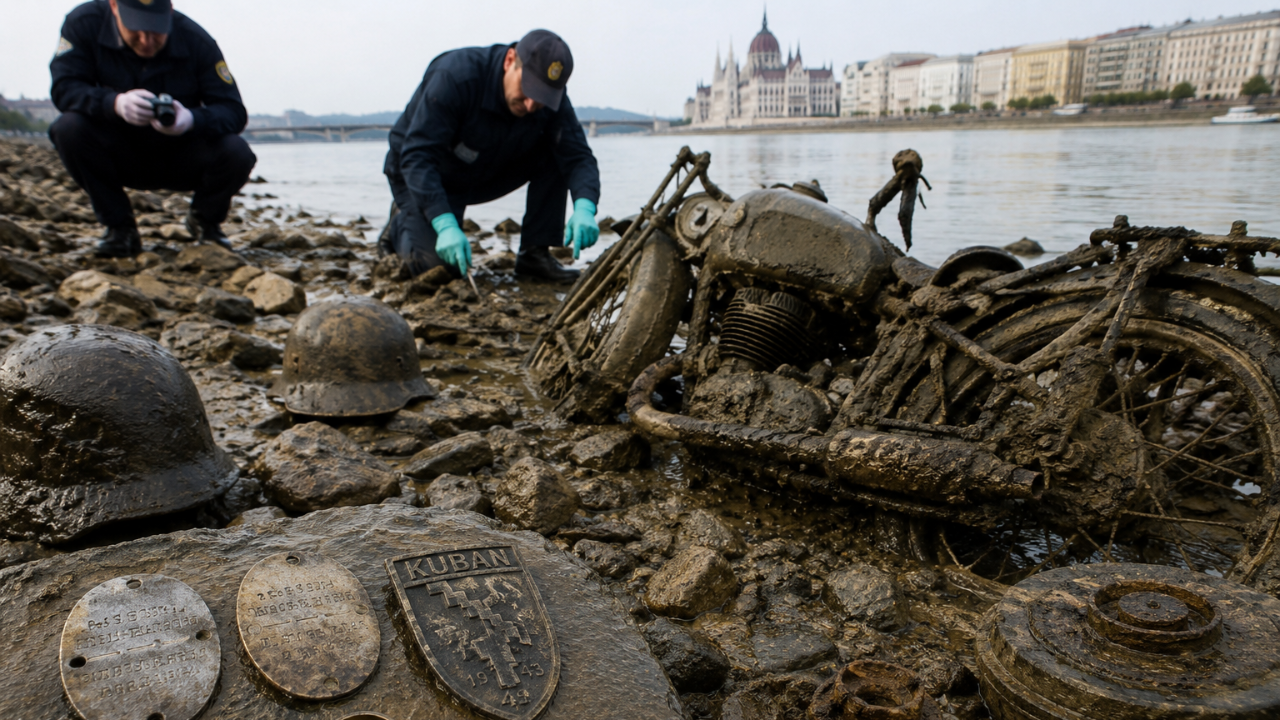
Record-low Danube water levels have exposed the remains of two German soldiers and wartime relics in Budapest, more than 80 years later.
By Pranjal Gupta
New Delhi, August 12: The bodies of two German soldiers killed during the Second World War have reportedly been found in Budapest's Danube river in Hungary, more than 80 years after they disappeared. The discovery came after an intense drought caused the Danube's water level to fall to unusually low levels. As the river receded, it exposed wartime remains that had remained hidden beneath the water and riverbed for decades.
The German War Graves Commission, which investigates and recovers German war dead on behalf of the German government, found the soldiers alongside several remarkably well-preserved objects, reported BBC.
These included:
Identification tags belonging to the soldiers
A largely intact German military motorcycle
A wedding ring
A Kuban Shield, a German military decoration awarded to troops who fought on the Eastern Front
Anti-tank mines, which forced authorities to temporarily close the riverbank while bomb disposal experts secured the area
The motorcycle is believed to be a DKW NZ 350-1, a model produced for wartime use from 1944.
Record-low Danube levels expose bodies of two German soldiers and WWII relics in Budapest after more than 80 years. (Representative Image, Generated using AI)
How were they discovered?
The remains were reportedly found on 2 August, after a passer-by noticed part of a motorcycle sticking out from rocks along the riverbank in central Budapest.
The discovery initially appeared to be a wartime wreck. But when investigators examined the site, they found human remains and other military objects.
The presence of anti-tank mines added a serious safety risk. Authorities closed part of the riverbank and sent in a bomb disposal team.
The unusually low water level made the discovery possible. The Danube normally keeps much of the wartime material hidden beneath deep water and sediment. The drought exposed parts of that buried history.
Why could the objects survive for so long?
The condition of some of the objects surprised investigators.
The German War Graves Commission said the identification tags and motorcycle were particularly well preserved because they had been buried in a mixture of harbour sludge and oil on the riverbed.
That preservation could prove important because the identification tags may help investigators establish who the soldiers were.
However, the commission has warned that the investigation is not straightforward.
Finding a name on an identification tag is only the beginning. Investigators still have to establish whether the tags actually belonged to the two men whose remains were recovered.
They will also use bone analysis and other evidence to confirm the identities.
What do the identification tags reveal?
German military identification tags from the Second World War were designed to help authorities identify soldiers after their deaths.
The tags were split into two parts when a soldier died. One half stayed with the body, while the other went to German military authorities, who used it to record casualties and notify relatives.
In this case, investigators found two tags.
One appears to have belonged to a Wehrmacht soldier, the regular German armed forces. The other belonged to a member of the Waffen-SS.
The distinction is historically important. The Waffen-SS was the military branch of the SS and was declared a criminal organisation at the Nuremberg Trials because of its involvement in war crimes and other crimes committed during the Nazi era.
Could families finally learn what happened to them?
That is one of the most significant aspects of the discovery.
The commission believes the families of the two soldiers may have spent decades without receiving confirmation of what happened to their relatives.
During the war, soldiers could disappear during battles, retreats and chaotic evacuations. Budapest saw particularly intense fighting towards the end of the war, when Soviet forces surrounded the city and German and Hungarian forces attempted to hold it.
Some soldiers were killed and buried without proper identification. Others simply disappeared from military records.
For their families, that could mean decades of uncertainty.
The commission has now begun trying to identify the two men. If investigators successfully confirm their identities, descendants could finally learn where and how their relatives died.
Why Budapest matters
The discovery becomes more significant when placed against the history of the Battle of Budapest.
From late 1944 into early 1945, Budapest became one of the major battlefields of the final phase of the Second World War.
Soviet forces surrounded the Hungarian capital, while German and Hungarian troops defended the city. Fighting continued for weeks and caused enormous destruction and loss of life.
German forces eventually attempted to break out of the encircled city. Thousands of soldiers were killed, captured or went missing.
The Danube ran directly through this battlefield.
As a result, the river and its banks became a repository for the physical remains of the conflict, from military equipment and vehicles to weapons and human remains.
Why are more wartime objects appearing now?
The Budapest discovery is part of a broader pattern.
Extremely low water levels in European rivers have recently exposed objects that have remained underwater or buried for decades.
The Danube has previously revealed wartime wreckage and military equipment. A broken-up Second World War-era vessel has also appeared near Prahovo in Serbia as water levels fell.
These discoveries show how environmental conditions can suddenly expose parts of history that have remained inaccessible for generations.
But they also carry risks.
Unexploded bombs, mines and other military weapons can remain dangerous even after more than 80 years. The anti-tank mines found near the Budapest site are a reminder that the Second World War has left behind not just historical artefacts, but potentially lethal remnants.
The larger significance
The discovery is ultimately about more than two bodies emerging from a river.
It connects today's extreme drought with one of Europe's darkest periods.
The falling water level exposed a small piece of the enormous human cost of the Second World War. At the same time, the discovery offers a chance to resolve two families' unanswered questions.
For historians, the objects provide another glimpse into the final battles of Nazi Germany's
war.
For investigators, they may help reconstruct the circumstances in which the two soldiers died.
For their descendants, if the identities are confirmed, the discovery could finally replace decades of uncertainty with a name, a grave and an answer.
The two soldiers are expected to receive a burial at the German war cemetery in Budaörs, outside Budapest.
More than 80 years after the fighting ended, the Danube has brought part of that forgotten battlefield back to the surface.