Foreign Funding, Conspiracy, and Public Order: What the PIL Against the CJP Protest Alleges
By Mahima Katal New Delhi, July 23: The Delhi High Court's decision to hear a public interest litigation (PIL) seeking a National Investigation Agency (NIA) probe into the Cockroach Janta Party's (CJP) July 20 protest has brought into focus an important legal question: when does a public protest cross the threshold from a law-and-order issue to a matter of national security? The PIL, filed by Satish Kumar Aggarwal, a former Vice-President of the Akhil Bharat Hindu Mahasabha, alleges that the...
By Mahima Katal
New Delhi, July 23: The Delhi High Court's decision to hear a public interest litigation (PIL) seeking a National Investigation Agency (NIA) probe into the Cockroach Janta Party's (CJP) July 20 protest has brought into focus an important legal question: when does a public protest cross the threshold from a law-and-order issue to a matter of national security?
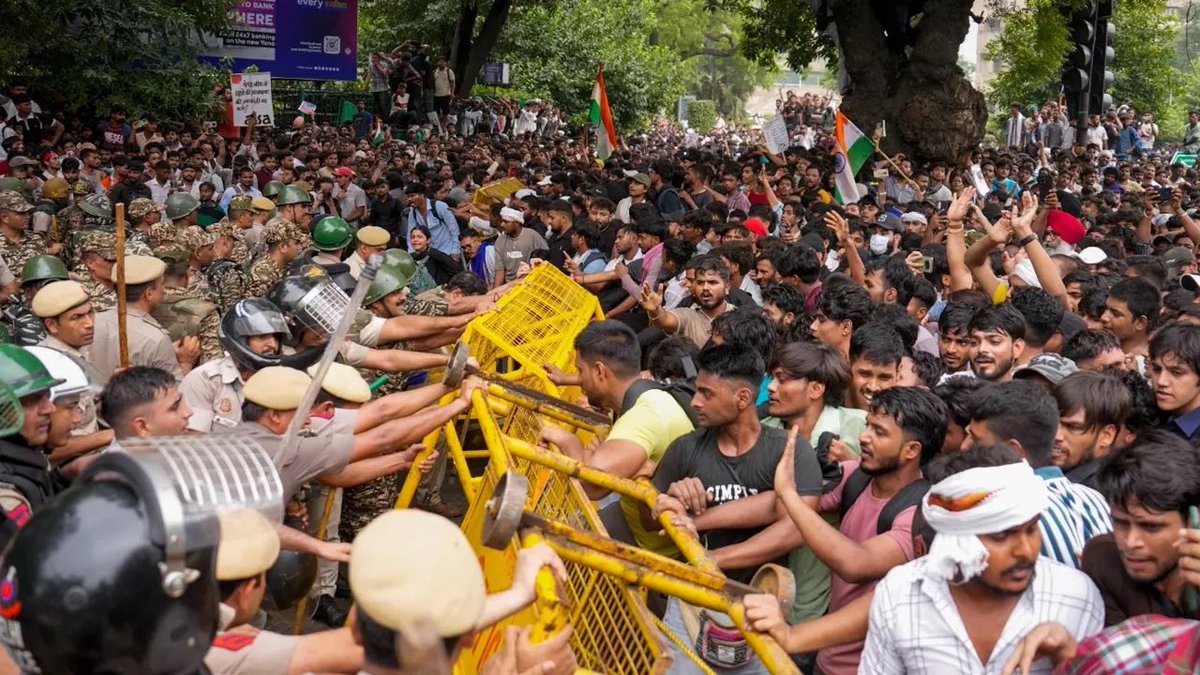
The PIL, filed by Satish Kumar Aggarwal, a former Vice-President of the Akhil Bharat Hindu Mahasabha, alleges that the CJP agitation was not a genuine student movement but part of a larger conspiracy backed by foreign-funded actors seeking to destabilise the country. The petition asks the High Court to direct the NIA, or another specialised agency, to investigate the protest, take over all FIRs registered by Delhi Police, and identify those allegedly responsible for violence, vandalism and obstruction of public services.
The matter was mentioned for urgent listing before a Bench of Chief Justice Devendra Kumar Upadhyaya and Justice Tejas Karia. Appearing for the petitioner, advocate Barun Kumar Sinha argued that the protest had "made the entire Delhi hostage" by blocking roads and causing inconvenience to citizens. Accepting the request, the Bench agreed to hear the matter on Friday.
The petition claims that the demonstration witnessed attacks on journalists, injuries to police personnel, damage to public and private property, obstruction of emergency services and attempts to march towards Parliament. It also refers to activist Sonam Wangchuk's alleged association with certain foreign organisations, contending that these links require investigation by competent authorities.
However, at this stage, these are allegations contained in the PIL. The Delhi High Court has neither examined the evidence nor expressed any opinion on the merits of the claims.
The significance of the petition lies less in the allegations themselves and more in the relief it seeks. The NIA is India's premier counter-terror investigation agency and ordinarily investigates offences that affect the sovereignty, security and integrity of the country. Its jurisdiction is governed by the National Investigation Agency Act, 2008, under which it investigates only those offences specifically listed in the Schedule to the Act, including various terrorism-related offences.
This means that every incident involving violence or public disorder does not automatically become an NIA case. Criminal offences such as rioting, unlawful assembly, destruction of public property or assault on police personnel are generally investigated by the local police unless the facts disclose offences falling within the NIA's jurisdiction or the Central Government decides that the agency should take over the investigation.
The PIL attempts to bridge that gap by alleging that the protest was part of a coordinated conspiracy involving foreign funding and anti-national elements. If such allegations are backed by credible evidence and disclose offences under the laws scheduled to the NIA Act, the demand for a specialised investigation may acquire legal significance. Mere allegations, however, are unlikely to be sufficient.
The Supreme Court has repeatedly emphasised that courts should exercise caution while directing investigations by specialised agencies. Such directions are generally issued only in exceptional circumstances where there is material suggesting that an independent investigation is necessary to ensure a fair and effective probe.
The case also raises broader constitutional concerns. The right to assemble peacefully and protest is protected under Article 19 of the Constitution, subject to reasonable restrictions in the interests of public order, sovereignty and security. While violence, vandalism and attacks on public officials are punishable under criminal law, branding an entire protest as a national security issue requires a much higher legal threshold.
This distinction becomes important because the use of anti-terror investigative mechanisms carries consequences that extend far beyond ordinary criminal investigations. Courts have therefore consistently insisted that such powers be invoked only where the statutory requirements are clearly met.
When the matter comes up before the Delhi High Court, the Bench is not expected to decide whether the allegations are true. The immediate question will be whether the petition discloses sufficient grounds to warrant judicial intervention and whether the existing investigation by Delhi Police is inadequate.
The Court may choose to issue notice to the Centre and Delhi Police, seek their response, or decline to entertain the PIL if it finds that the allegations do not justify the extraordinary relief sought.
Whatever the outcome, the proceedings are likely to be closely watched because they touch upon a recurring legal debate in India: where should the line be drawn between a protest that is dealt with under ordinary criminal law and one that is investigated as a threat to national security? The High Court's response may offer important guidance on that question, even if it does not finally decide the controversy.