From Nijjar to CEPA: How India and Canada Rebuilt a Relationship in Eighteen Months
India and Canada moved from diplomatic freeze over Nijjar's killing to launching CEPA talks and a $2.6B uranium deal, a reset that compartmentalises unresolved security tensions rather than resolving them. By Mahima Katal New Delhi, Aug 26: Nirmala Sitharaman stood before members of the Indian business community in Toronto this week and made a pitch that would have been unthinkable barely two years ago. India, she told them, offers Canadian investors "scale, sustained growth, a young...
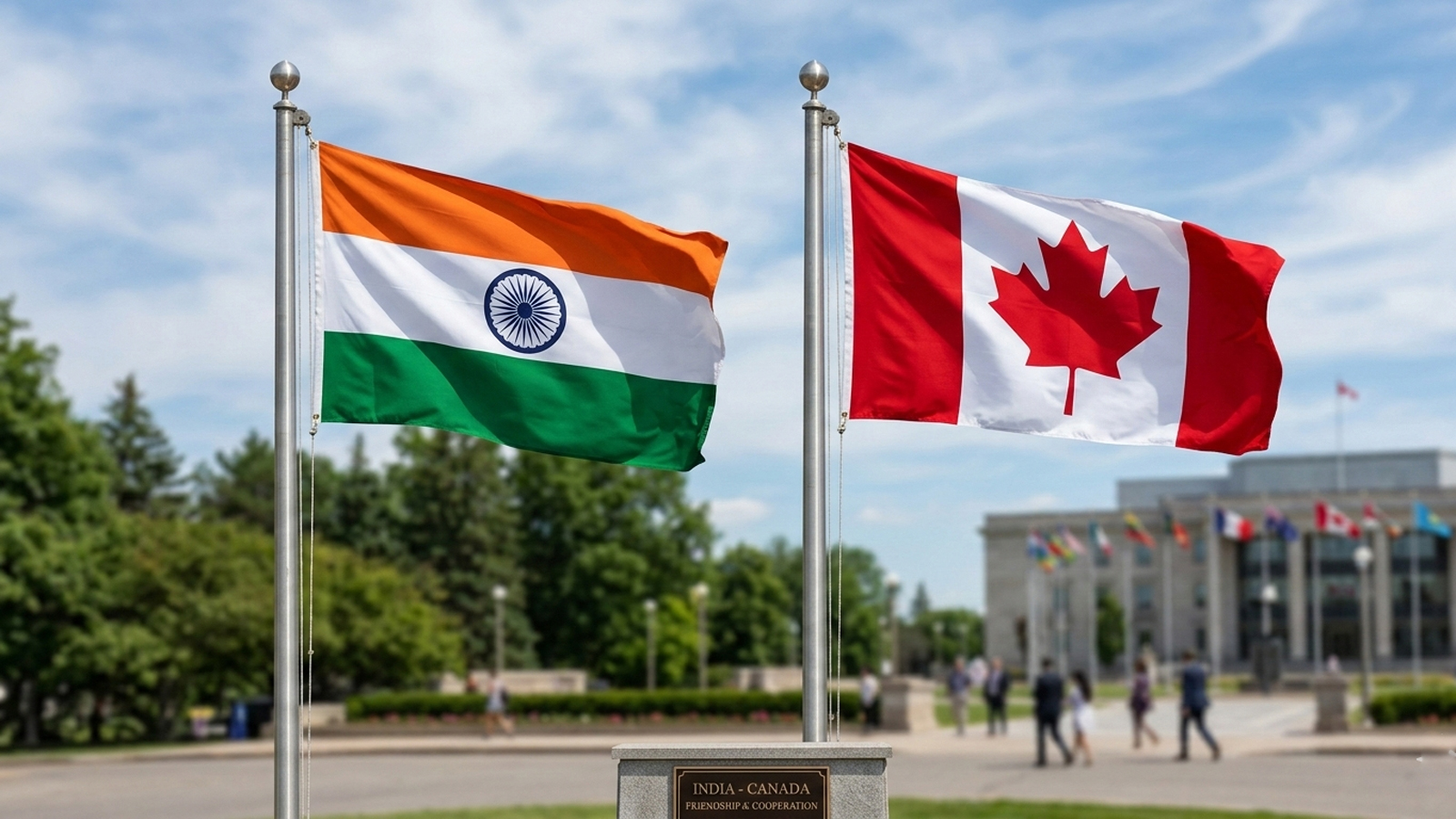
India and Canada moved from diplomatic freeze over Nijjar's killing to launching CEPA talks and a $2.6B uranium deal, a reset that compartmentalises unresolved security tensions rather than resolving them. By Mahima Katal
New Delhi, Aug 26: Nirmala Sitharaman stood before members of the Indian business community in Toronto this week and made a pitch that would have been unthinkable barely two years ago. India, she told them, offers Canadian investors "scale, sustained growth, a young population, expanding consumption and rapidly deepening capital markets." She spoke of banking and fintech collaboration, of pension funds and Bay Street boardrooms, of a "future-focused strategic partnership."
None of this was rhetorical filler. It was the latest instalment of one of the more striking diplomatic turnarounds of the decade, a bilateral relationship that went from near-total rupture to a formally launched trade negotiation in under two years.
The Rupture
The freeze began in September 2023, when then-Canadian Prime Minister Justin Trudeau told Parliament that Canadian security agencies were pursuing credible allegations linking Indian government agents to the killing of Hardeep Singh Nijjar, a Canadian citizen and Khalistani separatist leader whom India had designated a terrorist.
Nijjar was shot dead outside a Sikh temple in Surrey, British Columbia, on June 18, 2023. India rejected the accusation outright, and the diplomatic fallout was immediate: both countries expelled diplomats, India suspended visa services for Canadians and recalled its High Commissioner, in what was widely described as the sharpest breakdown in the relationship in decades.
The rupture deepened rather than healed. By October 2023, India had demanded Canada withdraw dozens of its diplomats from the country, and matters escalated further the following year. In October 2024, Ottawa expelled six Indian diplomats, including the acting High Commissioner, after police alleged evidence of a broader campaign of intimidation and violence targeting Sikh separatists on Canadian soil, allegations India again dismissed. For roughly two years, the world's largest democracy and a G7 member with one of the world's largest Sikh diaspora populations had effectively downgraded relations to a diplomatic freeze, with trade talks that had limped along since their original 2010 launch shelved entirely.
The Reset
The thaw tracked closely with a change of leadership in Ottawa. After Trudeau's resignation, both governments signalled an interest in resetting the relationship; Mark Carney and Narendra Modi met on the sidelines of the G7 Summit in June 2025, high commissioners were reinstated, and a trade ministerial dialogue was revived.
That groundwork culminated in Carney's visit to New Delhi from February 27 to March 2, 2026, his first trip to India as prime minister, and the first bilateral visit by a Canadian head of government since 2018.
The visit produced the two deliverables Sitharaman referenced in Toronto. First, India and Canada signed the Terms of Reference for a Comprehensive Economic Partnership Agreement and formally launched negotiations, with both sides committing to conclude talks by the end of 2026. Second, the Government of India and Saskatoon-based Cameco signed a roughly $2.6 billion agreement to supply nearly 22 million pounds of uranium for India's nuclear power programme, with deliveries running from 2027 through 2035. Both leaders also confirmed an ambition to more than double two-way trade to CAD 70 billion by 2030, alongside a broader Strategic Energy Partnership covering LNG, LPG, solar and hydrogen.
What Has Actually Changed, and What Hasn't
It is worth being precise about what this reset represents, because the language on both sides has tended to run ahead of the paperwork. CEPA is a negotiation, not a treaty, the Terms of Reference set a destination and an end-of-2026 deadline, not a concluded text. Whether that deadline holds will determine how much of Sitharaman's Toronto pitch survives contact with the fine print on tariff schedules, services access, and investor protections, historically the toughest chapters in any India trade deal.
The uranium agreement, by contrast, is a signed commercial contract, not merely an aspiration, which is precisely why it has done more concrete work in rebuilding trust than the trade talks have. A Canadian company committing to supply a strategic input to India's nuclear programme through 2035 is a bet that the relationship will hold for the better part of a decade. Industry figures involved in the talks have credited Carney's diplomatic repair work directly for making that commercial bet possible in the first place, rather than treating the politics and the commerce as separate tracks.
What the freeze never fully resolved is the underlying dispute. Canadian prosecutions related to Nijjar's killing continue to work through the courts, and India's position on Canadian tolerance of Khalistani activism has not shifted. The reset is best understood not as a resolution of that disagreement but as a decision by both governments to compartmentalise it, to pursue economic and strategic cooperation on a separate track from an unresolved security and diaspora dispute. Sitharaman's own framing in Toronto, casting the Indian diaspora as "a strategic bridge" sitting inside Canadian boardrooms and pension funds, is notable precisely because it inverts the diaspora-as-friction-point narrative that defined the Trudeau years into a diaspora-as-asset narrative, without the underlying tension actually disappearing.
The Pattern
For a Canadian government trying to diversify trade away from an increasingly unpredictable United States, and an Indian government eager to lock in Western capital and nuclear fuel supply, the incentives to compartmentalise turned out to be stronger than the incentives to hold the line indefinitely on Nijjar. That is arguably the more durable story here: not that the dispute was resolved, but that both sides discovered how quickly a security rupture between two democracies can be set aside once the economic case gets large enough, a template that is likely to be tested again as the CEPA deadline approaches at the end of this year.