Gadkari's Bombay High Court Plea Over E20 Posts Reignites the Debate on Free Speech, Deepfakes and Online Reputation
New Delhi, July 27: Union Minister Nitin Gadkari's move before the Bombay High Court is not merely another defamation dispute involving a public figure. It represents a growing legal challenge confronting democracies worldwide: how should courts balance the constitutional value of free expression with the equally important right to reputation in an era where artificial intelligence can manufacture falsehoods at unprecedented speed? On Monday, the Bombay High Court granted Gadkari permission...
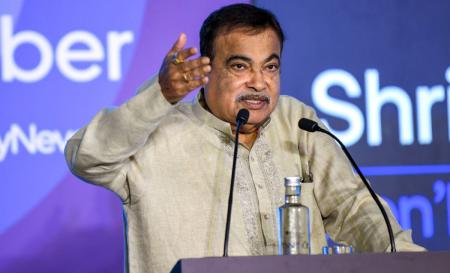
New Delhi, July 27: Union Minister Nitin Gadkari's move before the Bombay High Court is not merely another defamation dispute involving a public figure. It represents a growing legal challenge confronting democracies worldwide: how should courts balance the constitutional value of free expression with the equally important right to reputation in an era where artificial intelligence can manufacture falsehoods at unprecedented speed?
On Monday, the Bombay High Court granted Gadkari permission to institute a substantive civil suit against X, Meta, Google and unidentified individuals over allegedly defamatory and AI-generated content linking him and his family to financial gains arising from India's Ethanol Blended Petrol (E20) programme. The Minister seeks removal of the content and ₹11 crore in damages.
The controversy extends beyond one politician or one policy. It raises a larger constitutional question: when does criticism of a public official cross the line into actionable defamation?
In his proposed suit, Gadkari has maintained that while he has served as Union Minister for Road Transport and Highways since 2014, the Ethanol Blended Petrol Programme is a policy implemented under the Ministry of Petroleum and Natural Gas. According to the pleadings, the social media posts falsely portrayed him as being responsible for the E20 policy while alleging that he and members of his family had personally benefited from its implementation.
Importantly, the suit distinguishes between criticism and fabrication. Gadkari expressly states that he is not seeking to prevent criticism of government policies or his public conduct.
Instead, he argues that the impugned posts are fabricated, malicious and defamatory, and that several constitute AI-generated deepfakes exploiting his likeness without consent.
That distinction may ultimately define the legal battle.
Indian constitutional jurisprudence has consistently protected robust political criticism.
Public officials are expected to tolerate greater scrutiny than ordinary citizens. Yet the law has never recognised a right to knowingly spread false statements presented as fact. As synthetic media becomes increasingly sophisticated, courts are now confronted with content that may appear authentic despite being entirely fabricated.
The litigation therefore represents one of the clearest illustrations of how deepfake technology is reshaping traditional defamation law. Earlier disputes largely revolved around newspaper reports, television broadcasts or social media comments authored by identifiable individuals. AI-generated content introduces new complexities: anonymous creators, algorithmic amplification, multiple intermediaries and cross-border digital platforms.
The case also underscores the expanding role of internet intermediaries. While the alleged content may have originated with unknown users, platforms increasingly find themselves drawn into litigation because they host, recommend or continue to carry disputed material. Courts are consequently being asked not only to determine whether content is defamatory but also to define the extent of responsibility borne by technology companies in responding to complaints involving AI-generated misinformation.
Equally significant is Gadkari's decision to pursue civil remedies rather than rely solely on criminal defamation provisions. By seeking removal of the content and monetary damages, the litigation reflects a growing trend among public figures who increasingly turn to civil courts to protect their digital reputations while attempting to establish accountability for online falsehoods.
The Bombay High Court will eventually decide the merits of Gadkari's claims. Whether the posts are indeed defamatory, whether they amount to protected political speech, and whether the platforms bear any legal responsibility remain issues for judicial determination.
Whatever the outcome, the case is likely to become an important reference point in India's evolving digital jurisprudence. As AI-generated content becomes more convincing and misinformation spreads more rapidly than ever before, courts will increasingly be required to draw the constitutional boundary between legitimate public criticism and digitally manufactured defamation.
That boundary may prove to be one of the defining legal questions of the AI era.