Himachal Wants Fewer IAS, IPS and IFS Officers. Can It Do It?
Himachal Pradesh plans to reduce its IAS, IFS and IPS cadre strength, citing under-utilisation and administrative costs. But the move raises important legal and fiscal questions: cadre strength for All India Services is governed by a statutory framework involving the Centre, while the government’s ₹2,000-crore savings claim requires greater transparency. By Mahima Katal New Delhi, Aug 18: The Himachal Pradesh government’s decision to undertake a major restructuring of its administrative...
Himachal Pradesh plans to reduce its IAS, IFS and IPS cadre strength, citing under-utilisation and administrative costs. But the move raises important legal and fiscal questions: cadre strength for All India Services is governed by a statutory framework involving the Centre, while the government’s ₹2,000-crore savings claim requires greater transparency.
By Mahima Katal New Delhi, Aug 18: The Himachal Pradesh government’s decision to undertake a major restructuring of its administrative machinery has brought an old question of governance back into focus: how large should a bureaucracy be, and who ultimately decides?
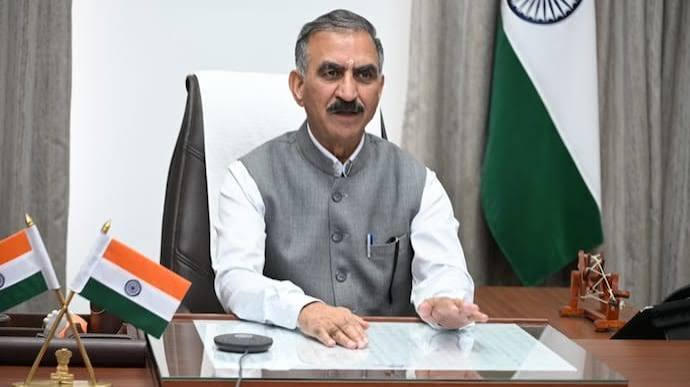
Chief Minister Sukhvinder Singh Sukhu has said that the State government proposes to reduce the sanctioned strength of the Indian Administrative Service (IAS) from 153 to 130 posts and the Indian Forest Service (IFS) from 118 to 83. The government also intends to reduce the number of sanctioned IPS posts, although the proposed figure has not yet been disclosed.
The Chief Minister’s justification is straightforward. Several officers, he said, do not have sufficient work and their capabilities are consequently not being fully utilised. The government, according to him, needs officials who can implement schemes and deliver services rather than maintain positions for which there is inadequate work.
The proposed restructuring, Sukhu has claimed, could reduce government expenditure by around ₹2,000 crore. The government has also said that officers seeking assignments in Delhi will no longer have their requests unnecessarily delayed and that they will be relieved promptly once approval is granted.
There is an obvious administrative logic behind such a policy. A government cannot indefinitely maintain a large establishment merely because the posts were created at an earlier point of time. If the functions of government have changed, the machinery performing those functions must also be periodically reviewed.
But the proposal becomes legally and constitutionally more complicated when the posts in question belong to the All India Services.
The IAS, IPS and IFS are not ordinary State government services. Their constitutional foundation lies in Article 312 of the Constitution, while the All-India Services Act, 1951 provides the statutory framework under which these services operate. Their cadre structures are governed by rules and regulations framed at the Union level, with the concerned State government playing an important role in the process.
This distinction matters because a State government cannot simply treat the sanctioned strength of its IAS, IPS or IFS cadre in the same manner as an ordinary departmental establishment.
For the IAS, the Indian Administrative Service (Cadre) Rules, 1954 and the Indian Administrative Service (Fixation of Cadre Strength) Regulations, 1955 provide the framework for determining the strength and composition of a State cadre. The Central Government determines cadre strength in consultation with the State government.
The same broad principle applies to the Indian Forest Service and the Indian Police Service.
Himachal Pradesh can therefore undertake a review of its administrative requirements and propose a reduction, but the final alteration of the All India Service cadre strength has to take place within the statutory framework governing these services.
This also raises another important question: what happens to officers who are already serving?
A reduction in sanctioned posts does not mean that existing IAS or IFS officers can simply be removed from service because the number of posts has been reduced. The number of sanctioned posts and the number of officers already belonging to the service are legally distinct questions.
A reduction in cadre strength would ordinarily have to be managed through vacancies, retirement, future recruitment, deputation and other administrative mechanisms. The government’s decision to facilitate the movement of officers to Delhi is therefore significant.
Deputation can provide a practical solution where the State believes that it has more officers than it currently needs, while the Union government or other eligible organisations have a requirement for experienced administrators. It allows officers to be utilised without immediately treating cadre reduction as a question of removing people from service.
But deputation cannot by itself answer the larger question of whether the existing cadre strength is genuinely excessive.
That requires evidence.
The government's argument that officers are not getting enough work should ideally be supported by a department-wise and cadre-wise assessment. How many sanctioned posts are vacant? How many officers are currently on deputation? How many are performing substantive field assignments? How many are occupying positions that could be merged or abolished? And in which departments does the government believe there is genuine duplication?
Without such information, the policy risks becoming a numerical exercise rather than a genuine administrative reform.
The proposed ₹2,000-crore saving also requires closer examination.
The announced reduction in IAS strength amounts to 23 posts, while the IFS reduction amounts to 35 posts. Together, that is a reduction of 58 sanctioned posts, even before the undisclosed IPS figure is taken into account.
On the face of it, the reduction of 58 IAS and IFS positions alone cannot explain a ₹2,000-crore saving. Even a hypothetical annual expenditure of ₹50 lakh per officer would put the direct cost associated with 58 positions at roughly ₹29 crore a year.
That does not establish that the government's ₹2,000-crore estimate is incorrect. The figure may include savings from a much wider restructuring of government departments, vacant posts, support establishments, offices, vehicles, pensions or other administrative expenditure. It could also represent a cumulative saving over several years.
But if that is the case, the government should disclose the methodology.
A fiscal claim of this magnitude deserves a transparent calculation. The public should be able to see whether ₹2,000 crore represents annual savings or a multi-year projection, what categories of expenditure have been included and how much of the amount can actually be attributed to the reduction in All India Service posts.
There is also a larger policy question that cannot be ignored.
A smaller bureaucracy is not necessarily a more efficient bureaucracy.
Himachal Pradesh has a distinctive administrative geography. Its mountainous terrain, disaster vulnerability, forests, tourism economy, infrastructure challenges and dispersed population impose demands that cannot always be measured simply by the number of government offices or files handled.
If the government removes positions without examining where administrative capacity is actually required, the result could be an understaffed field administration rather than a leaner and more efficient government.
The better approach would be to undertake a workload-based review of the State's administrative structure. Posts should be examined against actual functions, population, geographical responsibilities, service-delivery requirements and measurable outcomes.
The question should therefore not merely be how many IAS, IPS or IFS officers Himachal Pradesh can do without.
It should be how many it actually needs to govern effectively.
There is also a federal dimension to the proposal. The All India Services were created precisely because certain administrative services were intended to operate across the Union and the States rather than become completely fragmented into separate State establishments. Any substantial alteration of a State cadre therefore has implications beyond the State government's immediate financial calculations.
The Himachal government is right to question whether public money is being spent on posts that no longer correspond to actual administrative requirements. Periodic cadre reviews are necessary in any modern government.
But the legal framework exists for a reason. The restructuring must respect the statutory rules governing the All India Services, and the State's proposal must ultimately fit within the Centre-State consultation mechanism prescribed by law.
The success of the exercise will therefore depend less on the headline reduction in numbers and more on what follows it.
If the government can demonstrate that redundant posts have been identified through a genuine workload assessment, that existing officers will be properly utilised, that essential field administration will not suffer and that the claimed financial savings are supported by transparent figures, the exercise could become a meaningful example of administrative reform.
If not, reducing sanctioned posts may simply produce a smaller number on paper without necessarily producing a better government.
Himachal Pradesh's proposal therefore deserves to be viewed neither as an automatic victory for fiscal discipline nor as an attack on the civil service.
It is an opportunity to ask a more fundamental question about governance: whether the
State's administrative machinery is designed around the needs of the people it serves, or around positions inherited from an earlier model of government.
Ultimately, good administration is not measured by how many officers a government
employs. Nor is it measured simply by how many posts it abolishes.
It is measured by whether the machinery of government has the capacity to make decisions, implement schemes and deliver services effectively, at a cost that the public can afford.
That is the real test facing Himachal Pradesh's proposed bureaucratic restructuring.