India and Uzbekistan Elevate Ties to Comprehensive Strategic Partnership, But Real Story Is Uranium Framework
India and Uzbekistan upgraded ties to a Comprehensive Strategic Partnership, agreeing a long-term uranium supply framework and a $5 billion trade target by 2030, alongside heritage, mining and education agreements signed in Tashkent. By Mahima Katal New Delhi, Aug 30: The joint announcement in Tashkent on Sunday, upgrading India-Uzbekistan relations to a Comprehensive Strategic Partnership, arrives dressed in the vocabulary that now accompanies nearly every high-profile bilateral visit New...
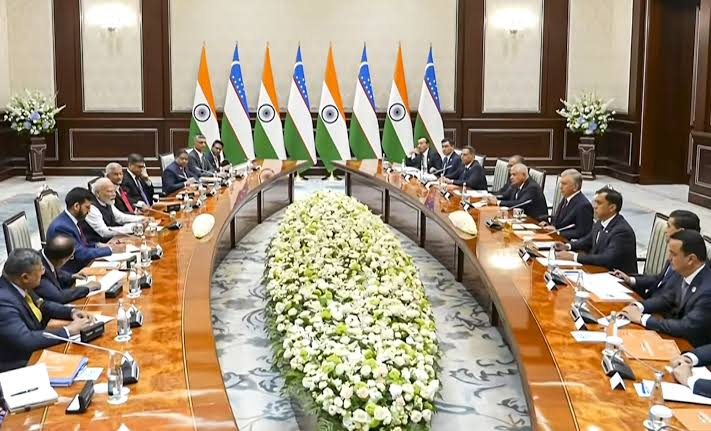
India and Uzbekistan upgraded ties to a Comprehensive Strategic Partnership, agreeing a long-term uranium supply framework and a $5 billion trade target by 2030, alongside heritage, mining and education agreements signed in Tashkent.
By Mahima Katal
New Delhi, Aug 30: The joint announcement in Tashkent on Sunday, upgrading India-Uzbekistan relations to a Comprehensive Strategic Partnership, arrives dressed in the vocabulary that now accompanies nearly every high-profile bilateral visit New Delhi undertakes. India currently holds Comprehensive Strategic Partnership status, or its equivalent higher-tier labels, with more than thirty countries and groupings, from ASEAN and Australia to Indonesia and the United Arab Emirates. The designation itself, then, is not the news. What matters is what sits underneath it, and here the Tashkent outcome is more substantive than the ceremonial framing suggests.
The centrepiece is the agreement to establish a long-term framework for uranium supply. Coming three decades into India's civil nuclear programme and roughly four months after India finalised a uranium supply arrangement worth over four billion dollars with Kazakhstan's Kazatomprom, the Uzbekistan framework fits a discernible pattern rather than standing as an isolated gesture. New Delhi currently draws close to eighty percent of its uranium imports from Kazakhstan, with smaller volumes sourced from Russia, Canada, France and, more recently, Australia. Uzbekistan is not yet a supplier of comparable scale, but it holds substantial uranium reserves and is, alongside Kazakhstan, part of the same Central Asian resource architecture that India has been courting methodically since the 2015 Astana uranium contract under the Modi government. The Ministry of External Affairs has not disclosed volumes or contract duration for the new framework, which leaves the practical weight of the announcement, as with several of India's recent uranium diplomacy outcomes, to be assessed once implementation details emerge rather than at the signing stage.
The context for this urgency is domestic. India has set a target of 100 gigawatts of nuclear capacity by 2047, up from an installed base in the range of eight to ten gigawatts today, and that expansion cannot be met from domestic uranium reserves alone. Diversifying suppliers beyond Kazakhstan, which itself faces capacity constraints even as it ramps up production, is less a diplomatic flourish than a fuel-security necessity. Read against that backdrop, Sunday's framework is best understood as India hedging its uranium sourcing across the wider Central Asian belt rather than as a signal of any qualitative shift in the India-Uzbekistan relationship on its own terms.
The trade figures announced alongside the partnership upgrade tell a more modest story, and it is worth stating plainly rather than glossing over. Current bilateral trade stands at just over one billion dollars, and the two sides have set a target of five billion dollars by 2030. That is a fivefold increase in under four years, a target that MEA statements of this kind routinely set and that bilateral trade volumes just as routinely miss on the original timeline, as has been the case with comparable targets set for India's trade relationships with several other partners. The institutional architecture announced to support this, including a foreign-minister-level Coordination Council and the elevation of the joint commission to ministerial level, indicates an intent to manage the relationship more actively than before, though institutional upgrades of this kind have a mixed record of translating into trade outcomes on their own.
The agreements on Buddhist heritage conservation at Fayaz Tepa and Kara Tepa, along with the mining, culture, tourism and ayurveda pacts, sit in a different register entirely, functioning as the connective tissue that fills out a comprehensive partnership announcement rather than as load-bearing elements of the relationship. They are worth noting for completeness but do not alter the substantive picture.
Taken together, the Tashkent outcomes point to a relationship being reshaped primarily around one strategic input, uranium, with trade and cultural cooperation running alongside as secondary tracks that have not yet been given the specificity, in disclosed volumes or binding timelines, that would allow an independent assessment of how much has actually changed. The Comprehensive Strategic Partnership label marks the fifteenth anniversary of the India-Uzbekistan strategic partnership and provides a diplomatic frame for that shift, but the framework agreement on uranium, once its terms are made public, will be the more reliable indicator of whether Sunday's visit produced a structural change in the relationship or a well-timed restatement of intent.