India Has Seen No Effective Increase in Petrol and Diesel Prices Despite Global Oil Market Volatility, Says Minister
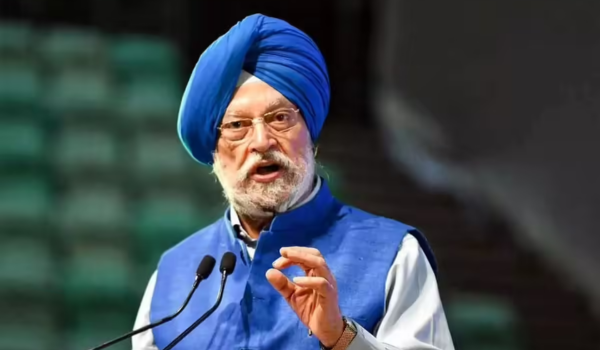
By Mahima Katal Sonbhadra (UP), June 20: Union Petroleum and Natural Gas Minister Hardeep Singh Puri on Saturday asserted that petrol and diesel prices in India have not effectively increased despite fluctuations in global crude oil markets. Speaking at a press conference in Sonbhadra during the Centre's campaign marking 12 years of the Narendra Modi government, Puri said the government had shielded consumers from the impact of rising global energy prices through repeated reductions in excise...
By Mahima Katal
Sonbhadra (UP), June 20: Union Petroleum and Natural Gas Minister Hardeep Singh Puri on Saturday asserted that petrol and diesel prices in India have not effectively increased despite fluctuations in global crude oil markets.
Speaking at a press conference in Sonbhadra during the Centre's campaign marking 12 years of the Narendra Modi government, Puri said the government had shielded consumers from the impact of rising global energy prices through repeated reductions in excise duty.
"In real terms, there has been no increase in petrol and diesel prices in the country," the minister said.
Puri noted that the Centre reduced excise duty on fuel in November 2021, May 2022, and again recently, absorbing a burden of nearly ₹10 per litre on both petrol and diesel.
Responding to queries about a possible reduction in fuel prices amid softer international crude rates, he said India had managed fuel inflation better than most countries.
"Among the 193 member nations of the United Nations, only Japan has recorded a lower increase in petroleum prices than India," he said.
According to the minister, the cumulative rise in petrol and diesel prices has been limited to ₹7.60 per litre. Compared to the period when the Russia-Ukraine conflict began in 2022, fuel prices have effectively remained unchanged, he added.
Referring to geopolitical tensions around the Strait of Hormuz, Puri said oil marketing companies were currently facing losses of nearly ₹1,000 crore per day. However, the government ensured that the additional burden was not passed on to consumers.
"If current prices are compared with those prevailing in 2022, they are actually lower," he said.
The minister also indicated that fuel prices could decline in the coming weeks as refiners begin processing cheaper crude oil.
"Oil companies are presently holding inventories purchased at higher prices. Once crude acquired at lower rates reaches refineries, there is a possibility of a reduction in fuel prices," he said.
Highlighting developmental progress in Sonbhadra, Puri said the district had secured the top position in the Government of India's Delta Ranking Programme and was rapidly overcoming its image as a backward region.
"Sonbhadra is moving beyond backwardness and is on its way to becoming a model district," he said, crediting the progress to the combined efforts of the Centre and the Uttar Pradesh government.
Puri further highlighted India's economic growth over the past 12 years under Prime Minister Narendra Modi's leadership, citing advancements in infrastructure, energy, social welfare and self-reliance.
"Our economy is growing rapidly and is moving steadily towards becoming the world's third-largest economy," he said.
The minister noted that India had risen from the world's 11th-largest economy in 2014 to a $4 trillion economy today.
On local economic indicators, he said Sonbhadra's per capita income had increased from ₹43,000 in 2018 to around ₹1.2 lakh currently.
"There is still more work to be done, and we are all committed to that effort," he added.
Puri also highlighted Uttar Pradesh's economic transformation, stating that the state's Gross State Domestic Product (GSDP) had grown from nearly ₹13 lakh crore in 2016-17 to around ₹36 lakh crore.
He said initiatives such as more than 23,000 startups, over nine lakh government jobs filled through transparent recruitment, and the One District One Product (ODOP) scheme had strengthened employment generation and industrial growth.
The minister further said that Ayodhya, Kashi and Prayagraj were emerging as major global spiritual and tourism destinations, driven by projects such as the Ram Temple, Kashi Vishwanath Corridor and infrastructure developed for the Mahakumbh, which have boosted tourism and local economic activity.