India's Counter-Map of Arunachal Pradesh Changes the Optics, Not the Law
India formally named 27 Arunachal Pradesh locations, countering China's eight-year renaming campaign (60+ places since 2017). Naming carries no legal weight over sovereignty, China's renaming never shifted the LAC. India's move standardises existing usage rather than inventing names, closing an optics gap, not a legal one. By Mahima Katal New Delhi, Aug 8: The Home Ministry's formal identification of 27 locations in Arunachal Pradesh on Survey of India maps is being read, correctly, as a...
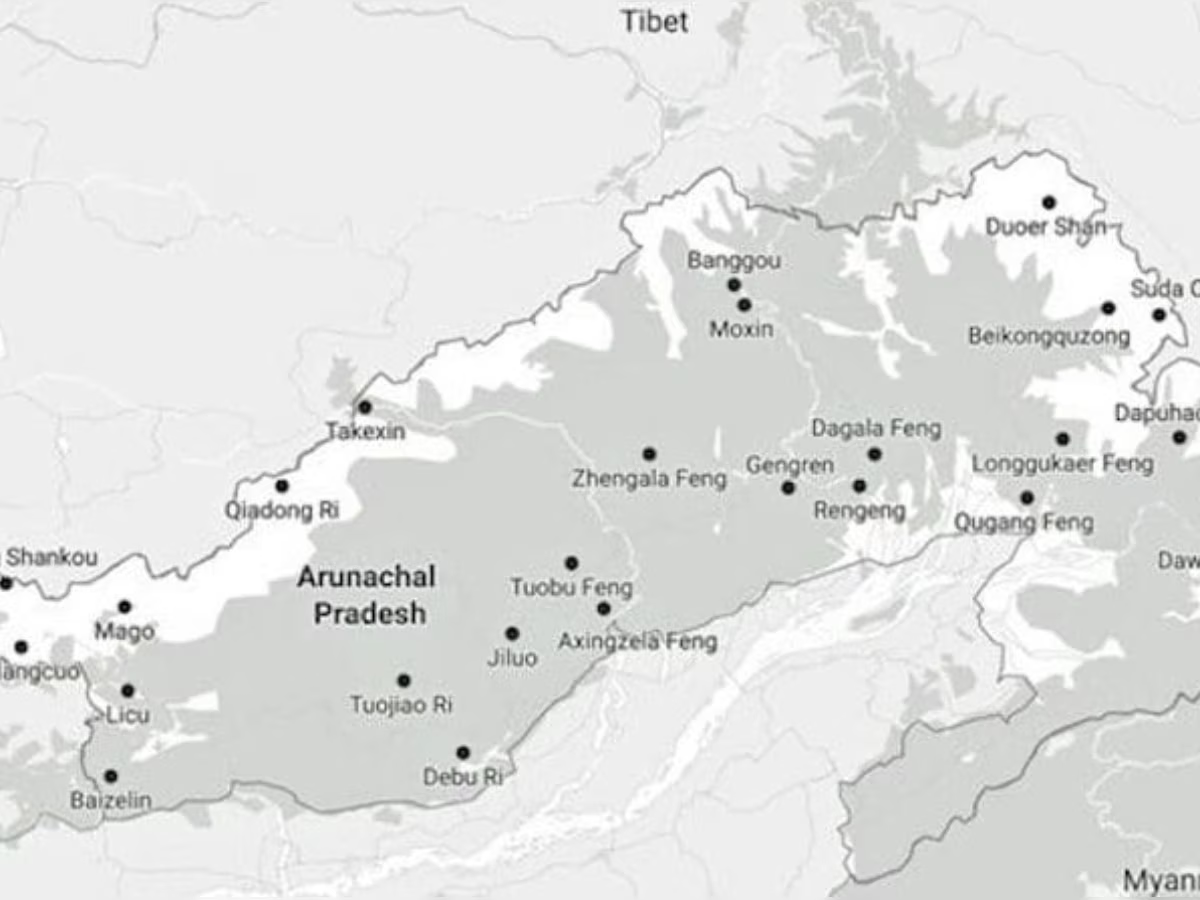
India formally named 27 Arunachal Pradesh locations, countering China's eight-year renaming campaign (60+ places since 2017). Naming carries no legal weight over sovereignty, China's renaming never shifted the LAC. India's move standardises existing usage rather than inventing names, closing an optics gap, not a legal one.
By Mahima Katal
New Delhi, Aug 8: The Home Ministry's formal identification of 27 locations in Arunachal Pradesh on Survey of India maps is being read, correctly, as a direct answer to China's long-running renaming campaign. What gets lost in that framing is what the exercise actually is, and what it demonstrably is not.
Start with what it is not. Naming a place, or renaming one, has no bearing on sovereignty under international law. Territorial title rests on effective control, historical administration, and, where relevant, treaty or customary boundary agreement, not on what a map calls a mountain pass. China has understood this as well as India has for the better part of a decade: its Ministry of Civil Affairs has issued six successive batches of "standardised" Chinese and Tibetan names for Arunachal locations since 2017, in 2021, 2023, 2024, and again this April, cumulatively covering more than 60 places, without any of it altering an inch of the Line of Actual Control.
New Delhi's own repeated response, that "assigning invented names will not alter the reality" of the state's status, has been correct every time it has said so. That same logic applies with equal force to India's own map now. Formally naming 27 features does not strengthen India's legal claim beyond where it already stood; the claim was never resting on nomenclature to begin with.
What the exercise does do is close a rhetorical gap that had opened over eight years of asymmetric response. Each Chinese naming batch drew a verbal rejection from the Ministry of External Affairs, calling the move "vain and preposterous" or "senseless," followed by nothing further. China kept adding names to a growing list; India kept issuing the same paragraph of denial.
A tit-for-tat counter-naming proposal had reportedly been under study by the government's China Study Group as early as 2024, alongside signs India had separately assigned Indian-language names to 30 locations across the border around that period. Whether this August action is genuinely the first substantive counter-move or a continuation of an already-quiet practice, its primary function is optical parity, not new legal ground.
The selection of locations makes the domestic audience clear even if the exercise is nominally aimed at Beijing. Longju, included in the list, was the site of the first armed clash between Indian and Chinese forces in 1959. Jaswant Garh commemorates Jaswant Singh Rawat, a soldier decorated for the 1962 war. Sher-e-Thapa Memorial and sites tied to the 1962 conflict round out a list that reads less like a neutral administrative gazetteer and more like a curated register of resistance memory.
There is nothing improper about that choice, but it is worth naming precisely because it signals the exercise is substantially aimed inward, reinforcing a domestic narrative of assertiveness, rather than outward, where China's territorial posture is unmoved by what New Delhi's maps say any more than India's posture has been moved by Beijing's.
The more interesting legal distinction, and the one least covered so far, is that India's list formalises existing, already-used place names rather than manufacturing new ones the way China's Sinicised and Tibetanised names for previously unnamed or differently named features do. That is a genuinely different act: standardisation of usage versus invention of usage.
It is a stronger position to hold rhetorically, since it does not require the same "creative naming" framing India has used against Beijing. Whether Indian commentary draws that distinction, or simply treats this as symmetrical retaliation, will determine whether the story lands as a coherent legal rebuttal or as a mirrored exercise in the same symbolic register India has spent eight years calling ineffective when China does it.