India's Opportunity to Become a Global Shipbuilding Hub
India laid Rs 3,500 crore foundations for GRSE and Yantra India expansions, framed as a global shipbuilding hub push. But India holds just 0.06-1% of a market where China, Japan and South Korea control 95%. By Mahima Katal New Delhi: Defence Minister Rajnath Singh's foundation-laying ceremony in Kolkata on Sunday was pitched as a signal moment: India, he said, is positioned to seize a "golden opportunity" as traditional shipbuilding powers in the US, UK, France and the Netherlands scale back...
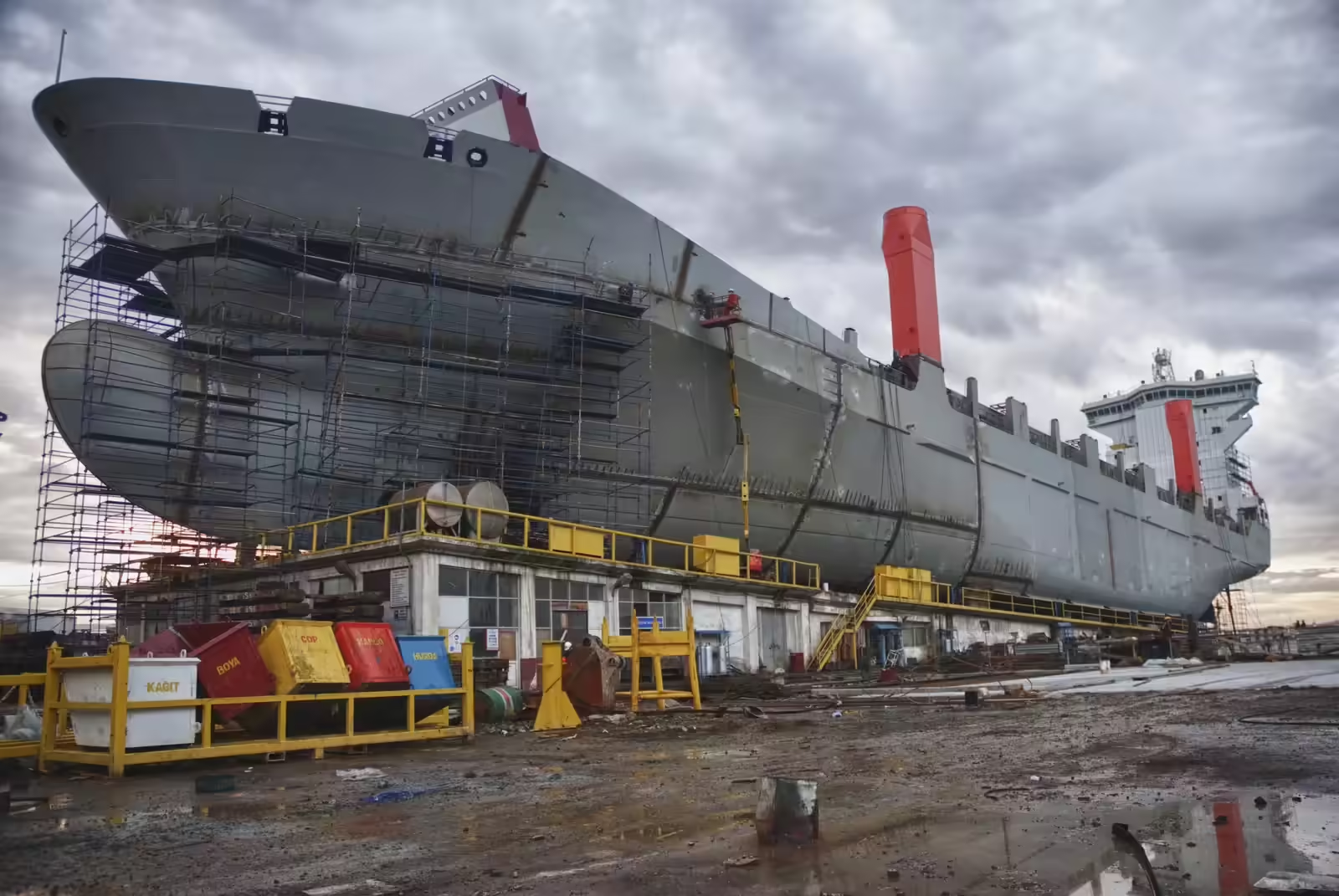
India laid Rs 3,500 crore foundations for GRSE and Yantra India expansions, framed as a global shipbuilding hub push. But India holds just 0.06-1% of a market where China, Japan and South Korea control 95%.
By Mahima Katal
New Delhi: Defence Minister Rajnath Singh's foundation-laying ceremony in Kolkata on Sunday was pitched as a signal moment: India, he said, is positioned to seize a "golden opportunity" as traditional shipbuilding powers in the US, UK, France and the Netherlands scale back capacity. The Rs 3,500 crore expansion across five projects at Garden Reach Shipbuilders and Engineers and Yantra India Ltd is real investment. Whether it adds up to the "global hub" ambition attached to it is a separate question, and the numbers argue for patience over triumphalism.
The starting point is a steep climb
India currently ranks 16th globally in shipbuilding, holding roughly 0.06 percent of the world market, which China, Japan and South Korea dominate with a combined 95 percent share. The Director General of Shipping has put India's global tonnage share at just 1 percent today, against a stated goal of climbing from 16th to 5th place globally by 2047. Framed against Western decline, this can look like an open door. Framed against East Asian dominance, it looks like a much longer contest, and the countries India would need to displace are not retreating from that fight.
The targets are real, and so is the funding behind them
To its credit, the Indian government has moved past aspiration into structured policy. Maritime India Vision 2030 aims to lift India's global shipbuilding share from under 1 percent to 5 percent within the decade, with the longer Amrit Kaal Vision 2047 targeting the same 5 percent share as part of a push into the world's top five shipbuilding nations. Behind these targets sits genuine capital: a Maritime Development Fund with about Rs 250 billion in budgetary support running through 2036, split between an equity-focused investment fund and an interest-incentivisation fund designed to bring down the cost of the long-term borrowing that shipbuilding requires. Additional measures, the Shipbuilding Financial Assistance Policy, infrastructure status for shipyards, and 100 percent automatic-route FDI in shipping and shipbuilding, signal a government treating this as a decades-long industrial project rather than a one-off announcement.
That said, the financing architecture has an acknowledged gap: ships themselves are still not classified as mortgageable assets, which limits how far infrastructure status alone can unlock private lending, a structural fix that hasn't yet caught up with the ambition.
What Sunday's projects actually build
The GRSE and Yantra India expansions are concentrated in defence shipbuilding, a 32-acre facility at Raichak designed to produce 200-metre warships and position GRSE to compete for next-generation destroyer contracts, alongside metallurgical capacity upgrades at Yantra's Ishapore plant. This is a legitimate and strategically important build-out of India's defence-industrial base. But it is not the segment where the "global hub" ambition will be won or lost. Cargo vessels make up around 43 percent of a global shipbuilding market valued at roughly $175.7 billion in 2026, driven by fleet-replacement demand under new IMO emissions rules, a commercial market India's defence-yard expansion does not directly address.
Where the momentum is genuine
The more encouraging signals sit outside Sunday's announcement. India's shipbuilding sector, valued at about $1.12 billion in 2024, is projected by industry estimates to reach $8 billion by 2033, and geopolitical pressure toward supply-chain diversification is pulling some international buyers to consider India as an alternative to established East Asian and European yards. Indian shipyards have started exporting smaller vessels, offshore support ships, patrol boats, barges, to Southeast Asia, Africa and the Middle East, while adopting digital design tools and automation to close the competitiveness gap. Independent market analysts now describe India as the fastest-growing shipbuilding market in the world, on the back of the Vision 2030 push and naval procurement exceeding Rs 2 lakh crore. That is a meaningfully different claim from "hub" status, but it is not a small one either, fastest-growing and dominant are not the same thing, but the former is usually a precondition for the latter.
The honest read
India has the coastline, the labour, the engineering talent and, increasingly, the policy architecture and capital commitment to build a serious shipbuilding industry. What it does not yet have is scale, and Sunday's Rs 3,500 crore in defence-yard expansion, welcome as it is, closes only a sliver of a market where rivals hold a 95 percent share built over decades. The government's own 2030 and 2047 timelines implicitly concede this: nobody credible is promising a hub by next year. The opportunity Defence Minister described is genuine. The distance between opportunity and hub status is the part the announcement leaves out.