Kulgam's Repeat Pattern: Non-Local Labourers Killed at Worksite Again as Security Cordon Goes Up
Two Chhattisgarh labourers killed in a terror attack at a Kulgam brick kiln, the latest in a pattern of targeted killings of non-local workers in J&K stretching from 2006 to a 2024 Srinagar attack. Security forces have cordoned off the area and launched a search operation as officials await details on the attackers. By Mahima Katal New Delhi, Aug 1: Two labourers from Chhattisgarh were killed in a terrorist attack at a brick kiln in Jammu and Kashmir's Kulgam district, officials said on...
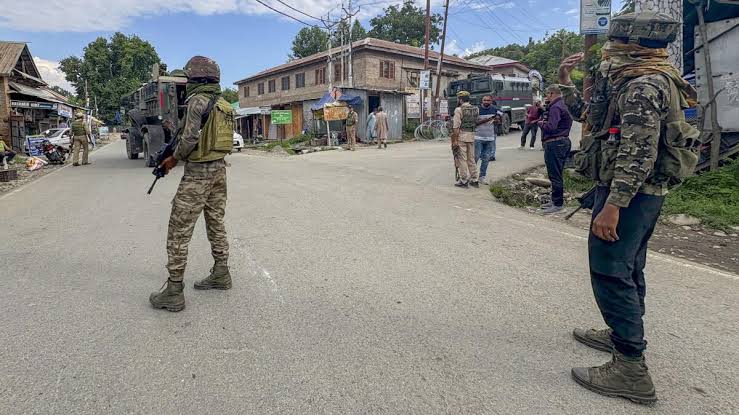
Two Chhattisgarh labourers killed in a terror attack at a Kulgam brick kiln, the latest in a pattern of targeted killings of non-local workers in J&K stretching from 2006 to a 2024 Srinagar attack. Security forces have cordoned off the area and launched a search operation as officials await details on the attackers.
By Mahima Katal New Delhi, Aug 1: Two labourers from Chhattisgarh were killed in a terrorist attack at a brick kiln in Jammu and Kashmir's Kulgam district, officials said on Saturday, in an assault that extends a pattern the Valley has witnessed with troubling regularity over nearly two decades. The assailants targeted the labourers at the brick kiln in the Kelam area of the south Kashmir district late on Friday evening. One of the two injured workers, identified as Deepak Ratray, succumbed to his injuries before he could be taken to a hospital, while the other, Bopinder, was first taken to GMC Anantnag and later referred to SKIMS Hospital in Soura, where he died during treatment. Both workers were in their twenties and hailed from Chhattisgarh.
Representational image
The attack follows closely on the heels of another incident less than ten days ago, in which terrorists allegedly shot and killed a police officer in Anantnag town. It also follows a February 2024 attack in the Shaheed Gunj area of Srinagar, where two non-local workers from Punjab, Amritpal Singh and Rohit Masih, were shot dead by a terrorist, the most recent instance, before this one, of migrant labourers being killed in the Valley.
What separates this attack from a standalone act of violence is the setting in which it recurs. Kulgam specifically, and non-local labour more broadly across the Valley, has become a recognisable target category rather than an incidental one. The lineage runs from the 2006 killing of nine Nepali and Bihari labourers near Yaripora in Kulgam, through the 2019 killing of seven Bengali Muslim labourers in the same district, to the 2024 Srinagar killing of the two Punjab workers, and now to this attack barely eighteen months later. Each incident has followed a broadly similar procedural arc: an attack on unarmed, non-local workers, a security cordon and search operation, official condemnation from political leadership, and, in time, an operation against those identified as responsible. What has been harder to identify, across this span, is a standing protective framework addressing the recurrence itself, as distinct from the state's response to each attack treated as a discrete event.
That distinction is where the constitutional question sits. The state's positive obligation under Article 21 is not exhausted by responding to violence after it has occurred. Where an identifiable class, non-local migrant labour, is being repeatedly targeted across a near two-decade span, in some cases in the very same district, the relevant question is not only whether force is deployed in the aftermath but whether protective measures existed in advance, calibrated to a risk the state's own record shows to be foreseeable rather than novel. Whether this specific pattern, considered as a pattern rather than as isolated incidents, has ever been placed before a court through a PIL seeking a structural protective framework for non-local labour in the Valley is a question worth establishing before any firmer conclusion is drawn.
Security forces have cordoned off the Kelam area and launched a search operation to identify those responsible. Further details on the attackers and their affiliation are awaited.