National Anthem Facts That Every Indian Should Know
Jana Gana Mana carries a century-old history, from Rabindranath Tagore’s composition to its adoption as India’s National Anthem in 1950.
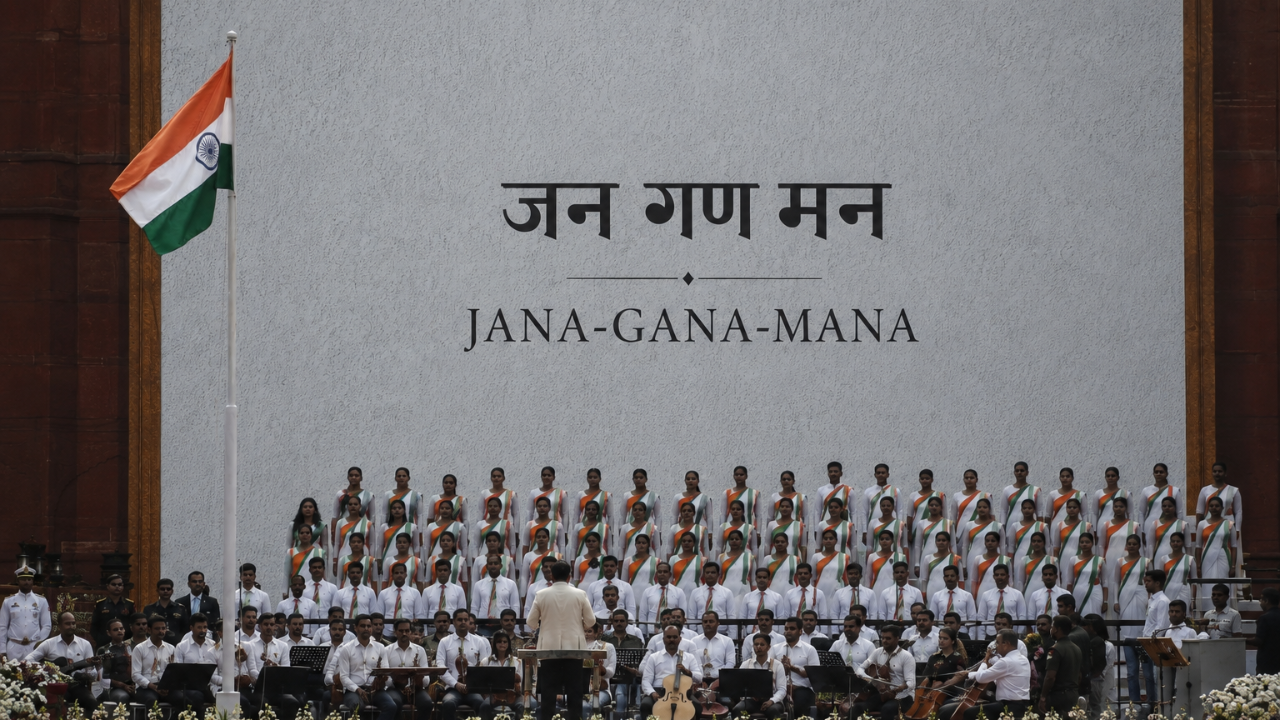
National Anthem Facts: From its 1911 origins to the Supreme Court’s landmark ruling, discover lesser-known facts about India’s National Anthem, Jana Gana Mana.
By Hitanshi Kothari
New Delhi, August 14: India’s National Anthem, Jana Gana Mana, is more than a song played at ceremonies and public gatherings. Its familiar 52 seconds carry a history that dates back to the freedom movement and the years before Independence. Written by Nobel laureate Rabindranath Tagore and first publicly sung in 1911, the composition went through decades of debate and discussion before it was formally adopted as India’s National Anthem in 1950.
From its origins and the controversy surrounding its lyrics to lesser-known rules governing its use, there is much more to Jana Gana Mana than the lines every Indian knows by heart.
Jana Gana Mana was not adopted through a specific Constitutional Article
The Constitution does not contain a separate Article declaring Jana Gana Mana as India's National Anthem. Instead, it was formally adopted through the Constituent Assembly's decision on January 24, 1950.
The George V controversy has followed the anthem for decades
One of the most debated aspects of Jana Gana Mana is the claim that Tagore wrote it in praise of King George V, who visited India in 1911. Tagore later rejected this interpretation and clarified that the reference to the "Dispenser of India's destiny" was not directed at the British monarch.
Jana Gana Mana and Vande Mataram have different official statuses
Jana Gana Mana is India's National Anthem, while Vande Mataram is recognised as the National Song. The Constituent Assembly gave Vande Mataram equal honour in view of its historic role in India's freedom struggle, while formally adopting Jana Gana Mana as the National Anthem.
The full version takes approximately 52 seconds, while the shorter version takes 20 seconds
The full version of Jana Gana Mana takes approximately 52 seconds to sing or play. This is not merely a commonly repeated trivia fact; the duration is specified in the official guidelines issued by the Ministry of Home Affairs.
Jana Gana Mana carries a century-old history, from Rabindranath Tagore’s composition to its adoption as India’s National Anthem in 1950. (Representative Image, Created Using AI)
The National Anthem also has a shorter version, consisting of its first and last lines, which takes approximately 20 seconds. The shortened version is officially recognised and is prescribed for certain occasions. Here it is:
Jana-gana-mana-adhinayaka jaya heBharata-bhagya-vidhata.Jaya he, Jaya he, Jaya he,Jaya jaya jaya jaya he.
The anthem question was still unresolved in 1948
Even after Independence, the Constituent Assembly had not immediately settled the question of India's National Anthem. In August 1948, Jawaharlal Nehru told the Assembly that the final decision still rested with it. By then, the tune of Jana Gana Mana had already gained recognition internationally, including at an event involving India's delegation at the United Nations in 1947.
It was first sung nearly four decades before its adoption
Jana Gana Mana was first publicly sung on December 27, 1911, at the Calcutta session of the Indian National Congress. This means the composition was already part of India's public life nearly 39 years before it became the country's official National Anthem.
It was originally written in Bengali
Rabindranath Tagore originally composed Jana Gana Mana in Bengali, using heavily Sanskritised vocabulary. The first stanza of this composition was later adopted as India's National Anthem. Tagore originally wrote the song in five stanzas, of which the first stanza was adopted as the National Anthem.
Not singing the National Anthem does not automatically amount to disrespect
The Supreme Court addressed this question in the landmark Bijoe Emmanuel v. State of Kerala case. Three schoolchildren had stood respectfully during the National Anthem but did not sing it because of their religious beliefs. The Supreme Court ruled in their favour, making the case an important reference when discussing the rights and duties of citizens during the National Anthem.