No Coercive Action, No Closed Case: SC's Middle Path on NEET Protest FIRs
The Supreme Court barred coercive action against NEET protesters and ordered release of minors without criminal records, while allowing Delhi's FIRs to proceed rather than quashing them. It also directed states to preserve all protest-related digital evidence, CCTV, drone and body-camera footage, without making protester data public, and flagged a possible independent probe or SIT. New Delhi, July 28: The Supreme Court's intervention in the student-led protests against the NEET paper leak...
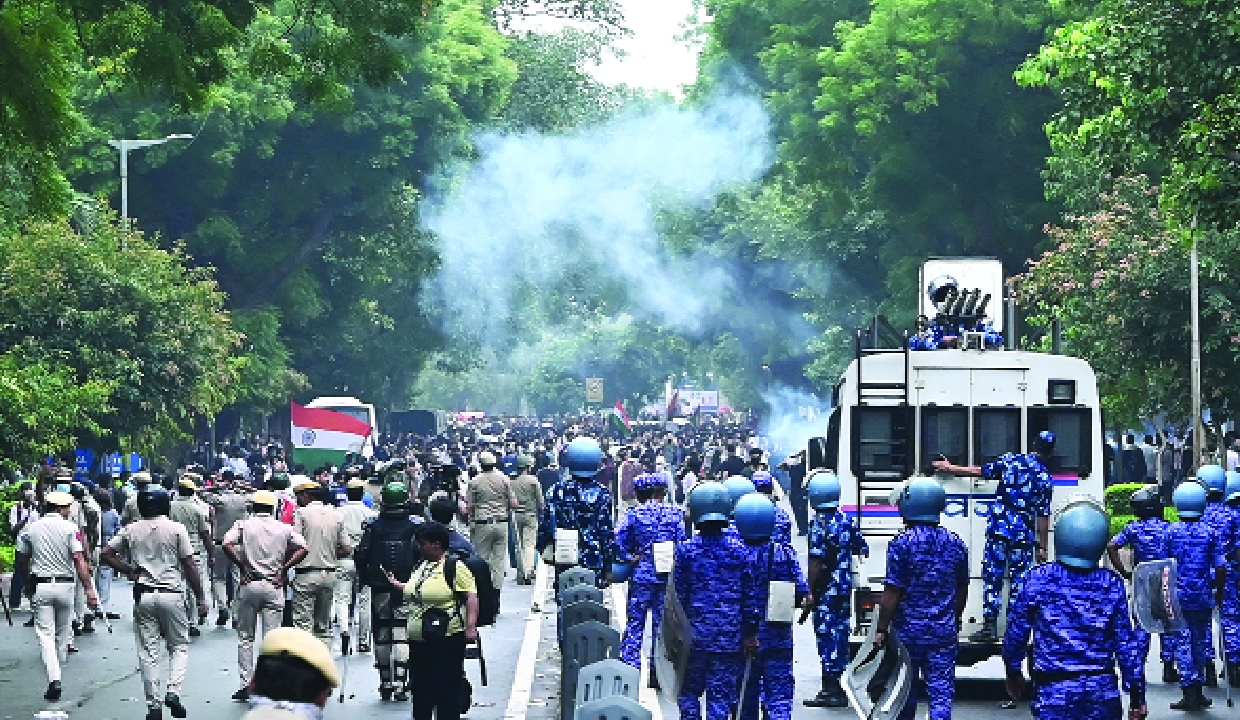
The Supreme Court barred coercive action against NEET protesters and ordered release of minors without criminal records, while allowing Delhi's FIRs to proceed rather than quashing them. It also directed states to preserve all protest-related digital evidence, CCTV, drone and body-camera footage, without making protester data public, and flagged a possible independent probe or SIT.
New Delhi, July 28: The Supreme Court's intervention in the student-led protests against the NEET paper leak illustrates a familiar but consequential pattern in Indian constitutional litigation: a bench choosing to regulate process rather than adjudicate merits at the interim stage. A bench headed by Chief Justice of India Surya Kant, sitting with Justices Joymala Bagchi and V Mohana, restrained states from taking coercive action against protesters while explicitly declining to close the FIRs already registered, and directed the release of minors involved in the agitation on the condition that they carry no criminal antecedents. The order neither vindicates the protesters' claim that the criminal cases against them are retaliatory nor endorses the state's continued use of arrest and custody as an investigative tool. It does something narrower and, in its own way, more disciplined: it lets the investigation proceed while foreclosing the coercive machinery that ordinarily accompanies one.
That distinction matters because the petitions before the court did not merely allege police excess in the abstract. They arose from a specific and escalating sequence, the Cockroach Janta Party-led march on July 20 in Delhi, which spread to several states and drew allegations of pellet gun use, lathis fitted with nails, and electric batons producing what the bench itself described as severe and life-threatening injuries. The protests sought the resignation of then Union Education Minister Dharmendra Pradhan over the NEET paper leak, a demand the government met on Saturday alongside a commitment to compensate the families of those who had died by suicide during the agitation and to withdraw FIRs against protesters generally. The order under discussion carves out an exception to that withdrawal commitment for the Delhi FIRs specifically, permitting the investigation to continue while ring-fencing protesters from arrest or custodial coercion during its pendency.
The bench's language is instructive on where it drew that line. It stated that whoever committed excesses or took the law into their own hands should be taken to task, a formulation aimed symmetrically at both police conduct and any protester-driven violence, including the reported attacks on over 250 police personnel that the court has asked to be independently examined alongside the allegations against the state. This is not a court treating the protest as uniformly lawful or the police response as uniformly unlawful. It is a court withholding judgment on both until a fact-finding mechanism, potentially an independent committee or a Special Investigation Team, can establish what happened, while using its interim powers to prevent either side's conduct from being punished or exonerated by default in the meantime.
Procedurally, the more far-reaching part of the order may be the directions on evidence preservation rather than the protection from coercive action itself. The bench directed states to preserve CCTV footage, drone recordings, body-camera footage, wireless communication records and PCR logs relating to the protests, while barring the public release of any digital data collected on individual protesters. This combination, preserve but do not disclose, addresses two separate risks simultaneously: the risk that evidence relevant to establishing what occurred on July 20 and after could be lost or overwritten before any probe is constituted, and the risk that data gathered on protesters could itself be used to identify, surveil or intimidate them in the interim. Read against the diary-entry disclosures already emerging in reporting on the RAF's use of pellet guns that day, the preservation direction functions as an anticipatory safeguard, ensuring that the documentary record the courts and any future SIT will need does not degrade while the larger question of an independent probe remains under consideration.
Solicitor General Tushar Mehta's submissions on behalf of the Centre and the Delhi government sought to locate responsibility for the violence outside the student body itself, telling the bench that individuals with records in serious offences, including murder, rape and cases under the Narcotic Drugs and Psychotropic Substances Act, had entered the protests and perpetrated violence against police personnel, distinct from the students who had gathered peacefully and retained the right to do so. The bench did not reject this account, but it did not adopt it as a finding either. Instead, both the government's characterisation of "miscreants" and the protesters' allegations of disproportionate force were left as competing claims for the contemplated probe to test, with the Centre and states directed to place their versions on record before the court considers constituting an independent mechanism.
The Chief Justice's observation that it was time to collate the legal principles courts have developed on protest policing over the years, and to arrive at uniform protocols governing such situations, signals an ambition beyond this particular batch of petitions. Indian courts have addressed the boundaries of permissible force against protesters episodically, case by case, without a consolidated doctrinal framework analogous to, for instance, the graded-response standards developed in some other jurisdictions for crowd control. Whether this bench eventually produces such a framework, or confines itself to resolving the specific allegations before it, remains to be seen once the states and the Centre file their responses and the court decides on the composition of any SIT or task force. What Tuesday's order establishes for now is narrower but still significant: an interim architecture under which the criminal process continues, the evidentiary record is preserved, and the coercive power of the state is held in abeyance until that process, and the independent probe the court is contemplating, can determine what actually happened.