Oneness on 8th Avenue: What Bhagwat's Madison Square Garden Address Reveals About RSS's Global Turn
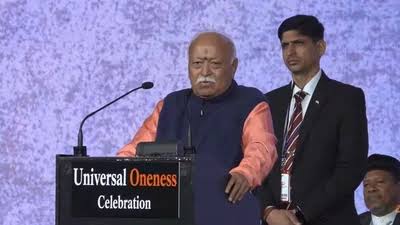
By Mahima Katal New Delhi, Aug 30: When Mohan Bhagwat took the microphone at Madison Square Garden on August 29, 2026, the choice of venue was itself a statement. This is the arena that has hosted Nelson Mandela, the Dalai Lama, and Pope John Paul II, a stage that confers a certain legitimacy on whoever stands on it. For the RSS, an organization that has spent a century operating largely within India's domestic political and cultural sphere, filling that arena with several thousand members of...
By Mahima Katal
New Delhi, Aug 30: When Mohan Bhagwat took the microphone at Madison Square Garden on August 29, 2026, the choice of venue was itself a statement. This is the arena that has hosted Nelson Mandela, the Dalai Lama, and Pope John Paul II, a stage that confers a certain legitimacy on whoever stands on it. For the RSS, an organization that has spent a century operating largely within India's domestic political and cultural sphere, filling that arena with several thousand members of the Indian-American diaspora marks a deliberate step into international visibility, timed to coincide with the organization's centenary year and framed as part of a wider tour through the US, Canada, and the UK.
The Message: Unity as Destiny
Bhagwat's address itself was built around a familiar RSS theme dressed in universalist language. He drew a contrast between the American idiom of "pluralism" and what he described as Bharat's innate condition of "unity in diversity," invoking Swami Vivekananda's 1893 address to the World's Parliament of Religions in Chicago as a touchstone, a comparison the organizers made explicit by naming the event after the philosophy of Vasudhaiva Kutumbakam, "the world is one family." He also urged diaspora Hindus to remain loyal to their karmabhoomi (land of livelihood, i.e., the US) while treating India as their janmabhoomi (motherland), a formulation that asks for civic loyalty to the adopted country alongside enduring cultural and emotional ties to India.
Rhetorically, this is a shift in register from the RSS's traditional domestic messaging. Concepts like Hindutva and cultural nationalism, which in India are entangled with debates over minority rights and secularism, were here recast in the vocabulary of interfaith dialogue, pluralism, and global citizenship, a register clearly calibrated for an American audience and reinforced by sharing the stage with a rabbi, a Protestant minister, and an imam.
A Contested Frame
That reframing is precisely what has made the event contentious. Civil rights and interfaith coalitions, including the advocacy group Hindus for Human Rights, organized opposition in the days before the event, arguing that the language of "oneness" and "engagement" was being used to present an organization they see as having a troubling record on minority rights and religious pluralism in more palatable, universalist terms. New York City figures, including mayoral candidate Zohran Mamdani and several city councilmembers, publicly opposed the event, though reporting suggests the city concluded it lacked authority to block a privately booked venue.
Organizers and supporters have rejected that framing just as firmly, describing the gathering as a genuine celebration of Hindu-American heritage and cross-faith cooperation rather than a political rally, and pointing to the participation of non-Hindu religious leaders as evidence of that intent. Attendees interviewed by wire services described the event as a chance to correct what they see as long-standing Western misconceptions about Hindu philosophy, comparing it to Vivekananda's own outreach more than a century earlier.
Why the Diaspora, Why Now
Several structural factors help explain the timing and target audience:
The RSS, founded in 1925, is using its hundredth year to consolidate a narrative of itself as a global civilizational movement rather than a purely Indian nationalist one.
Diaspora as a political and financial resource. The Indian-American community is large, prosperous, and increasingly courted by both Indian political currents and American electoral coalitions; visibility here has knock-on effects on fundraising, organizing capacity, and perception back in India.
Export of a domestic playbook. The "call to action" issued by roughly 180 religious leaders at the event, pledging solidarity across communities and a proactive, not just reactive, approach to interfaith relations, mirrors a pattern the RSS has used domestically: building broad coalitional language around a core organizational agenda.
The Interpretive Divide
What makes this event analytically interesting is less the content of Bhagwat's speech, which stayed at a fairly abstract, aphoristic register, than the fact that two audiences can hear the same words and draw opposite conclusions. To sympathetic listeners, "unity in diversity" is a genuine articulation of pluralist Hindu philosophy with deep roots in Indian thought. To critics, the same phrase functions as a rebranding exercise, an attempt to launder a movement's contested domestic record through the vocabulary of American multiculturalism. Both readings can be internally consistent; resolving between them requires evidence about organizational conduct rather than about the speech's language alone, which is exactly the terrain on which the current dispute is being fought.
Takeaway
The Madison Square Garden address is less notable for any single new claim than as a marker of strategy: an organization built for a domestic Indian political context is testing whether its core ideas travel abroad when translated into the register of interfaith pluralism, and whether a diaspora audience, courted simultaneously by Indian and American political actors, will receive that translation as authentic outreach or as strategic repositioning. The scale of both the turnout and the organized opposition suggests the answer, for now, is genuinely contested.