Rats, Fires, Overcrowding in NICUs: Who Is Protecting India's Vulnerable Patients?
Repeated NICU fires, rat infestations and overcrowding expose troubling gaps in newborn safety, infrastructure, maintenance and accountability across India’s government hospitals.
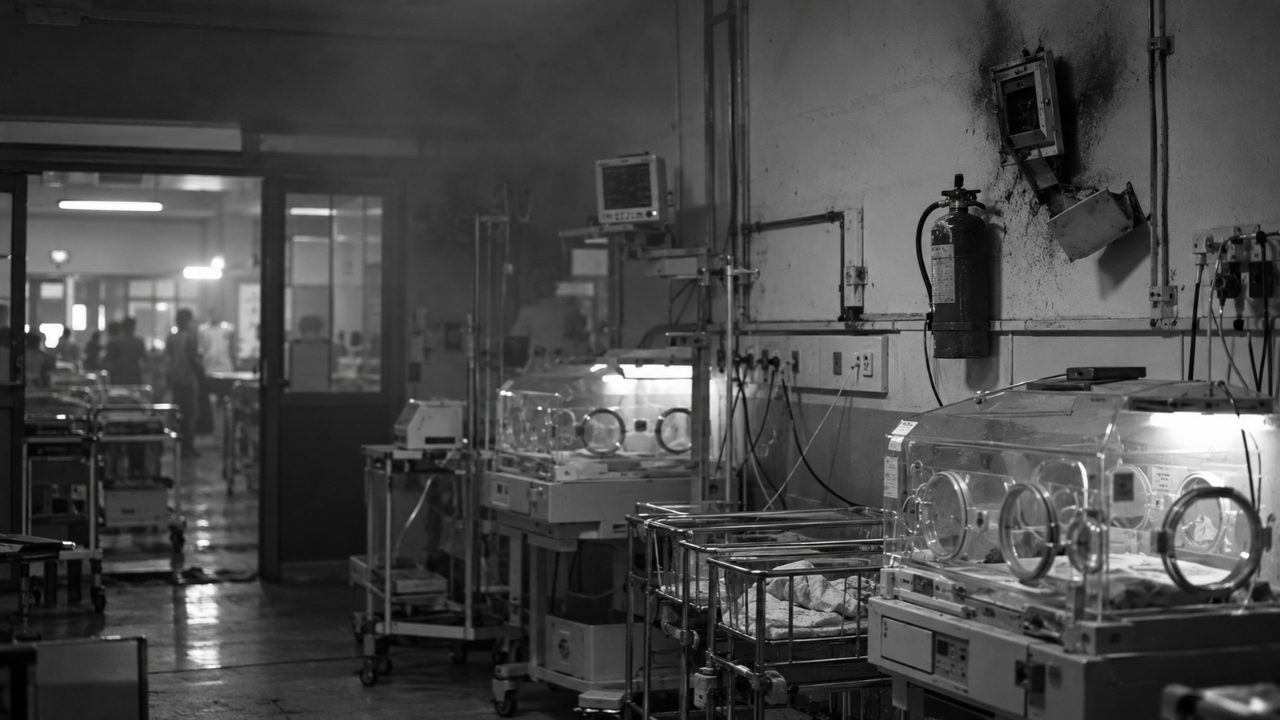
Repeated NICU fires, rat infestations and overcrowding expose troubling gaps in newborn safety, infrastructure, maintenance and accountability across India’s government hospitals.
By Sakshi.
A hospital should provide a nurturing environment that helps a newborn adjust to life outside the womb and supports their recovery if health complications arise. Yet another tragedy on Monday laid bare the inefficiency of the so-called safety net that promises to keep babies safe. Three infants who had just come into the world died after the neonatal care unit at Amravati's District Women's Hospital in Maharashtra caught fire.
It was not just matter of fate, but could have been prevented had the safety arrangements worked. When the flames turned into thick black smoke, the fire alarms remained silent and the water sprinklers were dry, requiring staff to manually control the fire. Several nurses, blinded by the thick smoke and poor visibility, scrambled to pull infants from cradles and incubators after a fire tore through the Neonatal Intensive Care Unit (NICU), said a report by news agency PTI.
While the tragedy claimed three new lives, it also put the lives of dozens of other infants at risk, who were fortunately rescued. Over the years, there have been a number of cases that have raised questions about the preparedness and effectiveness of safety measures in government hospitals. In some cases, the units themselves appeared to be inviting trouble.
Repeated NICU fires, rat infestations and overcrowding raise serious questions about newborn safety in India’s government hospitals. (Representative, AI-Generated Image)
Rats in Indore Hospital (September 2025)
Two newborn babies died reportedly after rats crawling through the unit bit them. They were receiving treatment in the Neonatal Intensive Care Unit (NICU) of Maharaja Yashwantrao Chikitsalaya (MYH), one of Madhya Pradesh's largest government hospitals in Indore.
Hospital staff allegedly noticed injuries on the infants and informed the administration. CCTV footage also showed rats moving around a swing near the newborns. One baby suffered bites on the fingers, while the other was bitten on the head and shoulders.
When concerns over hygiene and pest control at the hospital were raised, the hospital superintendent revealed that pest control had last been carried out five years earlier.
Jhansi Government Hospital Fire (November 2024)
In November 2024, a massive fire broke out late at night at the neonatal unit of Maharani Lakshmibai Medical College in Jhansi, Uttar Pradesh, where around 55 infants were receiving treatment. According to officials, an electrical short circuit started the fire, which quickly spread through the ward, killing 10 newborn babies.
Local media reports, however, quoted officials as saying that the fire started in machinery used to increase oxygen levels in the unit, with the high concentration of combustible gas helping the flames spread rapidly.
Fire Incident at a District Hospital in Chhindwara (August 2026)
At around 1:50 am on August 22, a short circuit caused a massive fire in the NICU of the government district hospital in Chhindwara, Madhya Pradesh. Officials said the electrical fault occurred in the filament coil of a radiant warmer, and sparks reportedly fell on oxygen tubing running near the coil, causing a fire in the cradle.
Three newborns were in the same warmer and suffered burn injuries. Hospital staff said they managed to remove the three infants from the cradle within about 15 seconds and referred them to the government medical college in Jabalpur because Chhindwara hospital did not have a paediatric surgeon.
One of the infants, a girl born with the congenital heart condition dextrocardia, later died, while the other two were reported to be stable.
Hospital in-charge and civil surgeon Kanchan Dubey described the incident as an accident and denied negligence, saying the warmer was under annual maintenance and had been checked on August 10. The Collector said engineers from the maintenance agency would inspect the machine.
Relatives of the affected infants, however, alleged negligence and said the NICU room was filled with smoke when they arrived.
Government Hospital Nanded (October 2023)
Twelve infants died in a single day at the Shankarrao Chavan Government Hospital in Nanded, Maharashtra, on October 1, 2023. They were among 24 patients who died at the hospital that day. Kin of the deceased alleged that the healthcare facility was overcrowded.
One such relative said the neonatal unit was extremely crowded, with four to five babies being placed in an incubator designed for one. Media reports also said the hospital was overcrowded, with patients lying in the corridors, while pigs were seen outside the premises.
The hospital dean, however, said there was no shortage of medicines or doctors and that patients had received proper care.
Infant Suffered Major Burns, Died in Alwar Hospital (January 2022)
A newborn girl died after suffering severe burns in a fire that broke out in the neonatal care unit of Geetanand Hospital in Alwar, Rajasthan, in the early hours of January. At the time, 15 infants were admitted to the unit. The fire broke out in an oxygen pipeline linked to a radiant warmer.
The girl, who was being treated for pneumonia, suffered burns to her face, chest and shoulder. She was taken to Jaipur's JK Lon Hospital after sustaining burns to 70 per cent of her body, where she died during treatment the following day. The other infants were rescued and shifted to different units.
Following the infant's death, the Rajasthan government suspended two doctors, three nursing staff members and one ward boy, while the services of a contractual electrician were terminated and a private contractor was sacked. The suspended doctors included neonatal care unit in-charge Mahesh Sharma and Kirpal Singh, who was on duty when the fire occurred.
A three-member preliminary inquiry panel found negligence and dereliction of duty by the unit in-charge, nursing in-charge and other staff members, leading to action against them.
The repeated incidents across government hospitals point to a larger and deeply troubling problem: newborn safety cannot depend on luck, individual vigilance or emergency responses after a disaster has already occurred.
From rats entering neonatal wards and overcrowding in incubators to electrical failures, faulty equipment and fires in NICUs, these cases expose gaps in infrastructure, maintenance, staffing and hospital safety protocols.