Sajjan Kumar's Death Turns Into a Bipartisan Liability, Not a Congress-Only One
Sajjan Kumar's death triggered bipartisan fallout: Congress's Hooda was rebuked for condoling him, then three BJP MPs faced their own party's reprimand for a condolence visit, exposing shared political risk around his legacy. New Delhi, Aug 29: The death of Sajjan Kumar on August 20 was always going to reopen old wounds. What has followed over the past week, however, is a reminder that the politics of the 1984 anti-Sikh riots refuses to sit neatly on one side of the aisle. Kumar, 80, died...
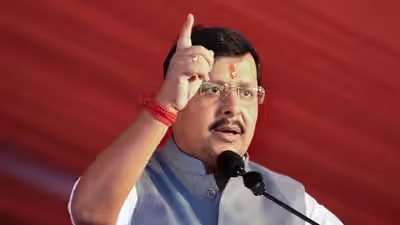
Sajjan Kumar's death triggered bipartisan fallout: Congress's Hooda was rebuked for condoling him, then three BJP MPs faced their own party's reprimand for a condolence visit, exposing shared political risk around his legacy. New Delhi, Aug 29: The death of Sajjan Kumar on August 20 was always going to reopen old wounds. What has followed over the past week, however, is a reminder that the politics of the 1984 anti-Sikh riots refuses to sit neatly on one side of the aisle. Kumar, 80, died at Safdarjung Hospital while serving a life sentence for the murder of five men during the riots, a conviction upheld in 2018, with a Delhi court adding a second conviction as recently as 2025 for the killings of Jaswant Singh and his son Tarundeep Singh. His death has since produced condolence gestures from leaders in both the Congress and the BJP, and both parties are now managing the fallout.
The first flashpoint came from within the Congress. Haryana leader Deepender Hooda's condolence message for Kumar drew swift internal criticism, with former Punjab chief minister Charanjit Singh Channi among those who publicly rebuked him. The timing sharpened the criticism: Punjab, where the 1984 riots remain a live political memory, heads into Assembly elections, and any perceived softness toward a convicted figure carries direct electoral cost in a Sikh-majority state.
The second flashpoint arrived days later, and it complicates the narrative that this is a Congress problem alone. Three Delhi BJP MPs, Kamaljeet Sehrawat (West Delhi), Ramvir Singh Bidhuri (South Delhi) and Yogender Chandolia (Northwest Delhi), visited Kumar's residence to offer condolences at his final bhog. BJP national president Nitin Nabin summoned all three on Saturday and, according to a party source cited by news agency, expressed his displeasure over the visit. Nabin's own comment was unambiguous: "They shouldn't have gone."
The response from opposition benches was immediate. AAP's Baltej Pannu and Saurabh Bhardwaj both used the visit to turn the BJP's own condemnation of Hooda back on the party, with Bhardwaj writing that the MPs' "hearts still beat" for a convicted killer. The more consequential criticism, though, came from within the BJP's own ranks. HS Phoolka, the lawyer who spent decades litigating the 1984 riots cases, condemned the visit in explicit terms, noting that the BJP had historically supported the pursuit of justice in these cases, and called for a boycott of the three MPs.
What the sequence shows is less about any single party's position on the riots and more about how thin the margin for error has become around Sajjan Kumar as a symbol. A condolence visit, a fairly routine political courtesy in Indian public life, is no longer being read as courtesy when the deceased is a convicted mass-murder accused whose case remains a live wound for an entire community. Both parties appear to recognise this: Congress moved quickly to distance itself from Hooda's remarks, and the BJP leadership moved just as quickly to publicly reprimand its own MPs rather than let the visit stand unaddressed. Whether that reprimand, expressed displeasure without any confirmed disciplinary action, is treated as sufficient will likely depend on how the story plays in Punjab over the coming weeks, and on whether Phoolka's call for a boycott gains traction beyond his individual statement.