Student Protests Reach Parliament as Centre Agrees to Debate; Opposition Demands Pradhan's Resignation
The Centre has agreed to discuss the NEET paper leak and student protests in Parliament after mounting nationwide demonstrations, but the Opposition insists any debate must begin with the resignation of Education Minister Dharmendra Pradhan. As Congress and other INDIA bloc MPs intensify protests, the controversy has evolved into one of the Modi government's biggest youth challenges, raising larger questions about examination reforms, accountability, and the handling of student dissent. By...
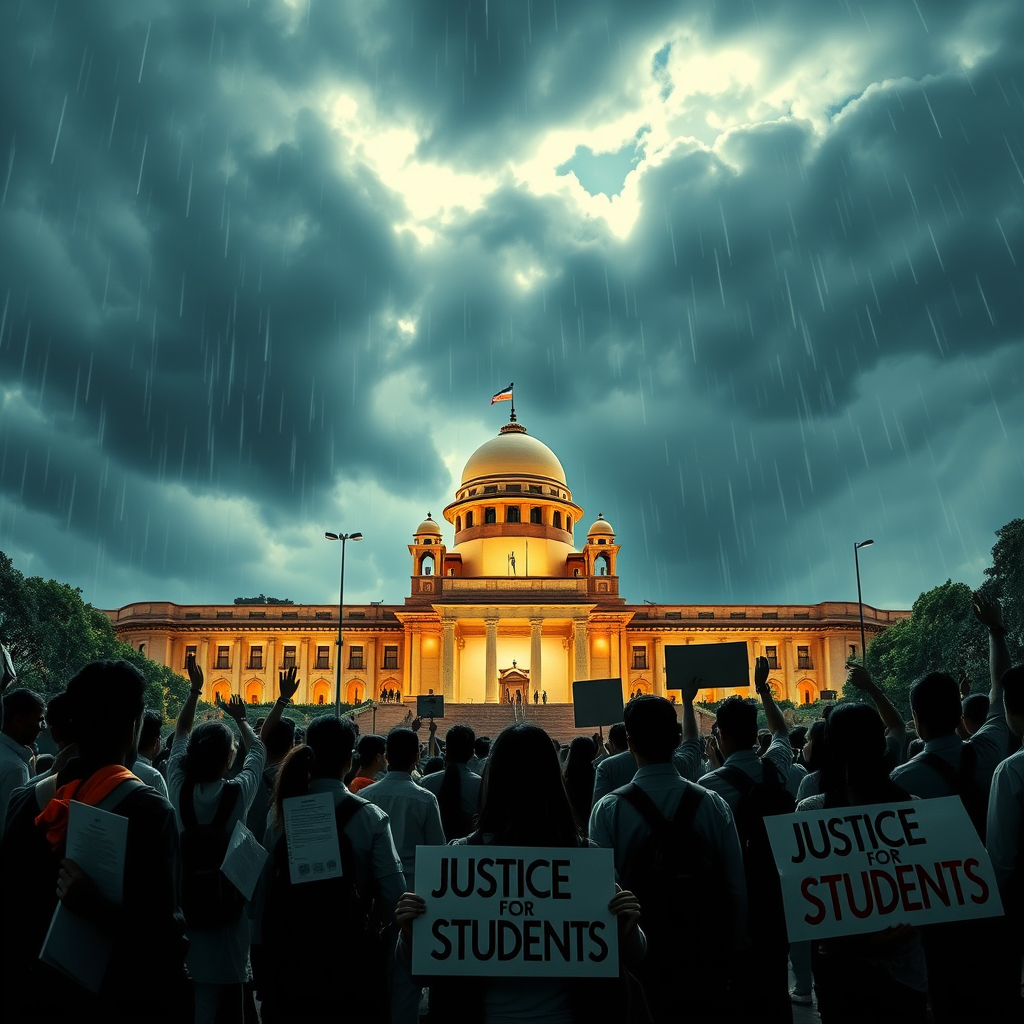
The Centre has agreed to discuss the NEET paper leak and student protests in Parliament after mounting nationwide demonstrations, but the Opposition insists any debate must begin with the resignation of Education Minister Dharmendra Pradhan. As Congress and other INDIA bloc MPs intensify protests, the controversy has evolved into one of the Modi government's biggest youth challenges, raising larger questions about examination reforms, accountability, and the handling of student dissent.
By Mahima Katal
New Delhi, July 22: The political fallout from the nationwide student protests over the alleged NEET paper leak intensified on Wednesday as the Centre indicated it was ready to discuss the issue in Parliament, while the Opposition insisted that any debate must begin with the resignation of Union Education Minister Dharmendra Pradhan.
AI Generated Image.
The standoff marks a significant escalation in what has become one of the Narendra Modi government's most serious youth-driven political challenges since 2014, with the protests evolving from a student movement into a broader confrontation over examination reforms, government accountability and police action against demonstrators.
Government Opens Door for Parliamentary Discussion
In his first detailed response since the protests gathered momentum, Education Minister Dharmendra Pradhan said the government remained committed to addressing students' concerns and reforming the examination system.
"Our government remains 100% committed to discussing NEET and addressing every genuine concern of our youth on the floor of the House," Pradhan said in a post on X.
He accused the Opposition of politicising the issue, stating that students "deserve far better than being treated as props in a political campaign."
Pradhan added that the government was committed to delivering "answers, reforms and accountability" following widespread anger over the alleged examination paper leaks.
His remarks came a day after Prime Minister Narendra Modi addressed the controversy for the first time, promising strict action against those responsible for examination leaks and calling for a foolproof examination system.
Health Minister J.P. Nadda also met representatives of the student-led Cockroach Janta Party (CJP) movement earlier this week, assuring them that the government would consider their demands.
Opposition Escalates Pressure
Despite the government's willingness to hold a discussion, Opposition parties intensified their protests inside and outside Parliament on Wednesday.
Congress MPs, dressed in black, staged demonstrations at the Parliament complex alongside MPs from several INDIA bloc parties, including the Samajwadi Party, demanding the resignations of Education Minister Dharmendra Pradhan and Home Minister Amit Shah.
The protests followed Tuesday's dramatic sit-in led by Leader of Opposition Rahul Gandhi outside the Prime Minister's residence, during which Gandhi, Priyanka Gandhi Vadra and several senior Opposition leaders were detained by Delhi Police before being released later in the day.
Congress leader Pawan Khera maintained that the Opposition would not settle for a discussion alone.
"Education Minister Dharmendra Pradhan must resign first, and then there will be discussion. After the lathi charge on so many students, what will be the discussion now?" he said.
According to government sources, the Centre has agreed in principle to a discussion in both Houses of Parliament. The procedural rule under which the debate will take place is expected to be decided by the Speaker after consultations with leaders of political parties.
Rahul Gandhi Lists Five Demands
Rahul Gandhi accused the government of exploiting students and failing to protect the integrity of India's examination system.
He demanded:
Resignation of Education Minister Dharmendra Pradhan.
Resignation of Home Minister Amit Shah.
Action against police officials involved in the crackdown on student protesters.
An apology from Prime Minister Narendra Modi.
Immediate reforms to India's examination and education systems.
In a video recorded while in police detention, Gandhi questioned the state of India's education system.
"Why is the Indian education system collapsing? Why are papers leaking? Why is education so expensive? These are legitimate questions."
He also urged Parliament to hold a full debate on the crisis.
From Satire to National Movement
The protests were initially launched by the self-described Cockroach Janta Party (CJP), a youth-led movement that began as an online satirical campaign following allegations surrounding the NEET examination paper leak.
What started as demonstrations involving a few hundred students has rapidly expanded into a nationwide movement attracting tens of thousands of protesters, particularly after clashes with Delhi Police earlier this week, when authorities used tear gas and batons to disperse demonstrators.
The movement has drawn support from environmental activist Sonam Wangchuk, whose hunger strike over education reforms and youth issues further amplified public attention before he was shifted to a private hospital following a Delhi High Court order.
Political Stakes Ahead
The controversy has emerged as one of the most politically sensitive issues confronting the Modi government in its third term.
Beyond allegations of examination irregularities, the protests have tapped into wider frustrations among young Indians over recurring paper leaks, unemployment, and concerns about fairness in competitive recruitment and admission processes.
For the Opposition, the issue has provided a rare opportunity to unite around a youth-centric campaign capable of mobilising first-time voters. For the BJP, which has traditionally enjoyed significant support among young voters, the challenge lies in balancing accountability with political damage control.
The BJP has accused Rahul Gandhi and the Congress of attempting to exploit student grievances for political gain and plans to organise protests outside Congress offices across the country in response to Tuesday's demonstrations.
A Defining Test for Education Reform
With the government signalling openness to parliamentary debate and the Opposition refusing to back down without ministerial accountability, the coming discussion in Parliament could become a defining moment in the national conversation on examination reforms.
Whether the debate results in structural changes to India's examination system, or remains another political confrontation, may determine how effectively the government can respond to growing youth discontent that has moved from campuses to the centre of national politics.