Supreme Court's Footage-Sharing Order Turns a Constitutional Right Into a Request
The Supreme Court's order gates footage-sharing behind two registrars' discretion, with no form, timeline or appeal specified, turning a right recognised in Swapnil Tripathi into something citizens must now request rather than exercise. Its own precedents placed the remedy at the point of judicial utterance, not audience restraint. By Mahima Katal New Delhi, Aug 1: The Supreme Court restricted what may be done with footage of its own hearings. A bench led by Chief Justice Surya Kant, sitting...
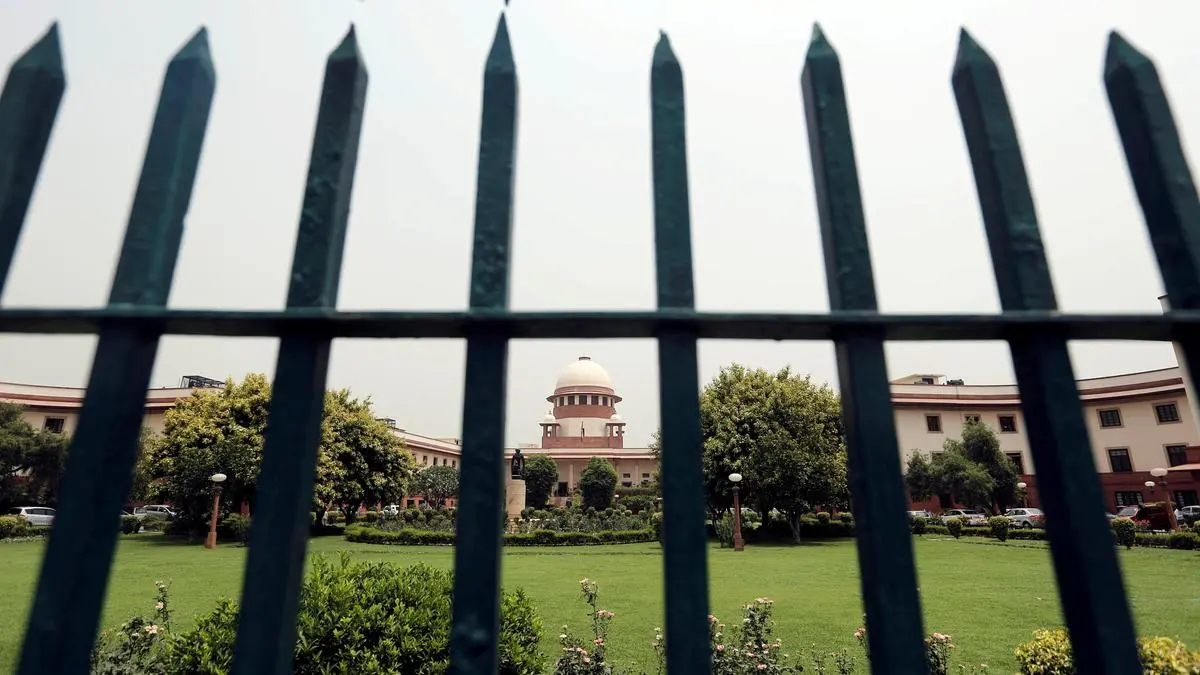
The Supreme Court's order gates footage-sharing behind two registrars' discretion, with no form, timeline or appeal specified, turning a right recognised in Swapnil Tripathi into something citizens must now request rather than exercise. Its own precedents placed the remedy at the point of judicial utterance, not audience restraint.
By Mahima Katal
New Delhi, Aug 1: The Supreme Court restricted what may be done with footage of its own hearings. A bench led by Chief Justice Surya Kant, sitting with Justices Joymalya Bagchi and V. Mohana, directed that live-streamed proceedings could not be extracted, modified, disseminated, reposted or monetised without prior permission from the Secretary General of the Supreme Court or the Registrar General of the relevant High Court.
The direction arose at the notice stage in a writ petition filed by journalist Harshita Grover, and the bench was careful to exempt news reporting from its reach. Justice Bagchi went further in remarks from the bench, suggesting that streaming ought to be treated as an exception rather than a default, and that those who wanted it should bear the cost. An institution that opened its proceedings to public view eight years ago is now asking, in effect, whether that opening should be qualified.
The right being narrowed did not arise on its own. In 2018, deciding a petition brought by law student Swapnil Tripathi, the Court held that access to live broadcast flows from the right of access to justice under Article 21, reinforced by Article 145(4)'s requirement that judgments be pronounced in open court. Watching, the Court said then, was not a privilege to be extended case by case but an entitlement grounded in the Constitution. What the July 24 order adds, without quite confronting the point, is a second question the 2018 judgment never had to answer: once a citizen has lawfully watched, on what basis may she be stopped from sharing what she saw.
That second question is not new to comparative jurisprudence, and the answer usually turns on whether the restriction takes the form of a standard or the form of an office. England offers the clearer comparison. The UK Supreme Court streams its own proceedings and releases the footage under a licence conditioned on fair and accurate reporting, a standard with a long common-law lineage, which a user can assess for themselves before publishing, with liability attaching afterward if they get it wrong. Nobody there queues for permission. The Indian order does the opposite: it names two offices, the Secretary General and the Registrars General, and asks citizens to approach them, without specifying a form, a timeline, criteria for grant or refusal, or any avenue of appeal. A standard can be met by everyone simultaneously. An office can only be approached one applicant at a time, and silence at that office will function as refusal, since anyone uncertain of their standing will simply choose not to publish rather than risk contempt.
This is precisely the asymmetry the sociologist Marc Galanter identified in his account of why repeat litigants tend to prevail over one-time claimants. A newsroom with a Delhi bureau will learn which registrar to approach within weeks and can absorb the delay of asking. A legal aid clinic in a smaller town, a students' collective, or an individual litigant will not have that institutional memory, and will not be prosecuted for failing to acquire it, they will simply stop circulating what they lawfully recorded. The cost of a permission counter rarely shows up as a denied application. It shows up as material that was never sought to be shared at all, which is why it goes unmeasured.
The exemption for news reporting does not resolve this so much as relocate it. India has no register of journalists and no licence to practise journalism, which means somebody must decide, on a case-by-case basis, who qualifies for the exemption. Under the terms of this order, that determination falls to a registrar, an institutional gatekeeper standing exactly where Swapnil Tripathi was meant to remove one. The litigants least likely to attract press attention in the first place, an undertrial whose bail plea is disposed of briskly, a person contesting a land acquisition years after the fact, are also the ones for whom a personal recording may be the only record their own hearing ever produces. Continuous streaming made such hearings visible for the first time; a permission requirement makes that visibility conditional again.
None of this is to say the underlying concern is manufactured. Selectively edited clips and decontextualised circulation are real problems, and the Court's own recent experience, video of an exchange concerning the Cockroach Janta Party protests travelling widely and, in the Chief Justice's account, without adequate context, illustrates why the bench felt compelled to act. But the Court has already ruled on the adjacent question of how such concerns should be addressed. In Chief Election Commissioner of India v. M.R. Vijayabhaskar (2021), asked to restrain reporting of oral remarks made from the Madras High Court bench, the Supreme Court declined, holding that free speech extends to reporting judicial proceedings and that off-the-cuff observations form no part of the judicial record, while also cautioning judges to weigh their own remarks with that reality in mind. The restraint prescribed there ran toward the bench, not the audience. Separately, in State of Uttar Pradesh v. Mohammad Naim (1963), the Court's remedy for an intemperate judicial observation was to expunge the observation itself, not to restrain those who had reported it. Both precedents locate the corrective at the point of utterance rather than the point of circulation.
There is also a question of process the July 24 order does not fully address. It was passed at the notice stage, before any respondent had filed a reply, in a petition that had arrayed the Union and the Bar Council of India but had not impleaded any social media platform or any High Court. The Court added Meta, X, and every High Court to the proceedings on the same day it issued the restriction, parties that were noticed but not yet heard. An interim direction of nationwide application, issued without the benefit of contest from those it binds, sits uneasily with the ordinary process by which such questions are usually settled.
What makes the current moment resolvable, at least in principle, is that the Court has already built machinery that could address the underlying grievance without a permission regime. The e-committee's Model Rules of 2021, on which the 2022 decision to stream Constitution Bench proceedings was based, treat streaming as the default and list narrow, enumerated exceptions, matrimonial and custody matters, sexual offences, POCSO and juvenile cases, in-camera hearings, and the recording of evidence. Reversing that presumption, as the July 24 order effectively does for reuse of the footage, requires more than a general reference to misuse; it requires reasons tied to a rate of harm, which the record so far does not appear to establish. If the concern is inaccurate circulation, the more targeted remedy, authenticated video, published transcripts, a mechanism for prompt correction, already has a template in the one-way WhatsApp service the Court launched from the bench in 2024, and could be built out rather than substituted with a licensing counter.
The Court has asked all twenty-five High Courts to report on what continuous streaming has cost them, and those responses will form the record on which the underlying question, how far streaming should extend, and on what terms it may be shared, is eventually decided. No citizen who watches those proceedings has been asked to contribute to that record. A right recognised in 2018 on constitutional reasoning may now be narrowed on the basis of institutional self-reporting, and an institution invited to audit its own exposure does not always find that exposure necessary.