That ‘Fat-Shamed’ Joke That May Strain U.S.-Canada Relations
Hegseth shared a photograph of the woman on X on Tuesday, placing a Canadian flag alongside the words “(this is real)”.
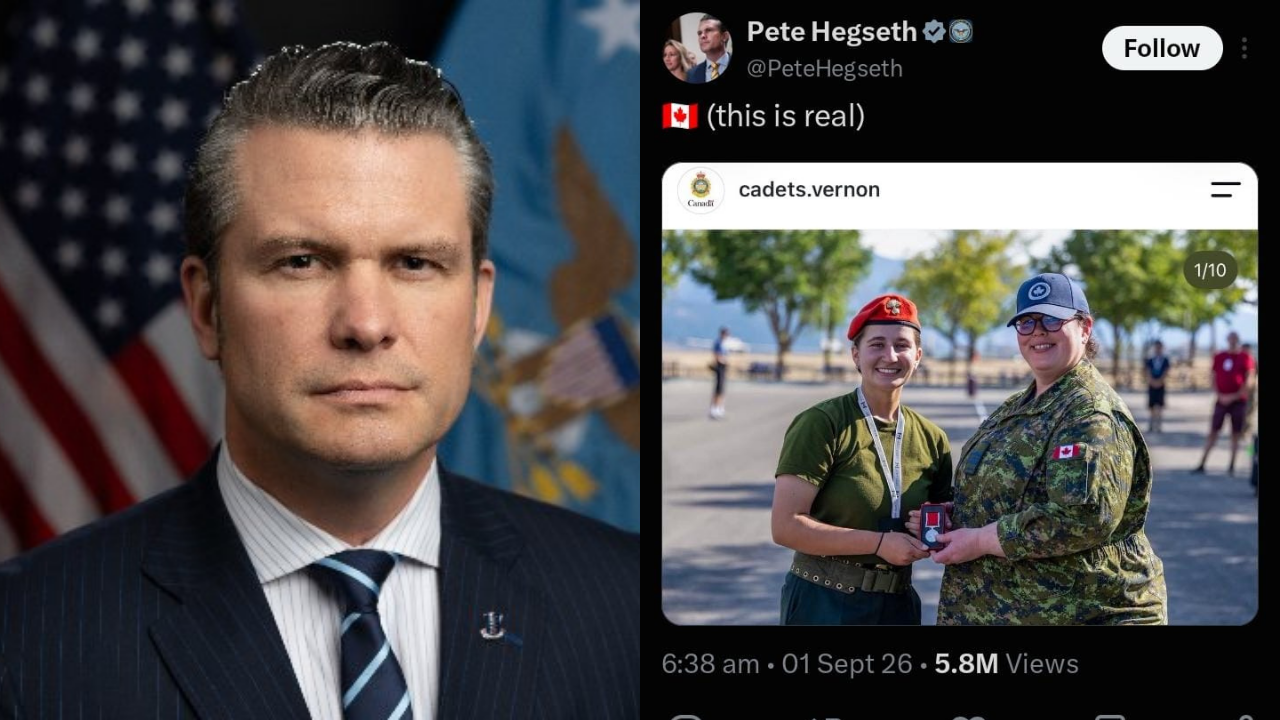
Hegseth shared a photograph of the woman on X on Tuesday, placing a Canadian flag alongside the words “(this is real)”.
By Sakshi
New Delhi, September 1: US Secretary of War Pete Hegseth drew attention by mocking the appearance of a uniformed Canadian woman in a social media post, adding another contentious moment to already strained US-Canada relations.
Hegseth shared a photograph of the woman on X on Tuesday, placing a Canadian flag alongside the words “(this is real)”. The image had originally been posted by the cadets.vernon Instagram account and showed the woman wearing Canadian military camouflage alongside another person dressed in cadet attire.
Hegseth did not explain what he meant by the post and did not explicitly refer to the woman’s weight. However, his post was interpreted as a weight-related jibe by social media users, particularly because of his repeated emphasis on physical fitness and his use of the phrase “fit not fat” while pushing for tougher standards in the US military.
The Canadian Cadet Instructors Cadre is part of the Canadian Armed Forces Reserve. According to Canada’s Department of National Defence, it has around 7,800 commissioned officers who are primarily responsible for the safety, supervision, administration and training of more than 52,000 cadets.
Hegseth did not explain what he meant by the post and did not explicitly refer to the woman’s weight. ( sourced from X)
Hegseth’s repeated ‘fit not fat’ message
Physical fitness and weight have been recurring themes in Hegseth’s efforts to introduce stricter standards across the US military.
While speaking to military leaders at the US Army War College in April 2025, Hegseth said troops needed to be “fit not fat, sharp not shabby” as he discussed a force-wide review of fitness, training and physical standards.
His remarks became even more direct in September 2025 during a gathering of senior US military commanders at Quantico.
Hegseth criticised what he described as overweight generals and admirals at the Pentagon and also complained about seeing “fat troops” in military formations.
Following those remarks, the Pentagon issued new guidance covering physical fitness and grooming standards.
Hegseth continued to use similar language in 2026. In February, he praised the US Army on X, writing: “Merit-based & Fit NOT Fat.” Later, while addressing graduating cadets at West Point in May, he again said: “You're fit, not fat. You are disciplined, not distracted.”
His latest post involving the Canadian cadet comes at a particularly sensitive point in relations between Washington and Ottawa, as the two countries remain locked in an escalating trade dispute while disagreements over Canadian sovereignty add to the friction.
Trade talks collapse as tariffs rise
Trade negotiations between the US and Canada broke down in late August after Canada rejected last-minute US terms and suspended the talks.
The United States subsequently imposed 50% tariffs on C$27.6 billion worth of Canadian goods. The Trump administration has accused Canadian policies of discriminating against US businesses, including in the automobile and dairy sectors, and imposed the duties under Section 338 of the Tariff Act of 1930.
Canada has rejected Washington’s argument
Prime Minister Mark Carney described the last-minute changes to the US proposal as “unfair, uneconomic”, saying they raised questions about the reliability of any agreement. Carney also said Ottawa would not accept terms that could undermine Canadian interests and sovereignty.
Automobiles and wider questions surrounding Canada’s ability to make independent decisions on trade and domestic policy have emerged as key points of disagreement.
Canada prepares retaliatory tariffs
The trade dispute is now set to move into another phase. From September 8, Canada will impose retaliatory tariffs of 15%, 25% and 50% on C$27.6 billion worth of US imports.
The measures will cover hundreds of American products, including steel, dairy, household appliances, agricultural equipment, pulp and paper, and electronics. Ottawa says the countermeasures will match the US tariffs dollar for dollar.
The economic stakes are significant. The US and Canada traded nearly $880 billion worth of goods and services in 2025, while around 72% of Canadian goods exports went to the US.
The two economies are particularly interconnected in the automobile sector, where vehicles and components frequently cross the border during the manufacturing process. At the same time, Carney has been pushing to reduce Canada’s dependence on the US market by expanding trade ties elsewhere.
Trump’s rhetoric adds sovereignty concerns
The tensions extend beyond tariffs and trade.
US President Donald Trump has repeatedly suggested that Canada could become the 51st US state, remarks that Canadian leaders have rejected and which have added a sovereignty dimension to the economic dispute.
The rhetoric took another turn on August 27, when Trump signed an executive order directing the US government to rename Lake Ontario “Lake America.” The order instructs the US interior secretary and the Board on Geographic Names to update federal references to the lake.
However, the change applies only to US federal usage and does not determine what Canada or international bodies call the lake.
With Canada’s retaliatory tariffs scheduled to take effect on September 8 and trade negotiations still suspended, Hegseth’s post has landed at a particularly sensitive moment in the relationship between the two neighbouring countries.