The FIR Against Rahul Gandhi Tests How Far Political Speech On Caste Can Go
An FIR against Rahul Gandhi over his Haldwani "purification" remarks tests two contested claims at once: whether his speech is protected, and whether his own untouchability allegation can be factually justified. By Mahima Katal New Delhi, Aug 31: An FIR registered against Leader of Opposition Rahul Gandhi at Haldwani's Kotwali police station on Sunday night has turned a localised political dispute over a "purification" ritual into a sharper question of law: how the state treats political...
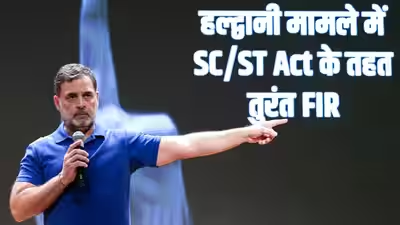
An FIR against Rahul Gandhi over his Haldwani "purification" remarks tests two contested claims at once: whether his speech is protected, and whether his own untouchability allegation can be factually justified.
By Mahima Katal
New Delhi, Aug 31: An FIR registered against Leader of Opposition Rahul Gandhi at Haldwani's Kotwali police station on Sunday night has turned a localised political dispute over a "purification" ritual into a sharper question of law: how the state treats political speech that alleges caste discrimination, and how far an allegation of discrimination can itself go before the person accused of discriminating has a legal remedy of their own.
The facts are layered, and each side has offered a different account of intent. On August 8, Kharge addressed a public gathering at Ramlila Maidan in Haldwani. Two days later, members of the Shri Ram Sena Dharmarth Seva Nyas Sangathan performed a havan at the venue. The organisation has given two justifications for it: that the ground needed cleaning after the rally, and separately, that the ritual was a response to slogans raised by Congress workers and to an earlier remark in which Kharge compared the BJP and RSS to a poisonous snake. Kharge told the Rajya Sabha the ritual made him feel the sting of untouchability and demanded cases under untouchability law against those involved. Gandhi repeated and sharpened that framing at an August 29 press conference in Delhi, calling the act "untouchability" and "a criminal offence", and it is this characterisation, not the ritual itself, that has now drawn a criminal complaint.
The complainant, Amit Kumar, a resident of Jawahar Nagar Colony in Haldwani and a member of the Shriram Sena Dharmarth Seva Samiti, identifies himself as belonging to the Scheduled Caste community. He alleges Gandhi gave a caste angle to what he describes as routine cleaning work, and used "caste-indicative and insulting words" against the Scheduled Caste community based on false and incomplete facts, inciting hostility within it. Nainital SSP T C Manjunath confirmed the FIR's registration, saying Kumar had submitted evidence to substantiate the allegations; ASP Amit Saini has been assigned to investigate. The FIR invokes Sections 196 and 299 of the Bharatiya Nyaya Sanhita, promoting enmity between groups, and deliberate acts intended to outrage religious feelings, along with Section 3(1)(q) of the Scheduled Castes and Scheduled Tribes (Prevention of Atrocities) Act, 1989.
The SC/ST Act invocation is legally unusual, but not, on inspection, absurd. Section 3(1)(q) penalises intentionally insulting or intimidating a Scheduled Caste or Scheduled Tribe member with intent to humiliate them in public view. The Act was drafted to shield SC/ST individuals from atrocities by persons outside those communities, and courts have generally required that the alleged act target a person specifically because of caste identity, with intent traceable to the accused. That threshold is harder to establish here because Gandhi's stated intent was to allege discrimination against Dalits, not commit it, but intent under the Act is a question of fact, not merely of stated purpose, and Kumar's complaint is at minimum an assertion that Gandhi's broad-brush characterisation of "those who conducted the ritual" swept in Scheduled Caste participants who did not share the alleged motive, and branded their conduct as caste hatred without individualised basis. Whether that assertion holds will turn on whether Gandhi's remarks named or clearly implicated Kumar and others like him, or spoke only to the ritual's organisers as a body, a distinction the press conference record, not yet public in full, will have to settle.
The BNS provisions raise a separate, more familiar tension. Speech by an opposition leader characterising a ritual as casteist is core political speech, and both the enmity-between-groups and outraging-religious-feelings provisions have drawn judicial caution over the years for their potential to criminalise political criticism rather than genuine incitement. The Supreme Court's 2023 ruling in Kaushal Kishor v. State of U.P. held that even ministers' public statements, however provocative, do not by themselves constitute a fresh, independent restriction on speech beyond Article 19(2), a principle that would extend to an opposition leader's remarks. But that principle protects the right to make an accusation; it does not certify the accusation's accuracy. If Gandhi's claim that the ritual amounted to "untouchability" rests on characterising a havan, a religious act with its own claimed, if contested, motivations, as inherently discriminatory, that is itself a factual claim capable of being wrong, and the BNS provisions on outraging religious feelings exist, in part, to test claims of that kind rather than only political ones about caste.
The Congress's response, framing the FIR as evidence of a BJP-RSS "anti-Dalit and anti-Constitution" mindset, is a characterisation this article does not adopt. Nor does it adopt the inverse reading, sometimes offered by the FIR's supporters, that Gandhi's remarks were a bad-faith political attack. Both readings assume a settled answer to what is, at this stage, a disputed question of fact: what the ritual's true purpose was, and what precisely Gandhi's remarks accused whom of. What is verifiable is only the sequence, the ritual, Kharge's Rajya Sabha statement, Gandhi's press conference, and then the Haldwani FIR, and the asymmetry that no case has yet been registered against those who conducted the ritual, a fact that is relevant to the politics of the dispute but does not by itself resolve the legal question of whether Kumar's complaint discloses an offence.
That asymmetry does not establish bad faith in the police's decision to register Kumar's complaint, magistrates and station house officers have limited discretion to refuse cognisable-offence complaints at the intake stage, and quashing, where warranted, is ordinarily a matter for the high court under Section 528 of the Bharatiya Nagarik Suraksha Sanhita. The more consequential legal test will not be the FIR itself. It will be whether the allegations, taken at their highest, disclose the ingredients of Sections 196, 299 BNS and 3(1)(q) of the SC/ST Act, and, just as much, whether a parallel complaint against the ritual's organisers, if filed, would clear the same bar. Both questions turn on the same underlying dispute: whether a religious ritual performed after a Dalit leader's rally was an act of caste hostility, a case of poor political judgment, or neither, a determination the Uttarakhand High Court, not a press conference or a press release, will ultimately have to make.