The Jantar Mantar Question Nobody Wants to Answer Directly
Jantar Mantar's real significance was never about infrastructure, it's proximity to Parliament that gives protest its power. The Supreme Court will examine the relocation plea on access and traffic grounds, but the petition itself doesn't raise that harder question. By Mahima Katal New Delhi, Aug 3: There's a particular kind of legal challenge that looks procedural on the surface and constitutional underneath, and the PIL the Supreme Court agreed to examine on Monday is exactly that kind. On...
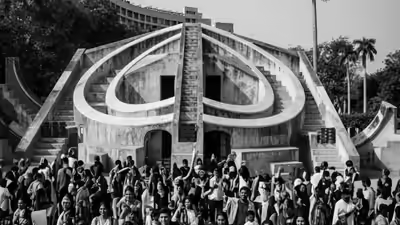
Jantar Mantar's real significance was never about infrastructure, it's proximity to Parliament that gives protest its power. The Supreme Court will examine the relocation plea on access and traffic grounds, but the petition itself doesn't raise that harder question.
By Mahima Katal
New Delhi, Aug 3: There's a particular kind of legal challenge that looks procedural on the surface and constitutional underneath, and the PIL the Supreme Court agreed to examine on Monday is exactly that kind. On paper, it's a petition about traffic.
Satish Chand Kaushik wants Jantar Mantar taken off the map as Delhi's default protest site, on the grounds that its narrow lanes can no longer absorb the ingress and egress demands of sustained demonstrations, let alone guarantee that ambulances and essential supplies move through unimpeded. Read charitably, it's a genuine urban-logistics complaint. Read less charitably, it's an attempt to get the judiciary to do, through a venue-relocation order, what would otherwise require the far messier business of actually managing protests as they happen.
What struck me watching this unfold is how carefully the bench — led by the Chief Justice, alongside Justices Joymalya Bagchi and V Mohana — avoided collapsing those two readings into one. The Court took the access argument seriously enough to issue notice and ask the Solicitor General to return with instructions, which is not nothing; it means the judiciary is willing to entertain the idea that a protest site's physical geography can become a legitimate constraint on how the right to assemble gets exercised. But the moment counsel tried to pull a live, unrelated controversy into the same frame — invoking Arvind Kejriwal's planned march to the Prime Minister's residence and warning against "another July 20 incident" — the bench drew a hard line. The CJI's response was almost curt: the authorities know how to handle it, and the Court will step in only if they don't. No comment on the march itself. No preview of how it should be policed.
That refusal is the most analytically interesting part of the hearing, more than the PIL's actual substance. It would have been easy for the Court to fold a structural venue question and a specific, time-bound political event into one sweeping observation about protest management in the capital, plenty of benches have done exactly that, using a narrow petition as a springboard for broader commentary. This one didn't. It kept the venue question narrow and procedural, and kept the Kejriwal march entirely outside its remit, unless and until something actually goes wrong. If you're inclined to read judicial temperament into hearing transcripts, this is a bench being deliberately careful not to let itself get used as a pre-emptive traffic cop for a protest that hasn't happened yet.
The harder question, which nobody in the courtroom really engaged with because it's genuinely difficult, is what an "alternative" protest site would even mean in practice. Jantar Mantar's significance isn't incidental to its location, it's a five-minute walk from Parliament, which is precisely why it has functioned as the default grievance-airing ground since long before this PIL existed. A protest site's power is largely a function of its proximity to power. Relocate the demonstrations somewhere with better traffic flow and you may solve the ingress-egress problem while quietly defanging the entire point of protesting there in the first place, proximity is the message, not a logistical inconvenience to be engineered around.
Whether the Solicitor General's eventual instructions grapple with that trade-off, or simply treat this as a traffic-management exercise, is what will actually determine whether this PIL becomes a meaningful precedent on the right to assemble or a footnote about municipal planning that happened to reach the Supreme Court.
For now, the matter is listed separately, and the real fight, over what "alternative arrangement" could possibly substitute for a location's political meaning, hasn't started yet.