The Politics Behind Vande Mataram's Four Missing Stanzas
A 150-year-old poem is currently one of the hottest fights in Indian politics. Here's why. By Mahima Katal New Delhi, Aug 21: This week, the Congress Working Committee (CWC) reaffirmed that the party will keep singing only the first two stanzas of Vande Mataram, India's National Song, at its own events. The BJP called that decision "anti-national." The Congress called the BJP's framing an insult to Gandhi, Nehru, and Tagore. Somehow, a song written in 1875 is now front and centre of a 2026...
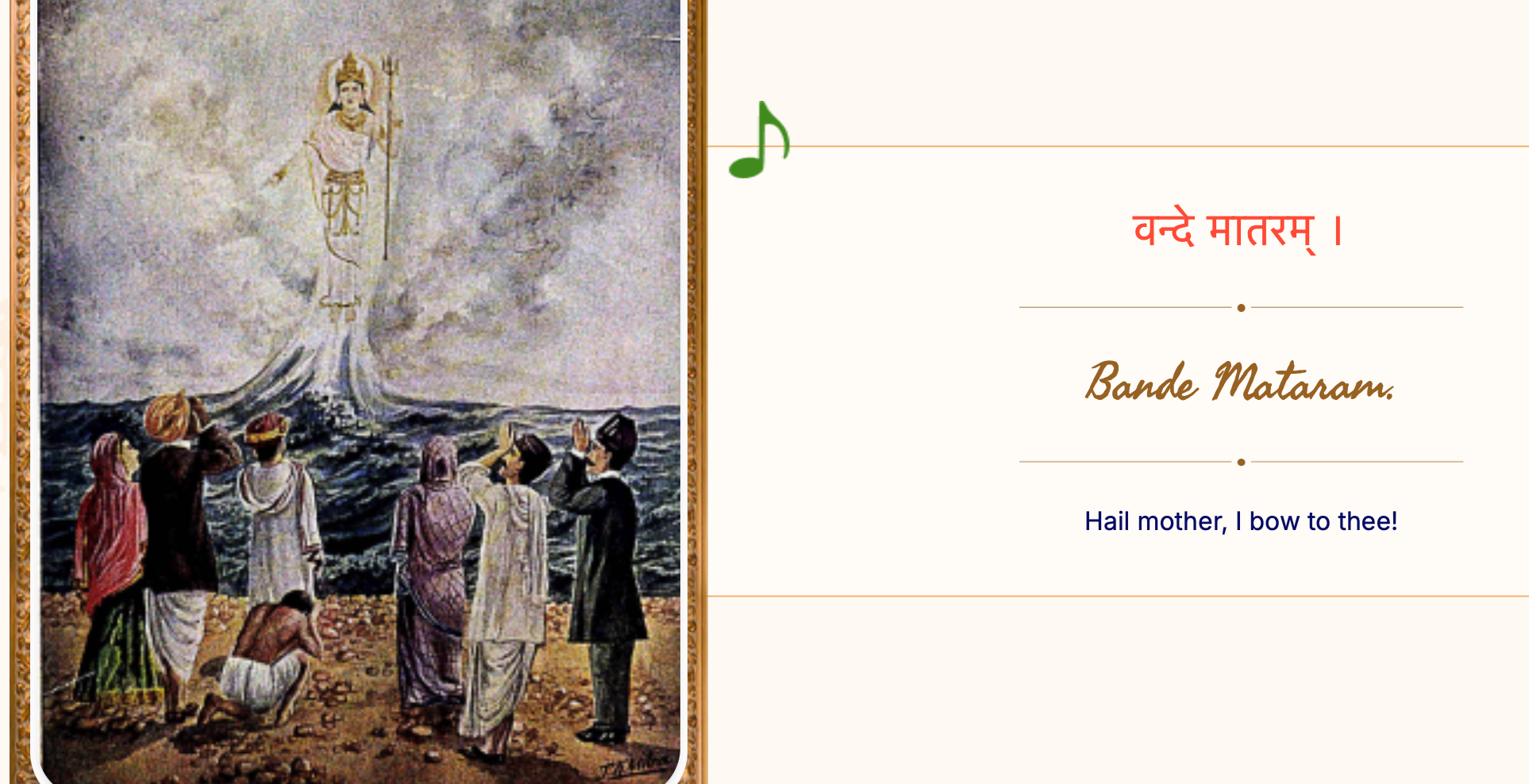
A 150-year-old poem is currently one of the hottest fights in Indian politics. Here's why.
By Mahima Katal New Delhi, Aug 21: This week, the Congress Working Committee (CWC) reaffirmed that the party will keep singing only the first two stanzas of Vande Mataram, India's National Song, at its own events. The BJP called that decision "anti-national." The Congress called the BJP's framing an insult to Gandhi, Nehru, and Tagore. Somehow, a song written in 1875 is now front and centre of a 2026 political slugfest.
To actually understand what's going on, you need to go back nearly a century, to a decision the Congress made in 1937, and to a debate about religion, nationalism, and who gets to define what "India" sounds like.
The song, quickly
Vande Mataram was written by Bengali writer Bankim Chandra Chattopadhyay in 1875, and later folded into his 1882 novel Anandamath, a story about an armed uprising against colonial and regional Muslim rule in 18th-century Bengal. The song imagines the motherland as a goddess-like figure worthy of devotion, and it became one of the most powerful rallying cries of the freedom movement, especially during the Swadeshi movement of the early 1900s.
The full song has six stanzas. Only the first two are widely known and commonly sung today. The other four are the source of the entire current controversy.
What's actually in the missing four stanzas
The first two stanzas describe the motherland in secular, almost pastoral terms, her rivers, her fields, her beauty. Nothing religious about them.
From the third stanza onward, that changes. The song starts describing the motherland in explicitly Hindu religious terms, as a warrior goddess with countless arms ready for battle, worshipped in every shrine, and directly likened to Durga, Lakshmi, and Saraswati. Historian Tanika Sarkar has described the later portion as effectively a call to war in which Muslims are cast as the adversary within the novel's plot, with the motherland taking the form of a Hindu deity that many Muslims can't relate to as a national symbol.
Here's what that actually sounds like. The fifth stanza, in the original Sanskritised Bengali, reads:
"Tvam hi Durgā daśa-praharaṇa-dhāriṇī, Kamalā kamala-dala-vihāriṇī, Vāṇī vidyā-dāyinī, Namāmi tvām namāmi kamalām"
Roughly: "You are Durga, bearing ten weapons; you are Lakshmi, who dwells upon the lotus; you are Saraswati, the giver of knowledge; I bow to you, I bow to you."
That's not a metaphor in passing, it's a direct, sustained address to three named Hindu deities, asking the reader to bow. That's the actual crux of the objection: it's not that the poem exists, or that it's disrespectful, it's that a song meant to represent every Indian, regardless of religion, spends two-thirds of its length worshipping specifically Hindu goddesses by name. For a country founded on secular, plural nationalism, that's a real tension, not just a manufactured one.
Why 1937, specifically
By the 1930s, Vande Mataram was already central to Congress gatherings, but so were objections to it. The Muslim League opposed several of its references and argued that "bowing" to the motherland amounted to idolatry, which conflicts with Islam's monotheism.
The Congress leadership took the disagreement seriously enough to consult Rabindranath Tagore, who had actually set the song to music years earlier and had his own attachment to it. Tagore's advice, in a letter to Nehru just before the party's October 1937 Working Committee meeting, was that the first portion of the poem could stand on its own: its tenderness toward the motherland didn't need the rest of the poem to carry meaning, even though he acknowledged the later stanzas, read in context, could reasonably offend Muslim sentiment.
On that basis, the CWC, meeting in Kolkata with Gandhi, Nehru, Patel, Subhas Chandra Bose, Rajendra Prasad, Maulana Azad and others in the room, passed a resolution limiting official renditions to the first two stanzas, on the grounds that the later portions carried religious content that didn't sit well with India's other religious communities.
Gandhi backed the same position. Writing in Harijan in 1939, he said he'd never thought of the song as belonging only to Hindus, but that he wouldn't push for it to be sung anywhere its presence caused a genuine quarrel.
Why it's a fight again now
Two things collided this year. First, Parliament passed an amendment giving Vande Mataram the same legal protection as the National Anthem, meaning disrupting its singing is now technically an offence. Around the same time, the central government issued its own protocol for official functions, specifying that all six stanzas should be sung, a break from the two-stanza convention Congress has followed for decades.
So when Congress leaders, including party president Mallikarjun Kharge, sang only the first two stanzas at party events this Independence Day, the BJP seized on it, accusing Congress of reviving "appeasement politics" and tying the 1937 decision to the seeds of Partition itself.
Congress's response has been to point straight back at the historical record: the two-stanza version isn't a new position, it's the one Gandhi, Nehru, Patel and Vajpayee all sang for decades, and it was Tagore — not political expediency — who first suggested the trim.
The actual stakes
Strip away the party slogans, and this isn't really a fight about a song. It's a fight about which story of Indian nationalism gets to be the "real" one: a pluralist compromise built by the same leaders who won independence, or a purity narrative in which any accommodation of religious difference is recast as a historical mistake.
Both sides are reaching for the same set of freedom-movement icons – Gandhi, Nehru, Tagore, Bose, to make opposite arguments. That's usually a sign the fight was never really about the past. It's about who controls it. Which raises the harder question underneath the political noise: the 1937 trim was a compromise built for a specific moment, a fractured, pre-independence coalition trying to hold itself together. Nearly ninety years on, with the full song now carrying the same legal weight as the National Anthem, is that still the right compromise, or does an independent, constitutionally secular India owe the song, and the debate it provoked, a fuller reading than convention has allowed?