The Public Examinations Amendment Bill, 2026 Explained: What It Means for Students, Coaching Centres and Exam Authorities
The Public Examinations (Prevention of Unfair Means) Amendment Bill, 2026 seeks to strengthen India's anti-cheating law by introducing stricter penalties, fast-track courts, enhanced cybersecurity and greater accountability for examination authorities. The proposed reforms aim to curb paper leaks, dismantle organised cheating networks and restore public confidence in competitive examinations. By Mahima Katal Seeking to reinforce the integrity of public examinations, the Union government on...
The Public Examinations (Prevention of Unfair Means) Amendment Bill, 2026 seeks to strengthen India's anti-cheating law by introducing stricter penalties, fast-track courts, enhanced cybersecurity and greater accountability for examination authorities. The proposed reforms aim to curb paper leaks, dismantle organised cheating networks and restore public confidence in competitive examinations.
By Mahima Katal
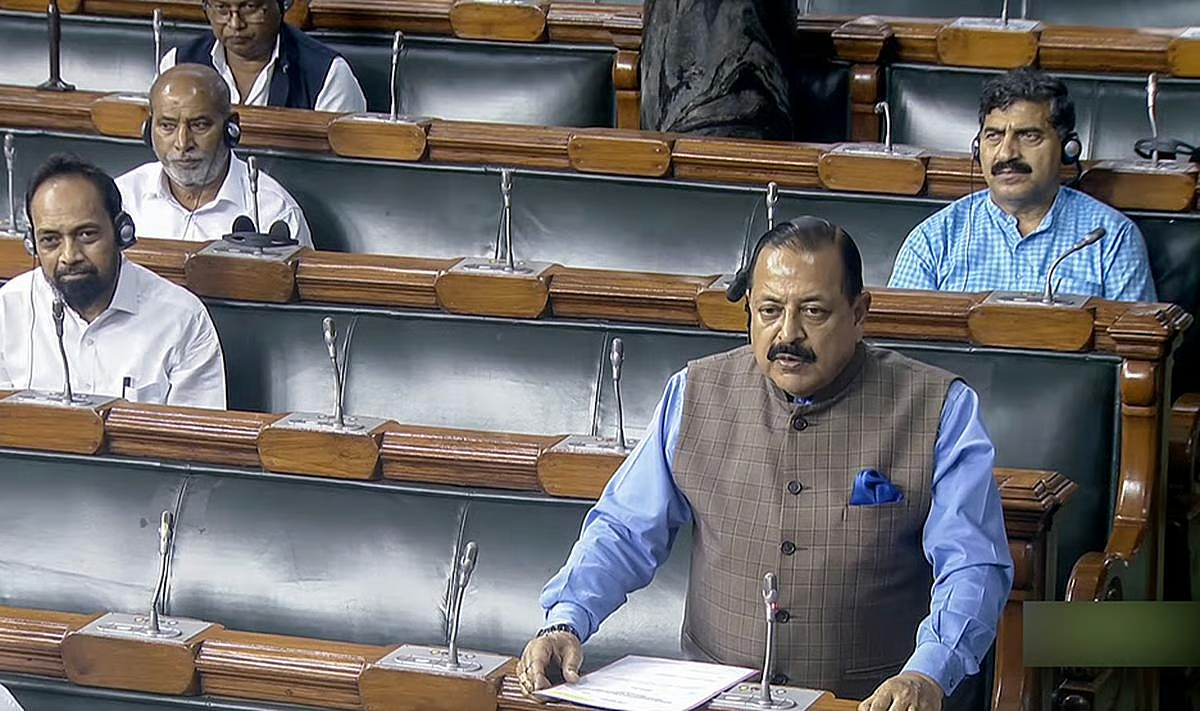
Seeking to reinforce the integrity of public examinations, the Union government on Monday tabled the Public Examinations (Prevention of Unfair Means) Amendment Bill, 2026 in the Lok Sabha. Introduced by Minister of State for DoPT Jitendra Singh, the proposed legislation aims to strengthen the existing anti-cheating law through tougher punishments, faster trials and stricter accountability for examination authorities.
The proposed amendment goes beyond increasing punishments. It seeks to improve the security of public examinations through faster investigations, stronger institutional accountability, better digital safeguards and quicker prosecution of offences. If enacted, the law is expected to have significant implications for students, coaching centres, examination authorities and service providers associated with public examinations.
Why the Amendment Has Been Proposed
The Public Examinations (Prevention of Unfair Means) Act, 2024 was enacted to criminalise unfair practices in public examinations. However, repeated incidents of paper leaks in recruitment examinations and entrance tests, culminating in the NEET-UG 2026 controversy, exposed weaknesses in enforcement and investigation.
Several recruitment examinations have had to be cancelled or postponed over the past few years due to allegations of organised cheating and question paper leaks, causing hardship to lakhs of candidates and delaying appointments. The proposed amendment seeks to strengthen the existing law by making investigations faster, punishments stricter and examination agencies more accountable.
Key Changes Proposed
One of the most significant proposals is the establishment of special fast-track courts to deal exclusively with paper leak and examination fraud cases. The objective is to ensure that investigations and trials are completed within a reasonable time so that recruitment and admission processes are not indefinitely delayed.
The amendment also seeks to enhance punishments for individuals and organised criminal syndicates involved in examination fraud. By imposing harsher imprisonment terms and higher financial penalties, the government aims to create a stronger deterrent against paper leaks and organised cheating.
Recognising that examination fraud is often carried out by organised criminal networks rather than isolated individuals, the proposed legislation strengthens provisions relating to investigation and prosecution of such syndicates. It seeks to cover offences such as question paper leaks, impersonation, candidate substitution, digital hacking and other forms of examination fraud carried out for financial gain.
Another important feature of the amendment is its emphasis on digital security. The government proposes stronger cybersecurity measures, including encrypted handling and transmission of question papers, secure digital infrastructure and enhanced protection of confidential examination data. These measures are intended to reduce vulnerabilities before examinations are conducted.
The amendment also introduces greater accountability for examination authorities, service providers and officials responsible for maintaining the integrity of public examinations. Institutions found negligent in ensuring examination security may face legal consequences.
Existing Legal Framework
The Public Examinations (Prevention of Unfair Means) Act, 2024 already contains several stringent provisions aimed at preventing examination malpractice.
The law defines unfair means broadly to include question paper leaks, unauthorised access to answer keys, impersonation, tampering with computer systems, manipulation of merit lists, fake examination websites, fraudulent admit card schemes and assisting candidates through illegal means.
Individuals found guilty of such offences may face imprisonment ranging from three to five years along with a fine of up to ₹10 lakh.
The Act also places strict liability on service providers such as technology vendors, printing agencies and infrastructure partners involved in conducting examinations. If found responsible for security breaches, they may be fined up to ₹1 crore, required to bear the cost of re-conducting examinations and barred from participating in public examinations for four years.
Senior officials, directors and managers who knowingly participate in examination fraud may face imprisonment ranging from three to ten years and fines up to ₹1 crore.
The law further classifies organised paper leak syndicates as organised crime, punishable with imprisonment between five and ten years and a minimum fine of ₹1 crore. The proposed amendment is expected to strengthen these provisions further.
Institutions and commercial coaching centres found involved in organised cheating may also face attachment of property, forfeiture of assets and recovery of costs incurred in conducting fresh examinations.
All offences under the Act are cognisable, non-bailable and non-compoundable. Investigations are required to be conducted by police officers not below the rank of Deputy Superintendent of Police or Assistant Commissioner of Police, with provision for transferring appropriate cases to central investigating agencies such as the CBI.
Impact on Students
For students, the amendment is intended to ensure a fairer and more transparent examination system. If effectively implemented, it could reduce the incidence of paper leaks, strengthen merit-based selection and minimise repeated cancellation of examinations.
Candidates may, however, witness stricter identity verification procedures and enhanced security measures at examination centres as authorities seek to prevent impersonation and other forms of malpractice.
Impact on Coaching Centres
The proposed law sends a strong message to coaching institutes and commercial establishments that facilitate organised cheating or examination fraud.
While legitimate coaching institutions are unlikely to be affected, organisations found participating in paper leak networks or assisting organised cheating may face criminal prosecution, attachment of property and recovery of financial losses arising from cancelled examinations.
Impact on Examination Authorities
The amendment also places greater responsibility on examination bodies such as the National Testing Agency and various recruitment agencies.
Authorities may be required to strengthen cybersecurity infrastructure, improve encryption systems, adopt secure question paper management protocols, conduct regular security audits and maintain comprehensive digital audit trails. Greater coordination with law enforcement agencies is also expected to become an integral part of examination administration.
Challenges in Implementation
Although the proposed amendment strengthens the legal framework, its effectiveness will ultimately depend on implementation.
Organised criminal syndicates involved in paper leaks continue to adopt increasingly sophisticated methods. Insider involvement remains difficult to detect, while evolving cybersecurity threats require continuous technological upgrades. Effective coordination between central agencies, state governments, police authorities and examination bodies will be essential.
The success of fast-track courts will also depend upon adequate judicial capacity and timely investigations. At the same time, authorities will have to ensure that genuine candidates are not unfairly inconvenienced during investigations or re-examinations.
Conclusion
The Public Examinations (Prevention of Unfair Means) Amendment Bill, 2026 represents one of the government's strongest legislative responses to recurring examination scandals in recent years. Alongside the recently announced Nandan Nilekani-led task force on examination reforms, it reflects a broader effort to rebuild confidence in India's public examination system through stronger laws and improved technology.
Whether these reforms succeed will depend not only on the severity of punishments prescribed by law but also on consistent enforcement, institutional accountability and the ability of authorities to stay ahead of organised examination fraud. For millions of students whose academic and professional futures depend on competitive examinations, the credibility of the examination system remains the ultimate measure of success.