Trump calls Mecca defence pact "big, bold" step — here's what India said
Trump called the Saudi-Turkey-Pakistan Mecca Joint Defence Agreement a "big, bold" step, praising regional unity. India said it is assessing the pact's national security implications. Experts note it could complicate India-Pakistan confrontations, though analysts stress it doesn't extend Pakistan's nuclear deterrent, and Saudi Arabia denies it forms a military axis. By Mahima Katal New Delhi, Aug 17: US President Donald Trump has welcomed the Saudi Arabia-Turkey-Pakistan defence agreement,...
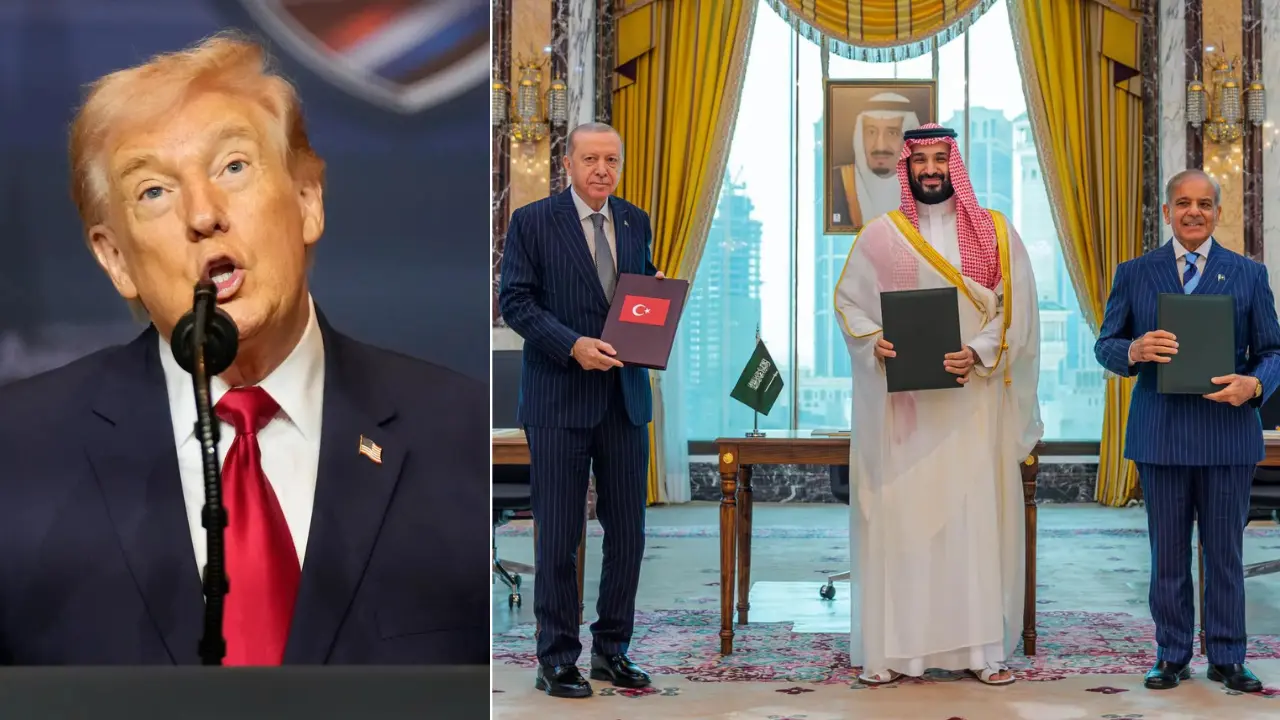
Trump called the Saudi-Turkey-Pakistan Mecca Joint Defence Agreement a "big, bold" step, praising regional unity. India said it is assessing the pact's national security implications. Experts note it could complicate India-Pakistan confrontations, though analysts stress it doesn't extend Pakistan's nuclear deterrent, and Saudi Arabia denies it forms a military axis. By Mahima Katal
New Delhi, Aug 17: US President Donald Trump has welcomed the Saudi Arabia-Turkey-Pakistan defence agreement, calling it a "big, bold, and important first step" toward the three nations defending themselves more effectively. In a Truth Social post on Sunday, Trump said the signing showed the Middle East "coming together" and credited the leadership of the three countries.
The Mecca Joint Defence Agreement was signed on 7 August by Saudi Crown Prince Mohammed bin Salman, Turkish President Recep Tayyip Erdogan and Pakistan Prime Minister Shehbaz Sharif at Al-Safa Palace in Mecca. The agreement establishes a collective security framework providing that an armed attack against any one of the three countries will be treated as an attack against all three, with high-level consultations to determine the nature, scale and form of military or strategic support in the event of an attack. The alliance will also set up a committee of ministers and a permanent General Secretariat based in Saudi Arabia.
India has responded cautiously. External Affairs Ministry Spokesperson Randhir Jaiswal said on 11 August that New Delhi is examining the agreement's implications for both national security and regional peace and stability, and that India would take necessary measures to safeguard its interests.
Experts have said the pact could complicate a future India-Pakistan military confrontation, with the view that a limited Indian military strike against Pakistan including cross-border counter-terrorism operations could technically allow Islamabad to seek support from its treaty partners under the agreement.
However, defence analyst Mansoor Ahmed of the Australian National University's Strategic and Defence Studies Centre has said Pakistan's nuclear posture remains oriented toward the perceived threat from India, and that the pact is better understood as a framework for regional security and defence cooperation rather than an extension of Pakistan's nuclear deterrent to its new partners.
Saudi Arabia has sought to pre-empt a starker reading of the pact. In a separate statement, the kingdom said the arrangement does not amount to a military axis or a religious bloc, is not linked to nuclear activity or an arms race, and is aimed instead at building "sustainable self-reliant capabilities" without affecting its existing strategic relationships in the Gulf, Arab world and internationally.
The Mecca pact builds on an existing bilateral foundation: Saudi Arabia and Pakistan signed a Strategic Mutual Defence Agreement in September 2025, to which India's response at the time was similarly measured, the MEA said it would study the pact's implications for national security and regional stability. That pattern of calibrated, non-alarmist public statements has now repeated with the trilateral expansion.