Twelve Years of Transformation: Achievements, Challenges and the Next Frontiers of Governance
The first twelve years strengthened the architecture of the Indian state. The next twelve years must transform the quality of Indian life. Future governance must focus on equity, innovation, skills, employment and sustainability to achieve the goal of Viksit Bharat. By Arun Kumar Mehta As India reflects on twelve years of Prime Minister Narendra Modi's government, it is time not only to celebrate what India has achieved but also to reflect on what it must do to truly become a Viksit Bharat....
The first twelve years strengthened the architecture of the Indian state. The next twelve years must transform the quality of Indian life. Future governance must focus on equity, innovation, skills, employment and sustainability to achieve the goal of Viksit Bharat.
By Arun Kumar Mehta
As India reflects on twelve years of Prime Minister Narendra Modi's government, it is time not only to celebrate what India has achieved but also to reflect on what it must do to truly become a Viksit Bharat. Many achievements of the past decade have been remarkable. Indeed, several changes that Indians today take for granted would have appeared improbable, if not impossible, in 2014.
The most important story of the last twelve years is not a particular scheme, project or election victory; it has been the strengthening of state capacity.
For decades, India grappled with the problem of implementation gaps. Policies were designed with good intentions, but outcomes often fell short due to leakages, delays and inefficiency. This changed significantly with the emergence of India's Digital Public Infrastructure. Aadhaar, Direct Benefit Transfer, UPI, DigiLocker, CoWIN and numerous digital governance platforms fundamentally altered the relationship between citizens and the state. Services that once required multiple visits to government offices can increasingly be accessed digitally, while leakages in welfare delivery have been reduced. India today processes billions of digital transactions every month through UPI, demonstrating that digital governance can operate at a scale unmatched by most of the world.
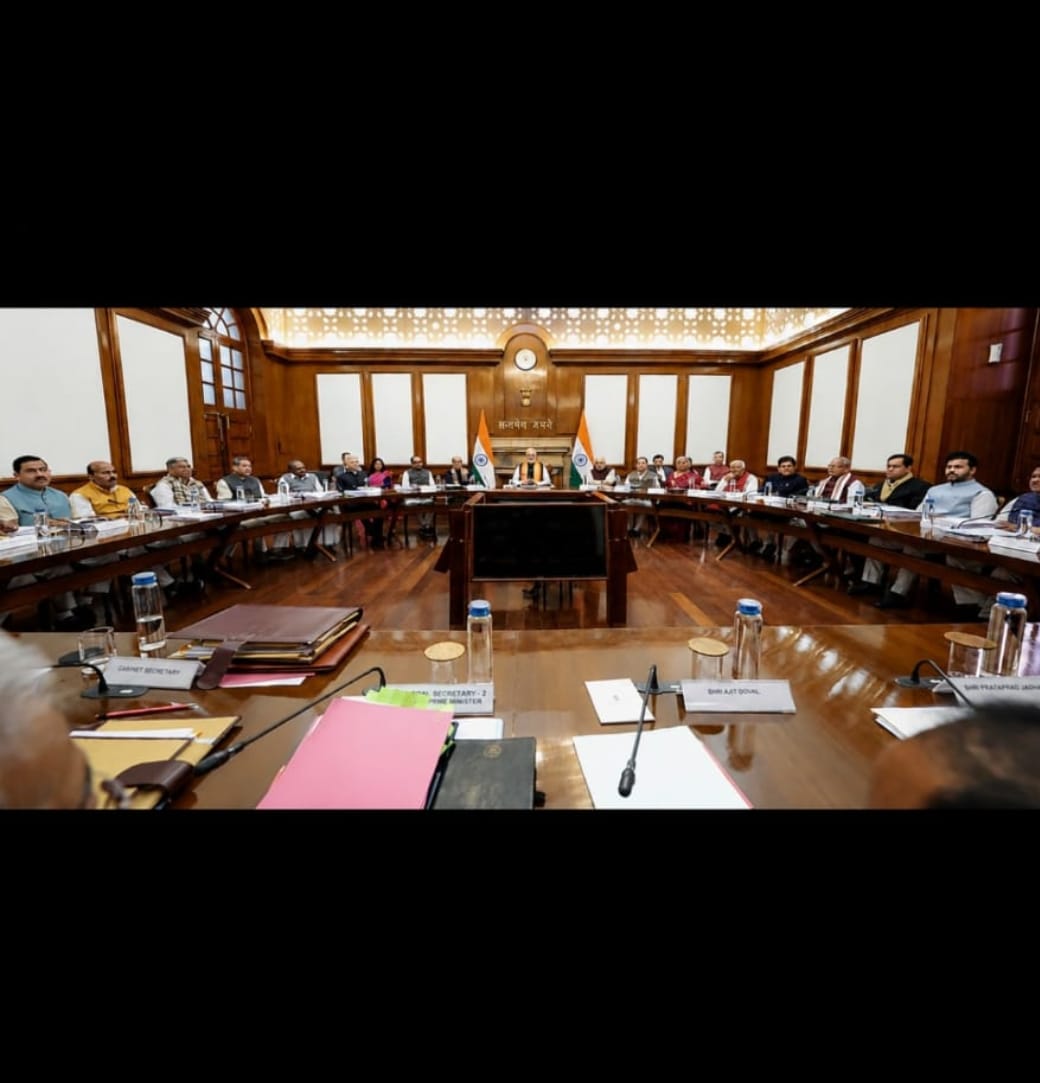
Prime Minister Narendra Modi holding a cabinet mreting. Source: PIB photos
This transformation extends beyond technology. By reducing dependence on intermediaries and enabling direct interaction between citizens and the state, it has helped create a new model of governance that is faster, more transparent and more accountable.
The strengthening of state capacity has been equally visible in physical infrastructure. Roads, railways, airports, logistics networks, digital connectivity, rural electrification and household tap-water connections have expanded significantly. Programmes such as Pradhan Mantri Gram Sadak Yojana, Saubhagya and Jal Jeevan Mission have improved everyday life for millions. Combined with the Goods and Services Tax, these investments have moved India closer to the vision of "One Nation, One Market" by strengthening both physical and economic integration.
The period also witnessed an unprecedented expansion of financial and social inclusion. Jan Dhan brought millions into the formal banking system. PM-KISAN, PMSBY, PMJJBY and Ayushman Bharat expanded income support, insurance coverage and health protection. As per NITI Aayog estimates, 24.82 crore people escaped multidimensional poverty between 2013–14 and 2022–23. India implemented the world's largest food subsidy programme. It also launched the Pradhan Mantri Ujjwala Yojana, which transformed nearly 11 crore kitchens by providing clean cooking fuel connections to poor households, equivalent to the combined population of the United Kingdom and Italy. Alongside these developments, structural reforms such as Goods and Services Tax and the Insolvency and Bankruptcy Code sought to modernise the economy and strengthen institutional foundations for long-term growth. The abrogation of Article 370 advanced the principle of "One Nation, One Constitution", while the construction of the Ram Mandir marked the culmination of one of the longest socio-political movements in modern India. Whatever one's political position, the significance of these developments in shaping constitutional, political and civilisational discourse cannot be denied.
The list can be extended further. Swachh Bharat transformed the national conversation on sanitation. Namami Gange renewed attention to river rejuvenation. Renewable energy capacity expanded rapidly. The International Solar Alliance helped establish India as a leading global voice in renewable energy. The economy approached the four-trillion-dollar mark while maintaining one of the highest growth rates among major economies.
These are substantial achievements.
Yet nations do not become developed by celebrating achievements alone. They become developed by confronting the challenges that remain.
Wealth without equity. Growth without jobs. Degrees without employable skills. GDP without innovation. Economic growth without sustainability.
These may well be the defining governance challenges of the next decade.
Despite remarkable progress in welfare delivery and financial inclusion, wealth ownership remains highly concentrated. Estimates suggest that the top one percent of Indians own more than forty percent of the nation's wealth, while the bottom fifty percent own barely six percent. Welfare can reduce hardship. It cannot create assets. Financial inclusion is important, but asset inclusion is even more important. A society in which millions participate in consumption but not in wealth creation will inevitably face social and economic tensions. The next frontier of inclusion is not merely access to welfare. It is participation in asset ownership and wealth creation. Schemes like SWAMITVA help, but many more such initiatives are needed.
India has demonstrated that it can grow. The more difficult question is whether growth is creating sufficient employment opportunities for its young population. Economic growth that does not generate jobs risks producing frustration alongside prosperity. The challenge is becoming more complex with the rapid emergence of artificial intelligence, robotics and automation. Millions of repetitive and low-skill activities may increasingly be performed by machines. Growth without jobs and jobs without growth are equally undesirable. India must strive for growth that is both rapid and employment-intensive.
The challenge extends beyond employment to the quality of education itself. India produces millions of graduates every year. Yet industry surveys repeatedly point to serious employability gaps. Too many institutions continue to produce degree holders rather than skilled professionals. A demographic dividend becomes a demographic liability unless education translates into capability, productivity and employment. No nation has ever become prosperous by confusing certification with competence.
Questions of employment and skills are closely linked to a larger concern: the country's capacity to innovate. India has excelled in software, digital platforms and technology-enabled services. Yet it continues to depend heavily on imported semiconductors, advanced manufacturing technologies and frontier innovations. India spends less than one percent of GDP on research and development. China spends around 2.5 percent. The United States spends around 3.5 percent. Because their economies are far larger, the absolute gap in research expenditure is even more striking. Nations do not become technological powers by importing technologies developed elsewhere. No country willingly parts with its most strategic technological advantages. Technological leadership is built not by importing the future, but by inventing it. For a country of India's size and aspirations, perpetual technological dependence is a strategic vulnerability.
Nor can sustainability remain a peripheral concern. Air pollution, water stress, land degradation, unplanned urbanisation and climate vulnerability continue to impose enormous economic and social costs. India cannot aspire to become a developed nation while millions continue to breathe unhealthy air, while rivers remain polluted and while ecosystems continue to degrade. Economic growth that undermines ecological stability ultimately becomes self-defeating. Nature always presents the bill. The only uncertainty is when.
Indeed, the challenge before India is not merely to build a stronger state. It is to build a more innovative, inclusive, equitable and sustainable society with human dignity at the centre of governance. The first twelve years strengthened the architecture of the Indian state. The next twelve years must transform the quality of Indian life.
Arun Kumar Mehta is a retired IAS officer and former Chief Secretary of Jammu & Kashmir. He has served in key leadership roles, including Chairman of the Central Pollution Control Board (CPCB), and has overseen major portfolios such as Environment, Urban Development, Finance, Information Technology, and General Administration.