A Pakistan-Born Chair, a Kashmir Record and a Sanctions Call Against RSS
Pakistan-born USCIRF chair Asif Mahmood, with a prior Kashmir advocacy record, has urged sanctions on RSS members and Bhagwat's visa revocation; India calls it biased, but documented minority-rights concerns remain unaddressed. By Mahima Katal New Delhi, Aug 27: The United States Commission on International Religious Freedom has once again put India in its crosshairs, this time naming individuals rather than institutions. Ahead of Rashtriya Swayamsevak Sangh chief Mohan Bhagwat's scheduled...
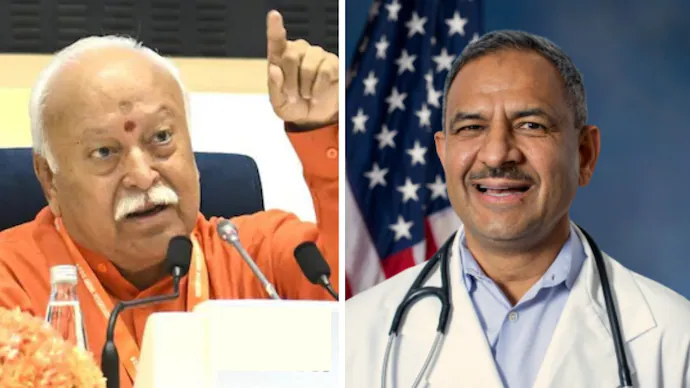
Pakistan-born USCIRF chair Asif Mahmood, with a prior Kashmir advocacy record, has urged sanctions on RSS members and Bhagwat's visa revocation; India calls it biased, but documented minority-rights concerns remain unaddressed.
By Mahima Katal
New Delhi, Aug 27: The United States Commission on International Religious Freedom has once again put India in its crosshairs, this time naming individuals rather than institutions.
Ahead of Rashtriya Swayamsevak Sangh chief Mohan Bhagwat's scheduled address at the Universal Oneness Celebrations in New York on August 29, USCIRF chair Asif Mahmood said the commission was urging Washington to consider targeted sanctions against RSS members and Indian officials it holds complicit in religious freedom violations, and to revoke the visa issued to Bhagwat, making him ineligible for future entry. Commissioner Gene Mills joined the call. New Delhi's response was immediate and categorical: Ministry of External Affairs spokesperson Randhir Jaiswal had already dismissed USCIRF a week earlier as a biased body whose statements should be ignored.
Mahmood's own biography has become part of that dismissal. He is a Pakistan-born American physician who, in 2019, was the only Pakistani-American to testify before the US Congress on India's reorganisation of Jammu and Kashmir, and who described the same developments in a 2023 public post as a "dark day" for democracy and self-determination. At USCIRF's own May 2026 hearing on India, he called religious freedom conditions there "abysmal," criticised the Citizenship Amendment Act and the National Register of Citizens, and cited the cases of activists Umar Khalid and Sharjeel Imam. Indian commentary has seized on this record, published in outlets including Organiser, to frame his chairmanship as advocacy rather than neutral monitoring.
The framing is not without an inconvenient counterpoint: as a commissioner in 2024, Mahmood also pushed for Pakistan's own redesignation as a Country of Particular Concern over its blasphemy laws and treatment of the Ahmadiyya community, which complicates any account of him as singularly focused on India. Either way, a chair's documented prior positions are relevant biographical context for readers assessing USCIRF's statement, they are not, on their own, a rebuttal to the specific factual claims the statement makes, in the same way that USCIRF naming Bhagwat is not, on its own, proof of the claims against him.
To weigh how much this carries institutionally, it helps to be precise about what USCIRF actually is. It is a bipartisan federal commission created under the International Religious Freedom Act of 1998, with no subpoena power, no evidentiary process, and no binding authority. Its statutory function is advisory: it recommends whether the State Department should designate countries or individuals for sanctions, typically under Global Magnitsky-type authorities, but the executive branch decides. That decision has, in practice, gone against USCIRF's own recommendation on India for close to a decade, the State Department has never accepted its Country of Particular Concern designation despite repeated annual reports pressing the case. New Delhi has cited exactly this record to argue that USCIRF's findings do not withstand scrutiny at the level where actual policy gets made, a point that is factually accurate as far as it goes, even if it does not by itself settle whether the underlying allegations have merit.
The specificity has nonetheless escalated. USCIRF's 2025 report had already named Prime Minister Narendra Modi and BJP leaders over election-season rhetoric, and separately sought sanctions on a named Research and Analysis Wing official, Vikas Yadav. The current statement extends that individualised approach to RSS members and unnamed "Indian officials," and for the first time seeks a visa action against Bhagwat, a private citizen holding no government office, timed to his physical presence in the country. The Ministry has characterised this timing as diplomatic theatre rather than genuine monitoring; the argument is not without force, since a recommendation attached to an imminent, high-visibility visit generates pressure independent of whether the State Department ever acts on it.
Where the government's position runs into difficulty is in what it declines to engage. Independent monitors, including United Nations human rights mechanisms, have documented a rise in hate speech targeting religious minorities, and rights groups have separately tracked demolitions of Muslim-owned properties, often carried out under municipal or encroachment law rather than any explicitly religious statute. The Citizenship Amendment Act, 2019, draws a religion-based classification for expedited citizenship, excluding Muslims from neighbouring countries from its fast-track provisions, a design the government defends as protecting persecuted minorities from three named states rather than discriminating within India, though the distinction does not fully answer why religion, rather than persecution status alone, is the operative test. The 2019 reorganisation of Jammu and Kashmir, whose constitutional validity the Supreme Court upheld in December 2023, remains cited by critics regardless of that judgment. State-level anti-conversion laws, now in force in a growing number of states, impose procedural burdens on conversion that critics argue chill the freedom of belief guaranteed under Article 25. Each of these is a documented, verifiable fact. The Ministry's response to USCIRF, that it is biased and should be ignored addresses the credibility of the messenger without addressing any of these specific, itemised concerns.
This is where USCIRF's own institutional design becomes the more interesting story. It has no adjudicatory process, takes no sworn evidence, and applies no evidentiary standard comparable to what an actual sanctions-designation process would require before naming individuals. Groups like HinduPACT have made this same argument from the American Hindu diaspora side, calling the sanctions push guilt by association and noting, not unreasonably, that USCIRF shows comparatively little urgency about documented attacks on Hindu properties of worship within the United States itself, a point the Ministry has also raised. That critique of process does not disprove the underlying allegations against RSS-linked actors in India. But it does mean USCIRF's credibility as a mechanism of accountability, rather than diplomatic signalling, remains genuinely weak, a decade of unimplemented recommendations being the clearest evidence of that weakness.
What this leaves is two institutions each avoiding the harder work. USCIRF issues escalating individual-level recommendations without building the evidentiary record that would let anyone outside its own commissioners test the claims, from a chair whose own prior advocacy record makes independence a fair question rather than a given. New Delhi responds with a blanket rejection of USCIRF's standing rather than a substantive answer to the specific, independently documented incidents that rights groups and UN mechanisms continue to flag. Both postures are politically economical. Neither advances an actual accounting of what is happening to religious minorities in India, which remains the question this entire exchange is nominally about.