Vikram-1 Takes Off: From Who Built It to the Emotional Sign-Off, Know Everything
Skyroot's Vikram-1 becomes India's first private orbital rocket, successfully reaching space and marking a historic milestone for commercial spaceflight.
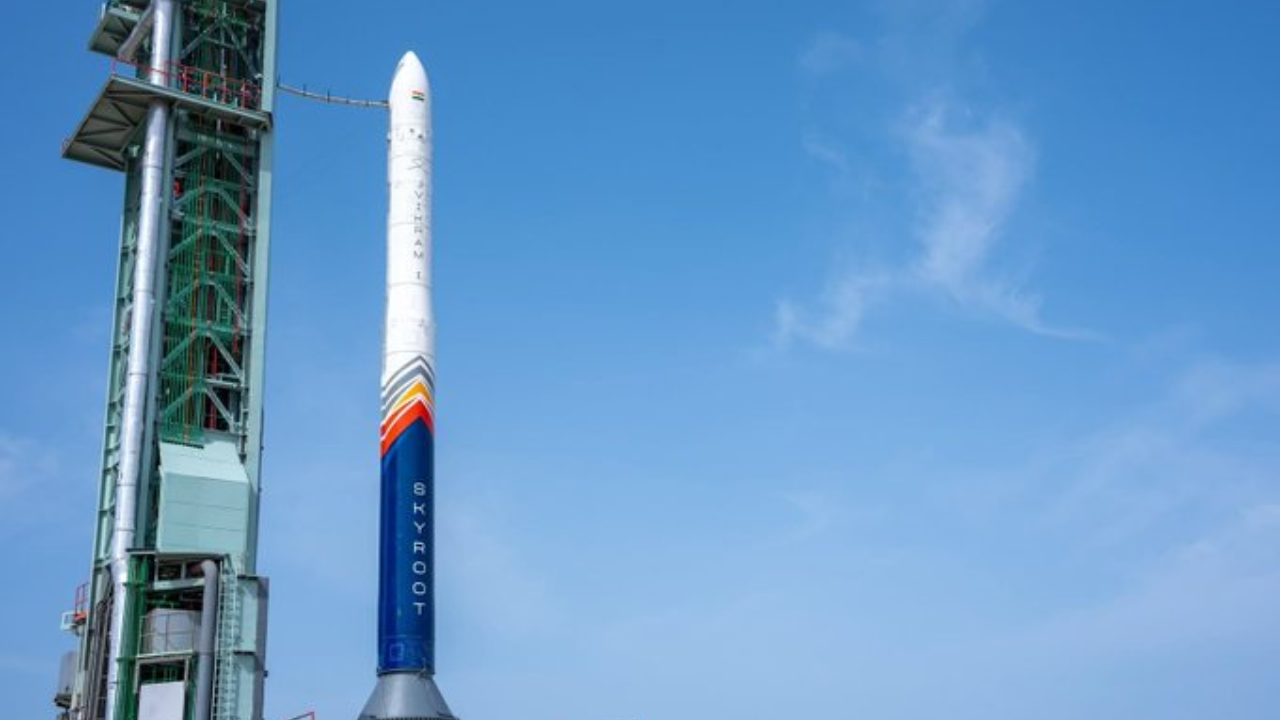
Skyroot's Vikram-1 becomes India's first private orbital rocket, successfully reaching space and marking a historic milestone for commercial spaceflight.
By Pranjal Gupta
New Delhi, July 18: India's first privately built orbital-class rocket, Vikram-1, lifted off successfully from the Satish Dhawan Space Centre on Saturday, marking a major milestone for the country's growing commercial space sector. Developed by Hyderabad-based Skyroot Aerospace, the mission, named Mission Aagaman (Arrival), carried several technology demonstration payloads, an artwork, and even a postcard signed by Prime Minister Narendra Modi.
The seven-storey-tall, four-stage rocket blasted off at 12.05 pm from the first launch pad after a planned 35-minute delay caused by an apparent navigation issue. The launch was originally scheduled for 11.30 am. During its nearly 16-minute journey, Vikram-1 was expected to place domestic and international payloads into a Low Earth Orbit (LEO) at an altitude of 450 km with an inclination of 60 degrees.
Soon after the successful launch, Skyroot Aerospace shared its excitement on social media. "We'll be watching this ignition on loop all day. Kalam-1200, Vikram-1's first stage, named after Dr A.P.J. Abdul Kalam, roared to life and lifted Vikram-1 off the pad on a flight that reached orbit," the company posted.
Skyroot Aerospace's Vikram-1 lifts off during Mission Aagaman, becoming India's first privately built orbital-class rocket to successfully reach space. (X/Himanta Biswa)
Vikram-1 is named after Dr Vikram Sarabhai, widely regarded as the Father of India's space programme. The rocket features an all-carbon composite structure and uses propulsion systems developed entirely in-house. These include advanced 3D-printed engines and high-thrust solid-fuel rocket boosters, highlighting India's growing capabilities in private space technology.
The mission carried payloads from Grahaa Space, Cosmoserve, DCubed and Skyroot's own SCOPE platform. It also carried an artwork titled Cosmic Bloom, symbolising the growing partnership between science, technology and creativity.
Engineers Sign Off
One of the most emotional features of the mission was hidden inside the rocket itself. Skyroot revealed that Vikram-1 carries the signatures of the engineers, technicians and team members who helped design, build and launch it. "Signed by the people who built it. Every signature on Vikram-1 belongs to an engineer, technician, or teammate who helped make this mission possible. Now, they're all headed to space aboard Mission Aagaman," the company said.
With Mission Aagaman, Skyroot Aerospace has taken a significant step in India's private space journey, demonstrating that Indian private companies are now capable of building and launching orbital-class rockets alongside the country's established space programme.