Wangchuk's Fast Is Over. The Government's Test Isn't.
Sonam Wangchuk ended his 26-day hunger strike at Medanta Hospital after Union Ministers JP Nadda and Dr Jitendra Singh conveyed government assurances on non-prosecution of protesters and NEET-related reforms. The resolution leaves the CJP's core demands, including Pradhan's resignation, unmet, shifting the contest to Parliament and, if commitments falter, potentially back to the courts. New Delhi, July 24: Sonam Wangchuk's decision to end his 26-day hunger strike at Medanta Hospital in...
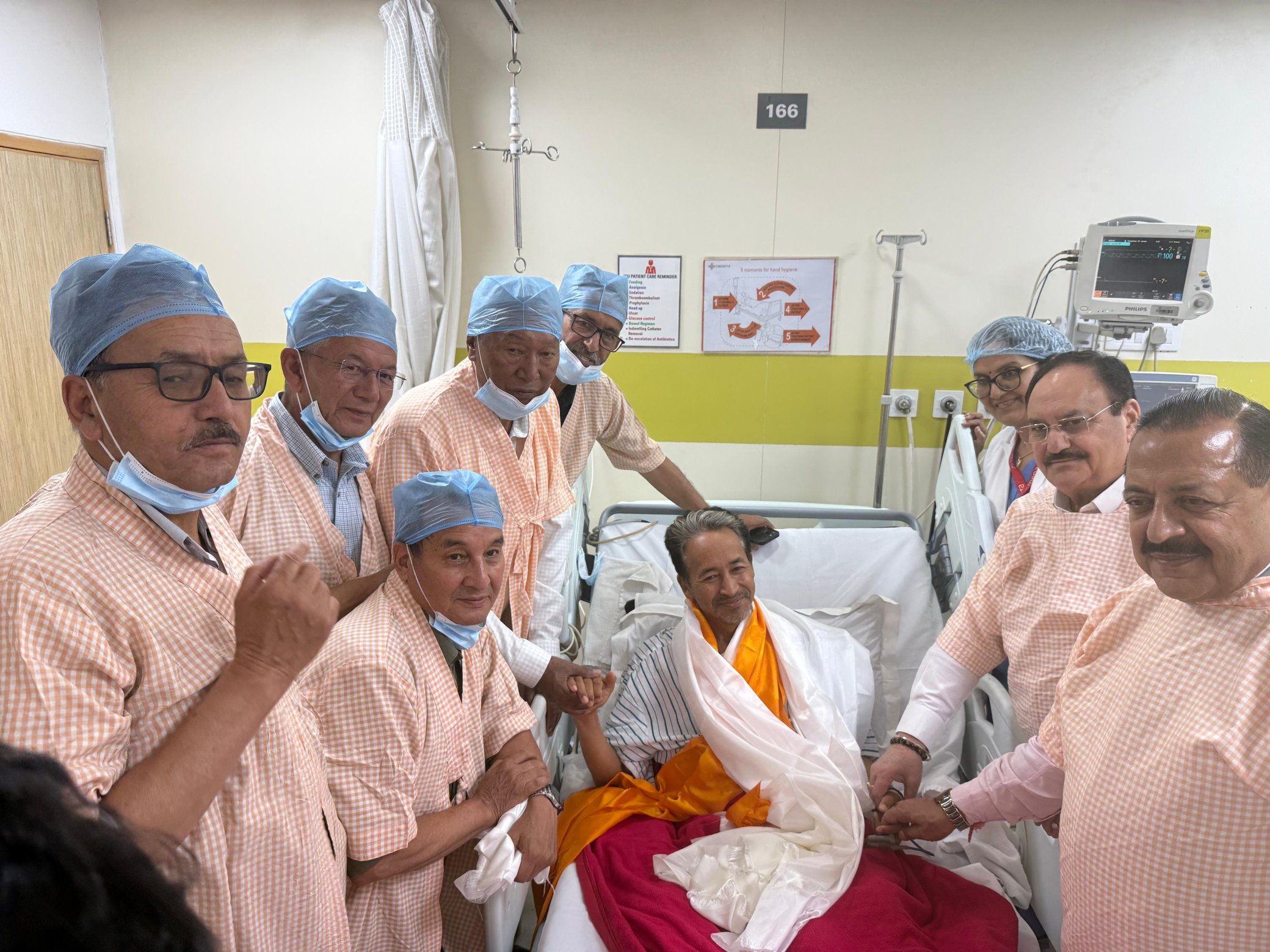
Sonam Wangchuk ended his 26-day hunger strike at Medanta Hospital after Union Ministers JP Nadda and Dr Jitendra Singh conveyed government assurances on non-prosecution of protesters and NEET-related reforms. The resolution leaves the CJP's core demands, including Pradhan's resignation, unmet, shifting the contest to Parliament and, if commitments falter, potentially back to the courts. New Delhi, July 24: Sonam Wangchuk's decision to end his 26-day hunger strike at Medanta Hospital in Gurgaon late Thursday night closes, at least for now, the most visible flashpoint in a protest movement that has tested the boundaries between political mobilisation, medical intervention, and the state's constitutional obligations toward a fasting citizen. But what ended Thursday night was the fast, not the obligation it forced onto the government.
Wangchuk broke his fast in the presence of Union Ministers JP Nadda and Dr Jitendra Singh, senior leaders of the Apex Body of Leh Ladakh, and his wife Gitanjali Angmo, following what he described as prolonged negotiations conducted against the backdrop of possible unrest.
His own framing of the moment, an appeal to the public to remain vigilant against violence even as he claimed a negotiated resolution, is worth sitting with, since it signals an awareness that the assurances extracted from government are political rather than judicially enforceable, and that their durability will depend on public attention rather than any binding instrument. The test now shifts entirely onto the state: whether the commitments made in a hospital room survive contact with Parliament, the courts, and the ordinary machinery of governance.
The events of 20 July sharpened the stakes considerably. Police used tear gas and batons against protesters marching toward Parliament to press the same demands, an episode that has since drawn a public interest litigation before the Delhi High Court seeking an NIA probe. Nadda's assurance to Wangchuk, that the government would not register cases against those who protested peacefully at Jantar Mantar or participated in the 20 July march, is significant precisely because it is not a legal remedy but an executive undertaking, extended in a hospital room rather than through any statutory or judicial mechanism. This is the first and most immediate marker of the government's test: whether that undertaking translates into actual withdrawal or non-registration of FIRs, or whether protesters who were detained or booked in connection with the march are left to seek relief through litigation the assurance was meant to preempt.
The government's other commitments, a parliamentary discussion on paper leaks and examination reform, and consideration of compensation for the families of NEET aspirants who died by suicide, arrive alongside a quieter administrative reshuffle that has drawn less attention than it perhaps deserves. Higher Education Secretary Vineet Joshi, who had overseen the National Testing Agency during the period the leaked paper was administered and who continued to serve as acting UGC chairman despite standing questions about the legality of that arrangement under Section 5(2) of the UGC Act, 1956, has now been moved out of the Ministry of Education entirely, to the Ministry of Panchayati Raj. The timing, three days after the Parliament march and hours before Wangchuk's fast ended, invites the obvious reading that this is an accountability gesture aimed at the protest's core grievance, even though the official order does not frame it that way.
Prime Minister Narendra Modi's own statements, promising fast-track courts and a legislative push against paper leaks from the second week of the Parliament session, suggest the government is trying to convert a street and hospital-room negotiation into a legislative response, which is the more durable route available to it, but also the one most exposed to the ordinary delays and dilutions of the parliamentary process. This is the second marker of the test: whether the promised Bill arrives intact, diluted, or not at all when the House convenes.
What happens next will determine whether this fast produced a genuine institutional shift or simply defused an immediate crisis. The CJP's core demands, Pradhan's resignation and structural reform of the examination system, remain unmet in the form originally sought; what has been offered instead is a discussion in Parliament and a Bill still being drafted.
Wangchuk's own caution, promising to detail the negotiated conditions in a separate video and urging vigilance against violence, reads as an acknowledgment that the settlement is fragile and contingent on continued scrutiny rather than self-executing. For a protest movement built around examination integrity and administrative accountability, the more consequential fight now shifts from the street and the hospital to the floor of Parliament and, if the promised Bill under-delivers or the assurances on non-prosecution are not honoured, potentially back into the courts. The fast has ended. The government's test, on FIRs, on the Bill, on compensation, is only beginning.