West Asia Conflict Shadow over International Law on Maritine Movement In High Seas
Repeated attacks on commercial vessels in international waters have once again raised questions on the International maritime law on navigation. India registers protest over death of Indian seafarers By Mahima Katal New Delhi, June 12: The death of three Indian seafarers aboard the commercial vessel MT Settebello off Oman coast has triggered diplomatic concerns and renewed debate over the limits of military enforcement at sea. Ministry of External Affairs spokesperson Randhir Jaiswal...
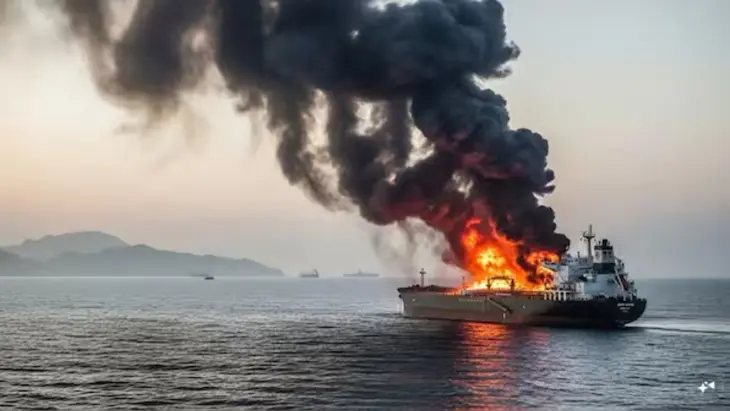
Repeated attacks on commercial vessels in international waters have once again raised questions on the International maritime law on navigation. India registers protest over death of Indian seafarers
By Mahima Katal
New Delhi, June 12: The death of three Indian seafarers aboard the commercial vessel MT Settebello off Oman coast has triggered diplomatic concerns and renewed debate over the limits of military enforcement at sea.
Ministry of External Affairs spokesperson Randhir Jaiswal confirmed that India had summoned the United States Chargé d'Affaires to register its protest over the incident.
"We had summoned the US CDA to register our protest on the attack that happened on this commercial vessel off the coast of Oman. Three Indian nationals have died in that incident. We conveyed our deepest concerns on this incident and the string of attacks that are happening," Jaiswal said.
The incident has sparked competing narratives about what happened and whether the use of force was justified under international law.
Critics of the strike argue that two facts remain central to the debate: the vessel was reportedly operating in international waters and was carrying civilian crew members. They question whether a commercial ship can be attacked based on suspicion alone, particularly when no publicly available evidence has established that the vessel posed an imminent military threat. For them, the deaths of the Indian seafarers raise serious concerns about the protection afforded to civilians at sea and the limits of military action against merchant vessels.
Others, however, contend that the incident should not be viewed as the deliberate targeting of Indian nationals. According to this account, MT Settebello was allegedly operating as a non-compliant vessel involved in sanctions-evasion activity and had ignored repeated warnings before being struck. They argue that the attack was aimed at disabling the vessel by targeting its engine room rather than sinking it, and that the deaths of three Indian crew members were an unintended consequence of an enforcement operation in a high-risk maritime zone.
Supporters of this view further point to the rescue of 21 crew members as evidence that the objective was to stop the vessel rather than cause mass casualties.
Yet the existence of competing narratives only sharpens the legal questions that remain unanswered.
At the heart of the controversy lies a fundamental issue of international law:
Even if a vessel is suspected of sanctions evasion, what level of evidence and threat is required before military force can lawfully be used against a commercial ship carrying civilian sailors?
International maritime law generally protects freedom of navigation on the high seas. Merchant vessels are presumed to be civilian in nature unless there is compelling evidence that they are directly participating in hostilities or otherwise constitute a legitimate military objective. Sanctions violations, by themselves, do not automatically transform a commercial vessel into a military target.
Legal experts note that the use of force against a civilian vessel is typically assessed through principles such as necessity, proportionality, distinction, and precaution. Authorities contemplating military action must consider whether less harmful alternatives were available, whether adequate warnings were issued, whether the vessel posed a genuine threat, and whether sufficient measures were taken to minimize civilian casualties.
These questions become particularly significant when civilian seafarers from third countries are involved. Thousands of Indian sailors work aboard merchant vessels navigating some of the world's most volatile maritime routes. Many have little control over the commercial or political decisions made by shipowners and operators, yet they often bear the greatest risks when geopolitical tensions escalate.
The deaths of the three Indian crew members therefore raise issues extending beyond a single incident. They touch upon the safety of civilian mariners, the legal boundaries of sanctions enforcement, and the obligations of states conducting military operations in international waters.
As calls for accountability grow, several questions remain unanswered:
What evidence linked the vessel to sanctions-evasion activities?
What warnings, if any, were issued before force was used?
Was the ship carrying cargo, weapons, or military personnel?
Did the vessel pose an imminent threat that could justify military action?
Were all feasible precautions taken to protect civilian crew members?
Should an independent investigation be conducted into the circumstances of the strike?
Until those questions are answered, the debate is unlikely to be settled. What is clear, however, is that the deaths of three Indian seafarers have transformed a maritime security incident into a broader discussion about the reach of military power, the protection of civilians at sea, and the standards that international law demands before force can be used against a commercial vessel in international waters.