When Rulebook Doesn't Exist: What Pellet Gun Hearing Actually Exposed
Nobody actually asked whether metallic pellets should be banned. What came up instead was whether there's even a rule to challenge, and Vrinda Grover, arguing the case, admitted she couldn't find one. No standing order, no published regulation, just a BPRD advisory doing the work of binding law. The Court didn't ban anything or clear anything. It just asked the Centre to show its homework first. New Delhi, July 30: There is a particular kind of silence that shows up in courtrooms when a...
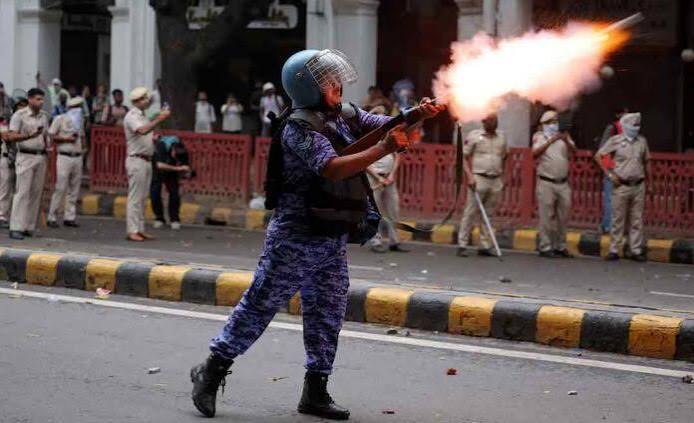
Nobody actually asked whether metallic pellets should be banned. What came up instead was whether there's even a rule to challenge, and Vrinda Grover, arguing the case, admitted she couldn't find one. No standing order, no published regulation, just a BPRD advisory doing the work of binding law. The Court didn't ban anything or clear anything. It just asked the Centre to show its homework first. New Delhi, July 30: There is a particular kind of silence that shows up in courtrooms when a lawyer is asked to produce a document that everyone assumes must exist, and it doesn't. That silence arrived on Thursday, when senior advocate Vrinda Grover, arguing before the Supreme Court for a ban on metallic pellet guns used against NEET protesters, admitted she could not locate any standing order of the Delhi Police authorising their use. Not that the order was confidential, or under review, or buried in some annexure she hadn't yet accessed.
It simply wasn't there to find.
That admission, more than anything else in the hearing, is the story.
The plea itself had come from Yashovardhan Azad, a retired IPS officer and former Central Information Commissioner, alongside two young men, Prashant Kumar and Sheikh Irshad Mansoori, who carried metallic pellets recovered from their own bodies as evidence of what happened at Jantar Mantar on July 20, when the Cockroach Janata Party's Sansad Chalo march met the Rapid Action Force's pump-action guns. The ask was straightforward: a nationwide ban on pellet ammunition for civilian crowd dispersal, on the ground that a weapon which scatters hundreds of projectiles indiscriminately cannot satisfy the constitutional tests of necessity and proportionality that any restriction on the right to peaceful assembly must clear.
Chief Justice Surya Kant's bench, sitting with Justices Joymalya Bagchi and V Mohana, didn't reject that reasoning. What it did was harder to sit with. Justice Bagchi called the prayer "vague", not because the harm wasn't real, but because you cannot ask a court to strike down a ban you haven't shown to exist as a rule in the first place. Pellet guns, the bench noted, are permitted in exceptional situations under a Bureau of Police Research and Development advisory. An advisory. Not a statute, not a regulation gazetted and open to challenge, not even a standing order specific to how Delhi Police may deploy them against a crowd. Just guidance, sitting somewhere in the architecture of internal policing practice, doing the work that binding law is supposed to do when the state decides to use force capable of blinding someone.
This is worth sitting with for a moment, because it inverts how these hearings usually get covered. The frame everyone will reach for is the ban-or-no-ban binary: did the Court say pellet guns are illegal, did it say they're fine, who won today. That frame doesn't fit what actually happened.
What happened is that a constitutional court, asked to test a use of force against Article 19(1)(b), discovered that the object it was supposed to test, the rule authorising that force, may not exist in any form that a citizen, or for that matter a senior advocate with full access to public records, can locate and argue against. You cannot challenge what has no fixed shape. Grover said as much herself: she could not find such regulations in the public domain and asked the bench to direct the Centre to place them on record, which is a lawyer's polite way of saying that the state is being asked to first show its own homework.
Solicitor General Tushar Mehta's response, that the government will do whatever is necessary to assist the bench, is the kind of sentence that sounds reassuring until you notice what it doesn't commit to. It doesn't say a standing order exists. It doesn't say one will be produced.
It commits to cooperation with an investigation into an incident, which is a narrower thing than producing the governing rule for a category of state action. The Court's July 28 order, as Grover pointed out, had already directed preservation of CCTV footage, drone visuals, body camera recordings and wireless logs, the evidentiary record of what happened on July 20. Thursday's direction to preserve the RAF's ammunition log extends that evidentiary trail. But an evidentiary trail answers what happened in one incident. It does not answer under what rule it was allowed to happen at all, and that gap didn't close on Thursday, if anything, it became visible for the first time on the record.
The bench's own language gestured toward an answer, and it's an answer worth watching closely as this case proceeds. Justice Bagchi spoke of examining pellet use "under a graded approach", the idea that a bona fide protest can turn violent, that anti-social elements may infiltrate a genuine assembly, and that law enforcement may need graded responses calibrated to how a situation evolves on the ground. Mehta echoed this: forces may have to take on-the-spot decisions based on the event. There is nothing constitutionally objectionable about graded response as a concept. Proportionality doctrine has long accommodated the idea that force should scale to threat. The difficulty is that "graded" implies gradations that are fixed in advance, known, and reviewable, a ladder of permissible responses that both the police and the public can see before the fact, not one improvised and rationalised after it. If the BPRD advisory is the only document doing that work, and if even a standing order specific to Delhi cannot be produced, then "graded approach" risks becoming a phrase courts and governments use to describe a process that exists mostly in retrospect, reconstructed to fit whatever force was actually used.
Grover's own limiting move in the hearing is instructive here too. She was careful to confine her plea to metallic pellets specifically, not to pellet guns as a category or to the RAF's armoury as a whole. "I am not saying pellet guns should not be in the armoury of the RAF," she said. That is a narrower and, I'd argue, a more litigable claim than an outright ban, it concedes the state's general power to arm its forces with less-lethal options while isolating the specific choice to load them with metallic pellets, which the petition frames as creating a substantial risk of eye injuries and grave harm precisely because they cannot be targeted with precision.
That distinction matters for where this case can actually go. A blanket ban plea invites exactly the "vague" objection the bench raised. A challenge to the absence of any published, binding rule governing metallic pellet deployment, read against the specific facts of July 20, where the petitioners allege force escalated to pump-action guns near Connaught Place without prior warning, is a plea a court can actually adjudicate, because it asks for a rule to be produced and then tested, rather than asking a court to imagine the rule's contents for itself.
What the Court has actually done, then, is neither grant relief nor deny it. It has asked the state to produce its own justification in documentary form, the ammunition log, and implicitly, whatever standing order or regulation supposedly governs the choice to load that ammunition in the first place. Whether that document exists, and what it says if it does, is now the real question this case turns on. Everything else, the ban, the compensation, the medical treatment for Kumar and Mansoori that the bench has already directed the Delhi government to provide, sits downstream of that. You cannot rule on whether a rule is proportionate until someone shows you the rule.