Why India Says the Hague's Indus Waters Ruling Does Not Bind It
A Hague tribunal ruled the Indus Waters Treaty remains binding and restricted construction at India's Ratle project, but India rejects the ruling outright, calling the court illegally constituted and refusing to recognise its jurisdiction. By Mahima Katal New Delhi, Aug 31: A tribunal sitting at the Permanent Court of Arbitration (PCA) in The Hague has ruled that the Indus Waters Treaty of 1960 remains fully binding on India, rejecting New Delhi's position that the six-decade-old...
A Hague tribunal ruled the Indus Waters Treaty remains binding and restricted construction at India's Ratle project, but India rejects the ruling outright, calling the court illegally constituted and refusing to recognise its jurisdiction.
By Mahima Katal
New Delhi, Aug 31: A tribunal sitting at the Permanent Court of Arbitration (PCA) in The Hague has ruled that the Indus Waters Treaty of 1960 remains fully binding on India, rejecting New Delhi's position that the six-decade-old water-sharing pact with Pakistan can be held in abeyance. India, in turn, has rejected the ruling outright, restating a position it has held since Islamabad first brought the dispute to the tribunal: that the court itself has no lawful standing to rule on the matter at all.
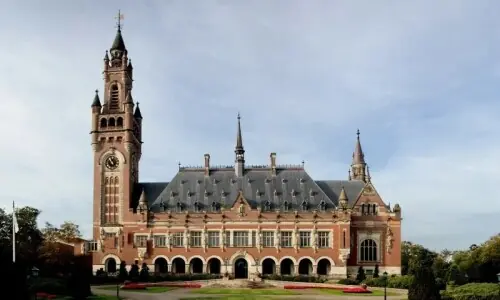
An image of the Peace Palace in The Hague, the Netherlands, where the Permanent Court of Arbitration holds a seat. — Permanent Court of Arbitration
The ruling brings back into focus a dispute that has run in parallel to, and increasingly entangled with, the broader diplomatic freeze between the two countries since the Pahalgam terror attack in April 2025. Understanding the ruling requires separating three distinct threads: how the case reached the PCA, what the tribunal has now decided, and why India insists none of it applies to it.
How the dispute reached the tribunal
The Indus Waters Treaty, brokered by the World Bank in 1960, divides the six rivers of the Indus basin between the two countries. India was given the eastern rivers, the Ravi, Beas and Sutlej, largely for unrestricted use, while Pakistan received the western rivers, the Indus, Jhelum and Chenab, with India retaining limited rights over them, including for run-of-the-river hydropower projects, subject to design specifications set out in the treaty.
It is those design specifications that produced the underlying dispute. Pakistan objected to the design of India's Kishenganga and Ratle hydroelectric projects, arguing they did not conform to the treaty's technical criteria. The treaty provides a specific mechanism for resolving exactly this kind of technical disagreement: a neutral expert, appointed jointly, to rule on design compliance. Pakistan initially invoked this mechanism in 2015. In 2016, however, it withdrew that request and instead sought the constitution of a full court of arbitration, a separate and more adversarial track under the treaty meant for disputes over interpretation rather than technical design. The World Bank, faced with two simultaneous and conflicting requests, took the unusual step of appointing both a neutral expert and a court of arbitration that same year.
India's objection to the tribunal is therefore not new. It goes back to this fork in 2016, when India argued that a technical design dispute could not lawfully be escalated into a full arbitral proceeding while the neutral-expert track already covered the same projects. India took part in the neutral expert's proceedings but declined to appear before the court of arbitration at any stage, including when the tribunal ruled on its own competence in 2023.
What changed after April 2025 is the scale of the dispute. Following the Pahalgam attack, which India attributed to a Pakistan-based proxy of Lashkar-e-Taiba, New Delhi announced it was holding the treaty itself in abeyance as part of a wider package of diplomatic and economic measures. Pakistan approached the same court of arbitration in March 2026, this time asking it to rule on the status of the treaty as a whole, rather than solely on project design, and separately sought interim measures to halt certain construction work at the Ratle project.
What the tribunal has now decided
The tribunal's ruling addresses both questions Pakistan put before it. On the status of the treaty, it examined the grounds India has publicly cited for suspending or terminating it and concluded that none of them meets the legal threshold required under the treaty or international law. On that basis, the tribunal held that the treaty remains in force in its entirety, and that India remains bound by its obligations, including those governing the design and operation of hydroelectric projects on the western rivers.
Notably, the tribunal also considered, and rejected, an argument India had made outside the proceedings rather than within them: that Pakistan's sponsorship of cross-border terrorism had itself obstructed India's ability to exercise its rights under the treaty, amounting to a material breach by Pakistan. The tribunal's reasoning was narrow rather than dismissive of India's underlying grievance. It found that the treaty's text addresses only the allocation and use of river waters and makes no reference to terrorism or the use of force, and that in any event India had continued to build hydroelectric projects on the western rivers throughout the period in question, undercutting the claim that Pakistan's conduct had impeded that construction.
On the narrower question of interim measures at the Ratle project, the tribunal split the outcome. It restricted India from concreting the dam wall and power intake structure of the Ratle project above specified levels until 90 days after a separate, ongoing decision by the neutral expert on the project's design, expected in July 2027, and imposed a reporting requirement on India's construction schedule in the meantime. But it declined two further measures Pakistan had sought: a requirement that India bear the risk of having to later modify or dismantle parts of the project, and a demand that India return to full compliance with the treaty pending the outcome of the broader case on the treaty's status.
Why India says none of this binds it
India's response, issued through the Ministry of External Affairs, does not engage with the substance of the tribunal's reasoning at all. Its position rests entirely on jurisdiction: that the court of arbitration was, in its words, "illegally constituted" by the World Bank in breach of the treaty's own terms, and that India has consequently never recognised its existence in law. Because India has never appeared before the tribunal on this basis, and has rejected every prior ruling it has issued since 2023, the government's position is that Monday's order is simply the latest pronouncement by a body that had no authority to make one, with no bearing on India's conduct now or in the future.
This is a materially different posture from the neutral expert track, where India has continued to participate on the same set of projects, with that process expected to produce its own final decision around the same time, mid-2027, as the deadline referenced in the tribunal's interim order. The result is an unusual situation in which two treaty mechanisms are running in parallel on overlapping questions, one of which India considers legitimate and is engaging with, and the other of which it regards as void from inception and has never joined.
For readers following the treaty dispute at a distance, the practical significance of Monday's ruling is limited by exactly this refusal of jurisdiction. The tribunal has no enforcement mechanism of its own within the treaty framework, and India has given no indication that it will alter construction at Ratle or reverse the abeyance announced in 2025. What the ruling does establish, at least as a matter of international legal record, is that a tribunal empanelled under the treaty's own arbitration clause has found India's stated grounds for suspending the treaty legally insufficient, a finding that will likely feature in Pakistan's diplomatic messaging even as it carries no operative force inside India.