China’s Space Play: Why Pakistan’s First Astronaut Matters to Beijing
China Pakistan Space Cooperation: Pakistan’s First Astronaut Muhammad Zeeshan Ali reaches Tiangong, giving China a chance to deepen space ties
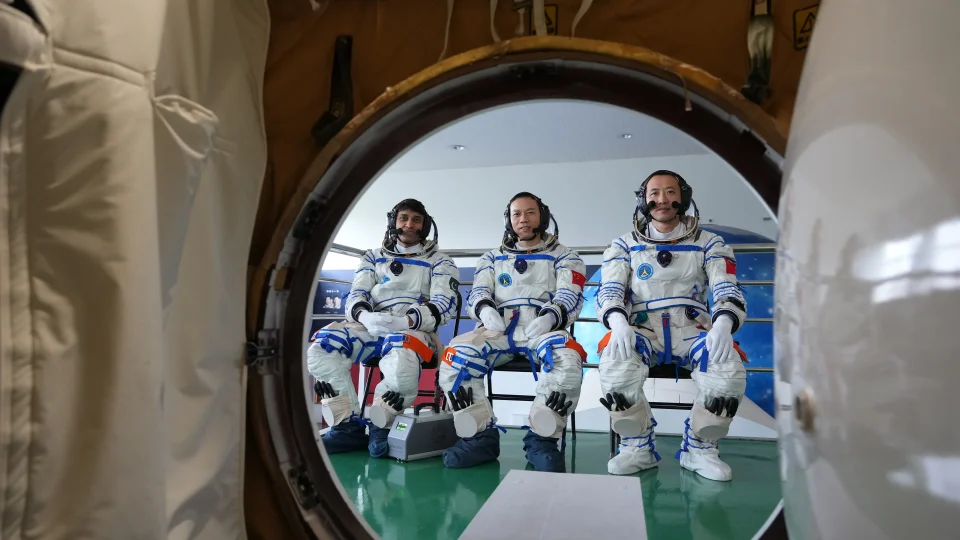
China Pakistan Space Cooperation: Pakistan Air Force pilot Muhammad Zeeshan Ali reportedly arrived at China’s Tiangong space station on November 25 aboard the Shenzhou-24 mission, becoming the first foreign astronaut to reach the orbital outpost. The payload specialist reportedly joined Chinese commander Tang Hongbo and flight engineer Wu Yi after launching from Jiuquan on a Long March-2F rocket, beginning a short scientific stay under the 2025 China-Pakistan space cooperation agreement.
For Beijing, the mission is likely more than a diplomatic gesture or a landmark for Islamabad. It may serve as a demonstration of China’s ability to train, launch and host international astronauts on infrastructure it controls, while also offering a chance to deepen a partnership that already covers satellites, navigation systems and planned lunar exploration.
Space As Statecraft
China has increasingly used space cooperation as a tool of foreign policy, not only for scientific work. The University of Washington’s China’s Space Diplomacy Around the World suggests that Beijing links space projects to the Belt and Road Initiative, the Space Information Corridor and multilateral bodies including the UN, International Telecommunication Union, BRICS and the Asia-Pacific Space Cooperation Organization. The study indicates that China uses communication, persuasion, and bargaining to expand partnerships and shape international space norms; While highlighting the International Lunar Research Station and the International Deep Space Exploration Association, which may give Beijing additional platforms to build partnerships and show technological leadership.
Tiangong appears central to this approach. Fully operational since 2022, the three-module station offers partner countries research opportunities and astronaut access, while China controls launch, operations, and station management.
Pakistan As The Flagship
Pakistan is likely the clearest example of how this model works. The 2019 agreement between the China National Space Administration and Pakistan’s Space and Upper Atmosphere Research Commission (SUPARCO) established astronaut training, joint exploration programmes and a dedicated cooperation committee.
The February 2025 bilateral agreement reportedly expanded that cooperation, creating a route for a Pakistani astronaut to fly to Tiangong. Ali and fellow Pakistan Air Force pilot Khurram Daud were reportedly selected in April 2026 for training in Beijing, with Ali chosen for the first mission.
For China, hosting an astronaut from a Muslim-majority country with links across the Gulf and the wider Islamic world may carry symbolic value. It could help Beijing present Tiangong as an open, non-Western alternative to the US-led International Space Station, especially for countries seeking access to human spaceflight.
Training Foreign Astronauts to Chinese Tech
The astronaut programme may also be intended to build longer-term institutional links. The research suggests that training foreign astronauts can create a generation of space professionals familiar with Chinese technology, operational protocols and technical standards. That familiarity could last beyond one mission. As partner countries use Chinese systems, they may become more likely to depend on Chinese maintenance, upgrades, training and future cooperation. Analysts describe this as technological lock-in.
The Texas National Security Review’s Choosing Orbits: China’s Space Diplomacy in the Middle East finds that satellite launches, ground infrastructure, BeiDou navigation integration and knowledge transfer can embed Chinese standards and expertise in partner institutions over time.
Is Pakistan Dependent?
For Pakistan, the partnership brings prestige and practical capability, however putting forward another question of whether Islamabad is building an independent space programme, or relying on China. SUPARCO has reportedly launched several satellites in recent months, including the electro-optical Earth observation satellites PRSC-EO1, EO-2 and EO-3, as well as the hyperspectral HS-1 and high-resolution remote-sensing KS-1. However, recent launches have reportedly used Chinese launch facilities, while the astronaut mission and planned lunar rover may also depend on Chinese technical support.
SUPARCO’s resources remain limited. Its development budget for 2025-26 was reportedly revised down to 4.5 billion rupees, about $19.2 million, amid austerity linked to Pakistan’s IMF programme. India’s space agency, ISRO, has an annual budget of about $1.6 billion.
The new satellites can support disaster response, agriculture, climate monitoring, urban planning and regional observation. But critics argue that dependence on Chinese rockets, spacecraft, training and technical designs could deepen Pakistan’s integration into China’s space ecosystem rather than build independent launch and advanced technology capacity.
Dual-Use Concerns
China’s space cooperation also overlaps with its wider security architecture. The Washington research notes that Beijing does not clearly separate civilian and military space activity, with state oversight across launch, tracking and control networks.
Technologies such as BeiDou, Earth observation satellites, ground stations and data networks can support civilian development while also potentially serving intelligence, surveillance, reconnaissance, space-domain awareness, missile guidance and deterrence. Pakistan is reportedly the only country outside China with full, unrestricted access to BeiDou.
This does not mean the Tiangong mission itself gives China a proven military advantage. But it shows why civilian space cooperation may carry strategic value: dual-use systems allow partner countries to pursue development and prestige while gaining capabilities that could also have security uses.
Beijing’s Wider Pitch
The Pakistan mission may also become a model for other developing countries. China’s approach in the Middle East suggests that it tailors cooperation to a partner’s capacity and strategic importance, offering satellite hardware, launch support, navigation integration and training rather than one standard package.
The Texas National Security Review analysis finds that countries such as Egypt, the United Arab Emirates and Iran are not passive recipients of Chinese influence. They may use Chinese space cooperation to pursue development, prestige and technical capability while balancing ties with the United States.
This “hybrid alignment” could give China an opening. Where US export controls or political conditions limit cooperation, Beijing may present itself as a more accessible partner, while competing with the US-led Artemis Accords through initiatives such as the International Lunar Research Station.
The Larger Prize
For now, Ali’s flight gives Pakistan a historic first and China a strong showcase. He is reportedly expected to conduct scientific experiments and technology tests aboard Tiangong before returning with the Shenzhou-23 crew.
The deeper significance may lie in the wider partnership: satellite launches, BeiDou access, astronaut training, planned lunar cooperation and a growing network of Chinese-built systems. Together, they suggest that Beijing sees space not only as a field for exploration, but as a way to build partnerships, set standards and expand influence over time.