Trump, Xi, Putin's Trilateral Talks in Shenzhen: Nuclear Arms, Ukraine and Iran Wars Top Agenda
Trump meets Xi and Putin at APEC in Shenzhen to discuss nuclear arms control, Ukraine and Iran wars, trade tensions and AI rivalry.
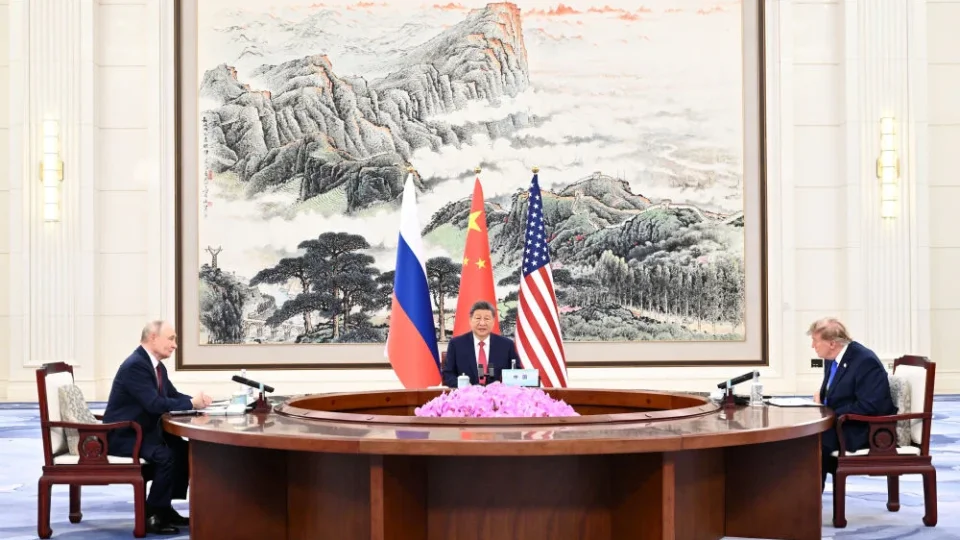
US President Donald Trump met Chinese President Xi Jinping and Russian President Vladimir Putin on Thursday (November 19) for a trilateral meeting on the sidelines of the Asia-Pacific Economic Cooperation (APEC) summit, with nuclear arms control and the wars in Ukraine and Iran expected to top the agenda.
Trump, who had separate one-on-one meetings with Xi and Putin before the three-way talks, reportedly promoted the meeting as a chance to establish rules for controlling nuclear weapons and begin resolving conflicts in Ukraine and Iran. Experts, however, kept expectations low for breakthroughs from a single meeting.
The announcement of the trilateral talks was made by the Chinese Foreign Ministry on X, formerly Twitter.
On November 19, President Xi Jinping will hold the China-Russia-U.S. Summit with President Vladimir Putin and President Donald J. Trump in Shenzhen.
— CHINA MFA Spokesperson 中国外交部发言人 (@MFA_China)
“We are really making history,” Trump reportedly said at the start of the trilateral. “The United States, Russia and China are uniquely positioned to discuss how to reduce the number of nuclear weapons on Earth and also to lessen the risk of those weapons being used.”
Xi said the three leaders would discuss “the theme of promoting world peace,” while Putin reportedly invoked the countries’ shared role as victors in the Second World War and their joint responsibility for international peace.
Bilateral Meetings First
Before the trilateral, Trump held a roughly hour-long meeting with Xi, his third substantial meeting with the Chinese president this year. Trump praised their friendship and said he would ask China to buy more American agricultural products.
Fighter jets overhead, anthems on the tarmac, and a high-stakes handshake in #Shenzhen. President Xi Jinping personally welcomed President Donald Trump to China ahead of the 33rd #APEC Summit. As the two leaders set the stage for pivotal talks on global stability and Asia-Pacific cooperation, all eyes are on what comes next. https://t.co/1lrM7RG9Wn
— China SCIO (@chinascio)
“I’ll be asking you to do some more for our farmers,” Trump said. Xi said US-China relations had been “generally stable and improved” during Trump’s presidency and that his efforts would “go down in history”.
Trump also met Putin separately; reported to be their first talks since last year’s meeting in Alaska failed to produce a deal to ease Russia’s war in Ukraine. Trump called Putin “my friend” and said, “wonderful things can come out of this - or at least start”.
Nuclear Arms Control
Trump has said he wants a “new, improved and modernised” nuclear arms agreement that includes China, after New START, the last US-Russia nuclear arms pact, expired in February.
China, however, has less incentive to accept limits, given that its arsenal of more than 600 warheads is far smaller than the more than 5,000 warheads believed to be in each of the US and Russian stockpiles, AP reported.
Daryl Kimball, executive director of the Arms Control Association, said Trump’s showmanship could at best begin a process leading to sustained talks on reducing nuclear arsenals. “We need more than diplomatic theatre and photo opportunities between Xi, Putin and Trump at APEC,” Kimball said. “And one meeting will not likely produce dramatic breakthroughs.”
Chinese President Xi Jinping on Thursday made four points on how major countries could find the right way to get along and jointly underpin world peace. Full story: https://t.co/BKffwA7ubH https://t.co/QJccTFVUkH
— China Xinhua News (@XHNews) November 19, 2026
Ukraine and Iran
The trilateral comes as Kyiv and its European allies view the meeting with suspicion, fearing it could cut them out of any settlement process over Ukraine. German Chancellor Friedrich Merz has warned of another “Anchorage moment”, referring to last year’s Trump-Putin meeting in Alaska that produced proposals rejected by Ukraine and its partners.
Trump’s recent moves have appeared to favour Moscow, including waiving new sanctions against Russia and striking a diesel deal allowing Russia to resume fuel exports, according to AP.
Further, on Iran, Trump and Xi discussed the importance of keeping oil flowing through the Strait of Hormuz, which has become a key site of attacks in the Iran war.
Trade and AI tensions
Beyond security, trade and artificial intelligence tensions hung over the meetings. The US-China trade truce reached last year after duelling tariff hikes is set to expire by January 10, and US officials said China had not fully honoured commitments to buy more American agricultural products and loosen restrictions on rare earth minerals.
The race between the US and China to master artificial intelligence has also grown tense, with Trump ally Jensen Huang resigning last week as Nvidia’s chief executive after revelations about an extramarital affair involving a woman whose company helped give China access to advanced computer chips, reports AP.
Trump held off on imposing tougher restrictions on China’s access to the chips, suggesting he did not want to aggravate relations with Beijing.
Putin’s Global Stage
For Putin, the three-way meeting offers a chance to demonstrate that Russia heads a superpower on a par with the United States and China, dealing another blow to Western efforts to isolate him, according to AP. The Kremlin’s foreign affairs adviser, Yuri Ushakov, said Putin, Trump and Xi were expected to discuss a broad range of issues, including Ukraine and other conflicts that are “literally festering now”.
Some in the West have compared the meeting to the 1945 Yalta conference, where the leaders of the US, Britain and the Soviet Union divided Germany and carved out spheres of influence in Europe, though the Kremlin and China have played down the analogy.
The Shenzhen trilateral is direct engagement reportedly between the leaders of the world’s three largest nuclear powers, but analysts caution that big structural differences, particularly over China’s smaller arsenal and Russia’s demands in Ukraine, make a breakthrough unlikely. The meeting also underscores Trump’s likely preference for great-power diplomacy conducted without the direct involvement of Ukraine or its European allies, raising concerns in Kyiv and European capitals.