Delhi's Air Worsens Before Diwali; Vehicles, Farm Fires Add to Pollution Load
Delhi AQI Very Poor, GRAP-III Imposed: Delhi enforces strict GRAP-III curbs early as AQI hits 382, bringing the capital on the brink of 'severe' pollution ahead of Diwali.
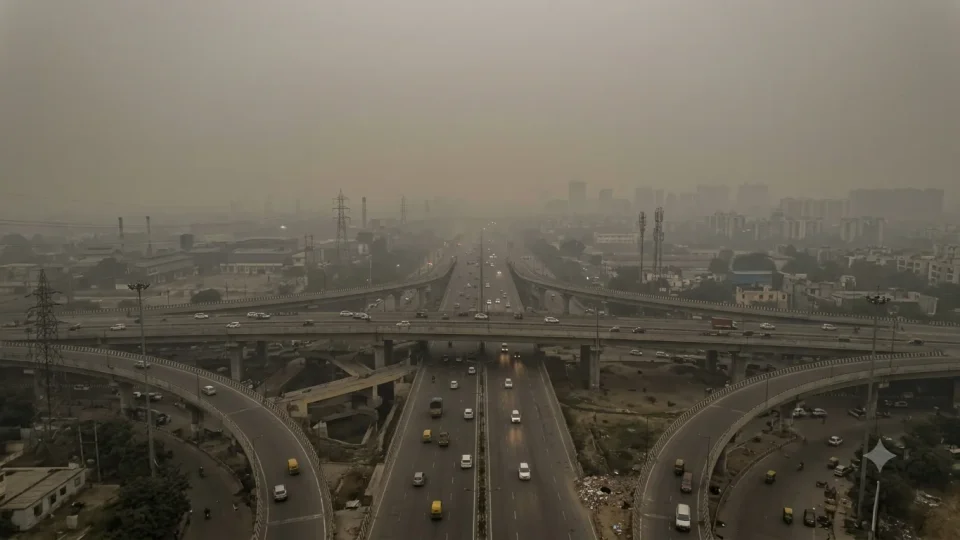
Delhi AQI Today: Delhi’s air quality deteriorated further on Friday, November 6, with the city’s average Air Quality Index (AQI) reaching 382. The Commission for Air Quality Management (CAQM) imposed Stage-III emergency measures across Delhi-NCR as a precaution, even though the average AQI remained in the “very poor” category. This comes days after Delhi entered the “very poor” zone on November 2, when its AQI touched 324 amid smoke from stubble fires in Punjab and Haryana and unfavourable wind conditions. The earlier spike had prompted CAQM to invoke Stage-II measures under the Graded Response Action Plan (GRAP).
2/4 Delhi’s average AQI has been on an increasing trend. As per the Daily AQI Bulletin of CPCB, Delhi recorded a daily average AQI of 382 on 06th November 2026, i.e., ‘Very Poor’ category;
— Commission for Air Quality Management (@CAQM_Official)
Also Read: Delhi’s AQI Surges to 324; The 3 PM Blind Spot in Punjab-Haryana Stubble-Burning Data
AQI Worsens Further
Delhi’s average AQI rose from 369 on Thursday (November 5) to 382 on Friday, bringing the capital closer to the “severe” threshold of 401, reports PTI. Of the 58 monitoring stations that recorded data, 26 recorded “severe” air quality, 31 recorded “very poor”, and only Lodhi Road remained in the “poor” category.
Punjabi Bagh reportedly recorded the worst reading at 453, followed by Jahangirpuri at 447 and Rohini at 444. A layer of smog reduced visibility across parts of the capital, while PM2.5 remained the predominant pollutant.
GRAP-III Imposed Early
CAQM invoked GRAP Stage-III on Friday as a precautionary measure, although the stage is generally triggered when the AQI reaches 400 and air quality turns “severe.” The decision came two days before Diwali, amid forecasts that pollution could worsen from Saturday onwards.
Under the stricter stage, non-essential construction and demolition activity is banned, including earthwork, piling, trenching and open-air operations of ready-mix concrete plants. The movement of BS-3 petrol and BS-4 diesel four-wheelers has also been restricted in Delhi and adjoining NCR districts.
Work From Home Advised
Private companies have been advised to allow work from home or hybrid working arrangements to reduce vehicular movement, as reported by NDTV. Schools up to Class 5 have been directed to close and shift classes online, while inter-state diesel buses face restrictions on entering or operating in Delhi.
The curbs also include a ban on transporting construction material such as sand and cement, particularly on unpaved roads, and the closure of stone crushers, mining operations and hot-mix plants not using clean fuel. Diesel generator sets have been prohibited except for emergency and essential services.
Stubble Burning Persists
Stubble burning continued to add to Delhi’s pollution burden. Satellite data showed 837 residue-burning incidents across six states on Thursday, including 414 in Punjab and 18 in Haryana, as reported by PTI, citing the Indian Agricultural Research Institute’s bulletin.
Between September 15 and November 5, 5,637 farm-fire incidents were detected across the six states, with Punjab accounting for 2,787 and Haryana for 80. The figures come from the Consortium for Research on Agroecosystem Monitoring and Modelling from the Space Laboratory.
1/4 High-level CAQM team led by Dr. T.S. Panwar, Member (Technical), visited Bathinda, Sri Muktsar Sahib, and Fazilka Districts in Punjab to review preparedness to prevent farm fires and paddy stubble management operations #CAQM #AirQuality #Punjab https://t.co/qaapp5FFsg
— Commission for Air Quality Management (@CAQM_Official) November 5, 2026
What is Driving the Pollution
According to the Decision Support System for Delhi, transport was the largest local pollution contributor on Friday, accounting for 17.9 per cent, while stubble burning contributed 13 per cent. PTI further states that among neighbouring districts, Sonipat contributed 7.3 per cent, Jhajjar 5 per cent and Rohtak 3.6 per cent to Delhi’s pollution load.
Weather and air-quality experts reportedly attributed the expected deterioration to unfavourable meteorological conditions, Diwali-related celebrations, vehicular emissions and the peak stubble-burning season. The Air Quality Early Warning System forecast that Delhi’s air would remain in the “severe” category from November 7 to 9.
Officials and Social Media
Delhi Environment Minister Manjinder Singh Sirsa said stubble burning in Punjab was contributing to the capital’s rising pollution, according to public broadcaster All India Radio. He maintained that construction, vehicular, and industrial sources were being controlled within Delhi.
The facts are out and the numbers speak for themselves. Punjab’s stubble-burning crisis cannot be hidden behind political excuses and propaganda. https://t.co/lgs1steg4W
— Manjinder Singh Sirsa (@mssirsa) November 4, 2026
Advisory for Residents
Authorities have advised residents to walk or cycle for short distances, use public transport where possible, and avoid non-essential vehicle trips. People have also been asked to avoid private gatherings that increase outdoor exposure, refrain from burning coal or firewood, and comply with hybrid-schooling and work-from-home advisories when notified.
1/2 Sh. Rajesh Verma, Chairperson, CAQM, sensitised the State Agencies about the recent order for implementation of precautionary measures for prevention and control of air pollution in Delhi-NCR during 05th to 20th November. https://t.co/yDEOWpRKkI
— Commission for Air Quality Management (@CAQM_Official) November 2, 2026
Will GRAP-III be Enough?
The latest deterioration shows how quickly Delhi’s air can move from “very poor” towards “severe” during the winter pollution season. It, however, may be likely that GRAP-III may limit further emissions; emergency restrictions alone might not be enough to address a crisis driven by vehicles, industry, dust, waste burning, and pollution transported from neighbouring regions.