Nvidia Halts AI Chip Shipments to China as US Export Controls Tighten
Nvidia AI Chip: With interim CEO Colette Kress ruling out further shipments for now, the move highlights the growing impact of Washington’s export controls on Nvidia’s China business and the wider US-China technology rivalry.
Nvidia AI Chip: Nvidia has stopped shipping licensed Hopper-Generation AI data centre chips to China, its interim Chief Executive Colette Kress said on Tuesday (November 17), despite previously securing US approval to sell the technology there, as well as recording $2.4 billion in such sales in the quarter ended October 25.
Kress announced Nvidia’s third-quarter earnings call, saying, “Our guidance does not have any licensed Hopper data centre products included, and we are no longer shipping licensed Hopper data centre products to China,” quoted by the Fortune The Hopper technology is used in Nvidia’s H200 chip, which the company had previously been approved to sell in China after Jensen Huang’s lobbying efforts in Washington. Further, Kress did not detail why the shipments had stopped or whether the halt would be permanent.
What Changed
Nvidia’s move affects Hopper-generation data centre products sold to China under US licences, rather than a blanket ban on all Nvidia products. The company’s fourth-quarter fiscal 2027 guidance explicitly excludes any data center compute revenue from China. The company had reportedly sold $2.4 billion worth of licensed Hopper data centre products to China in the third quarter, Kress said on the call. Nvidia’s Hopper family includes the H200, but the company did not disclose how much of the $2.4 billion came specifically from that chip.
The Updated US Export Controls
The announcement came after the US Commerce Department’s Bureau of Industry and Security (BIS) issued new restrictions on chip exports to overseas data centres, which have allegedly been used as a route for Chinese firms to access advanced chips for training AI models, titled “Addressing Remote Access to Advanced Semiconductors” on November 16.
The rule imposes new restrictions on exports, re-exports and in-country transfers to overseas data centres that remotely supply significant volumes of computing power to companies headquartered in Country Group D:5 or Macau. It is designed to limit the ability of companies in countries of concern to use advanced US “Super Intelligence” semiconductors to train advanced AI models.
Under the rule, data centres, foreign foundries and chip exporters must carry out due diligence on customers, including any direct or indirect ownership or control by persons in Country Group D:5 or Macau. The licence requirement does not apply to commercial recommender systems, such as those used by online retailers or social media companies, which the department says do not pose the same national security risk.
The rule also requires licences for exports of advanced semiconductors to Indonesia, Malaysia, Singapore, Thailand and Brazil, which the Commerce Department identifies as presenting a higher-than-normal risk of diversion. The requirement does not apply to chips destined for companies headquartered in, or whose ultimate parent company is headquartered in, the United States, subject to certain reporting conditions.
The department said it would monitor countries that tolerate evasion of the rule and could respond with import restrictions, new licence requirements, downgrading a country’s status in the US export-control regime, or Entity List designations and temporary export prohibitions for foreign persons involved in such activities.
The rule also amends presumptions facing front-end chip fabricators and chip packagers exporting advanced-node logic chips, reducing the pathways available to overcome them for chip designers in destinations subject to licence requirements for Super Intelligence chips. Finally, it formally rescinds the regulations implementing the Biden-era AI Diffusion Rule, which was never enforced and whose rescission the Bureau of Industry and Security had announced in May 2025.
It also requires operators to examine customers’ direct and indirect ownership and control, reportedly, and to obtain a licence within 90 days if they want to continue providing covered services.
Nvidia’s Compliance Move
Nvidia also announced the formation of a board committee dedicated to national security and export controls, according to company statements reported.
Harvey Jones, Nvidia’s chair, said, "The board appreciates that we're living in a world where the advanced silicon technologies and national security dynamics are making major changes in our marketplace," reports RTE. "Our new CEO will have to navigate those waters very carefully."
China’s Position
Chinese regulators have withheld approval for large-scale H200 imports as part of broader efforts to reduce the country’s dependence on US technology, according to Reuters reporting.
Further, around 600,000 H200 chips were being held in Hong Kong while awaiting permission to enter mainland China.
Chandy Ye, a dual-qualified Hong Kong solicitor and mainland China lawyer, said that the practical impact of Nvidia’s decision would be limited, as Chinese authorities had already been steering the domestic tech sector away from procuring H200s since January 2026, reports AFP.
Also Read: Nvidia Scandal, Chip Rivalry, AI Race: What Makes Trump's China Visit a Global
Huang’s resignation: Kress takes as Interim CEO?
Kress took over as interim chief executive after Jensen Huang resigned on November 12, amid allegations of extramarital affairs involving an alleged Chinese spy and two Nvidia employees. Huang had reportedly lobbied for months for Washington to approve the export of Nvidia’s Hopper-generation chips to China.
US-China Tech Standoff
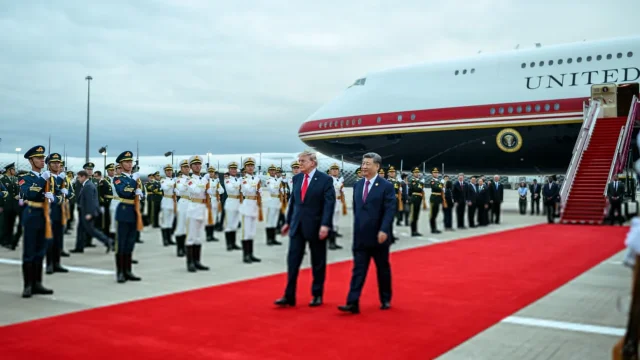
Nvidia’s halt on China shipments marks a significant escalation in the US-China technology standoff, coming just as President Donald Trump arrived in Asia for meetings with Xi Jinping and Vladimir Putin. The move underscores the growing tension between commercial interests and national security concerns in the global AI chip market.