VIDEO: MP Cop Asks to Plant Ganja After Unmarried Couple Found at Hotel Without Parents' Knowledge
A viral CCTV video from a hotel in Madhya Pradesh's Seoni allegedly shows a senior police officer threatening to plant marijuana in a man's bag after finding him with a woman. The incident has triggered public outrage and prompted suspension proceedings against two police officials, raising questions about police powers, moral policing and the rights of consenting adults.
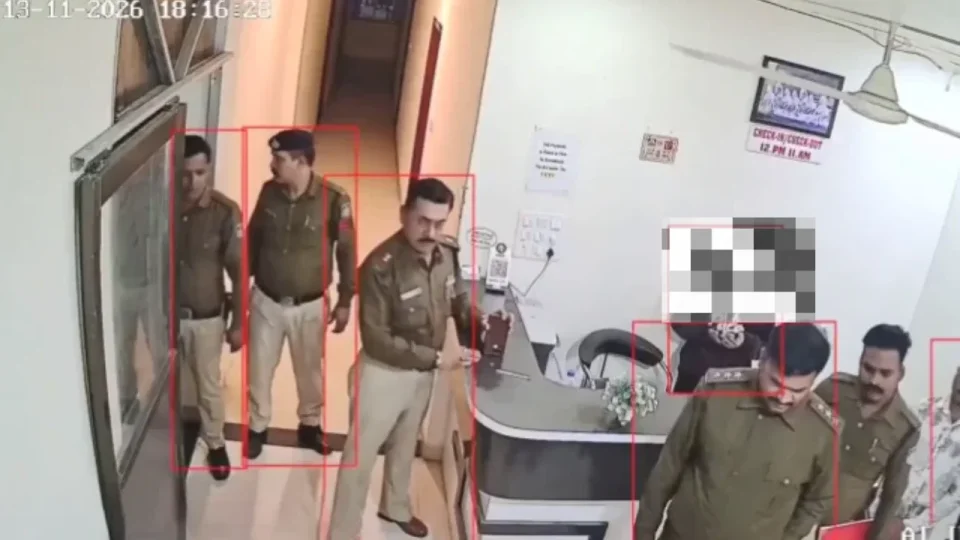
MP Police Threatenes Unmarried Couple With Fake Ganja Plot: A senior police officer in Madhya Pradesh's Seoni allegedly asked his subordinates to plant marijuana in the bag of a man who was found in a hotel room with a woman. The conversation was captured on the hotel's CCTV camera during a police visit. The officers first questioned the unmarried couple, pressured them to call their parents and threatened to plant cannabis in the man's bag.
The purported CCTV footage has surfaced on social media, drawing severe criticism from the public and government officials. When former Director General of Police (DGP) and IPS officer RK Vij enquired about the matter, IPS officer Kailash Makhwana replied that a proposal seeking the suspension of Additional SP Seoni Deepak Mishra and SDOP Seoni had already been sent to the government. Both officials would be suspended on Wednesday, he added.
हैलो dgp @ips_kmak साहब, आपकी पुलिस ganja रख कर झूठा फ़साने करने की बात कर रही है. कार्यवाही करिए ताकि बाकियों को भी सबक मिले!
— RK Vij (@ipsvijrk) November 18, 2026
Also Read: The Slate Exclusive - CAG Audit Finds BIS Lax on Grievance Redressal and Legal Action; 62% of Complaints Delayed
However, the incident has renewed debate over the rights of consenting couples and the limits of police powers. Indian law does not require consenting adults to be married or obtain parental permission to stay together in a hotel. The couple, therefore, did not violate any law merely by staying together. In its 2017 Justice K.S. Puttaswamy v. Union of India judgment, the Supreme Court recognised the right to privacy as a fundamental right under Article 21 of the Constitution. This includes the autonomy to make personal decisions concerning relationships, family and marriage.
While police can investigate suspected criminal offences, two consenting adults staying together without being married or declining to inform their parents does not, by itself, constitute an offence.
What Was The Matter?
Additional Superintendent of Police Deepak Mishra, Sub-Divisional Police Officer Chanchalesh Markam and Kotwali police station in-charge Satish Tiwari had reached the hotel, where they confronted an unmarried couple. The viral video showed the officers questioning the two individuals. In a shaken voice, the woman was heard saying that they belonged to the same caste, were in love and were planning to get married.
After hearing this, Mishra insisted that they call their parents. He initially told them they would be allowed to leave after speaking to their parents. However, he then threatened to plant marijuana in the man's bag and instructed another police official to do so, apparently to register a case under the drug law. “Chalo inke pass ganja (marijuana) rakh do, plant some on the boy. Now your life will be good; nobody will give you a job,” he is heard saying.
The anti-youth and anti-Gen Z BJP government’s police in Madhya Pradesh threatened an adult, consenting couple, saying they would be falsely implicated in a ‘ganja’ smuggling case. Nothing will happen here because the hate-filled BJP allows its administration to harass the young people of this country. https://t.co/BIx5fksRrq
— Saral Patel (@SaralPatel) November 17, 2026
The couple told the officers that they were adults and had checked into the hotel willingly. Mishra, however, lectured them for meeting privately without informing their parents. As he continued to insist that they contact their families, the woman was heard requesting him not to do so and refusing to unlock her mobile phone. The Slate could not independently verify the authenticity of the video.
The incident came to the notice of Seoni Superintendent of Police Krishna Lalchandani on Wednesday, November 18. He ordered that Kotwali police station in-charge Satish Tiwari be attached to the police lines and directed an inquiry into the matter.
“The video has come to our cognisance today. As an immediate action, the Kotwali police station in-charge has been attached to the (police) lines and a probe has been initiated. We will examine the details of the DVR (digital video recorder) and video soon,” a senior police officer said, The Indian Express reported.
Hotel Owner's Extortion Allegations
Sanju Sanodiya, owner of Sidarth Hotel, alleged that Kotwali police station in-charge Satish Tiwari, SDOP Chanchalesh Markam and Traffic Inspector Vijay Baghel demanded a monthly payment of Rs. 25,000 each from him. He claimed that Tiwari and Markam had already collected Rs. 10,000 each and that the police raid on his hotel followed his refusal to make further payments, Brut India reported.
Sanodiya said he made the CCTV footage public to expose the alleged misconduct. The extortion allegations have not been independently verified and are subject to investigation.
What Does The Law Say About Planting Drugs?
Section 20 of the Narcotic Drugs and Psychotropic Substances (NDPS) Act, 1985, criminalises offences involving cannabis, including illegal possession, production, sale, purchase and transportation. The punishment varies according to the quantity involved:
-
Small quantity: Imprisonment of up to one year, a fine of up to Rs. 10,000, or both.
-
Intermediate quantity: Imprisonment of up to 10 years and a fine of up to Rs. 1 lakh.
-
Commercial quantity: Imprisonment of 10 to 20 years and a fine of Rs. 1 lakh to Rs. 2 lakh.
If drugs are deliberately planted to implicate an innocent person, the act could expose those responsible to criminal prosecution.
The Bharatiya Nyaya Sanhita (BNS), 2023, also provides for punishment for certain forms of misconduct by public servants. Section 198 deals with a public servant knowingly disobeying the law with the intention of causing injury to a person. Section 201 covers a public servant preparing an incorrect document or electronic record with the intention of causing injury.