Ancient Indian Medicine Draws Global Attention With Sushrutha Being Honoured in Edinburgh
After Yoga, ancient Indian System of Medicine gets global attention with the Royal College of Surgeons of Edinburgh, regarded as the world's oldest surgical college, unveiling a 90-kilogram bronze statue of Sushrutha, the ancient Indian physician widely recognised as the "Father of Surgery" and a pioneer of plastic surgery. By Mahima Katal New Delhi, June 23: More than 2,600 years ago, an ancient Indian physician compiled one of the world's most comprehensive medical texts, documenting over...
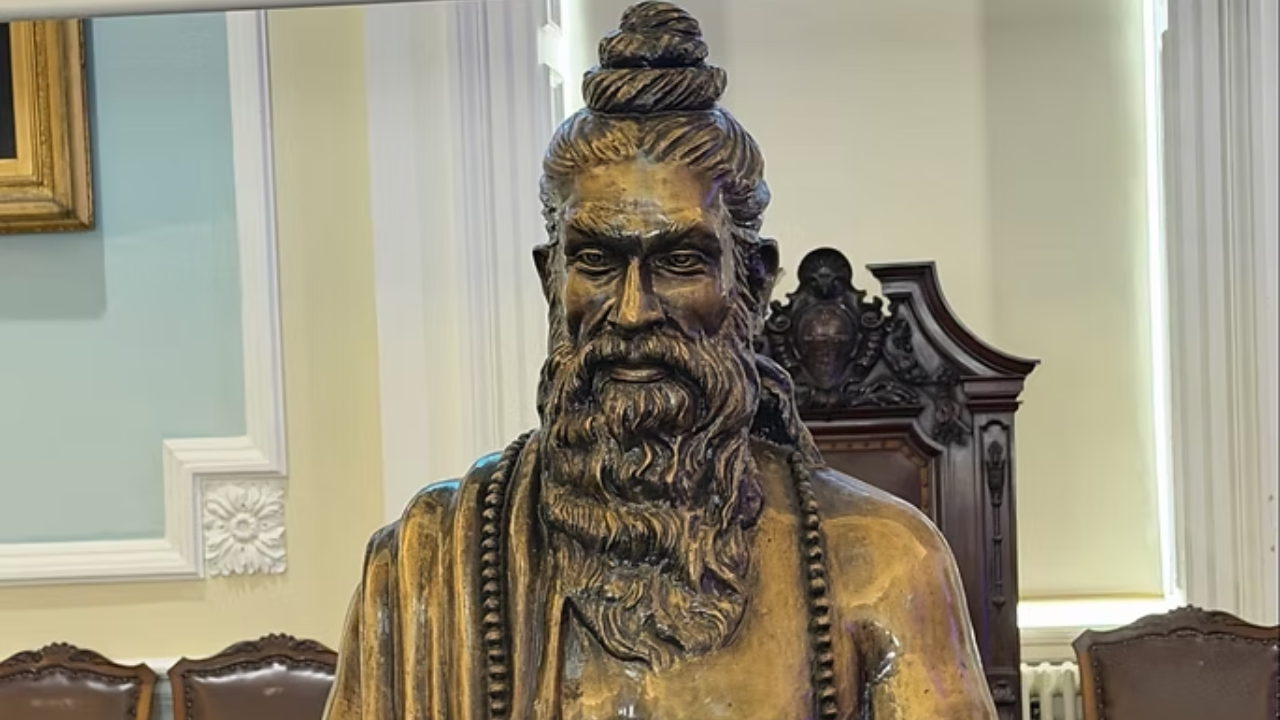
After Yoga, ancient Indian System of Medicine gets global attention with the Royal College of Surgeons of Edinburgh, regarded as the world's oldest surgical college, unveiling a 90-kilogram bronze statue of Sushrutha, the ancient Indian physician widely recognised as the "Father of Surgery" and a pioneer of plastic surgery.
By Mahima Katal
New Delhi, June 23: More than 2,600 years ago, an ancient Indian physician compiled one of the world's most comprehensive medical texts, documenting over 1,100 diseases, hundreds of medicinal plants, surgical procedures, and medical instruments. Today, that legacy is receiving renewed global recognition.
The Royal College of Surgeons of Edinburgh, regarded as the world's oldest surgical college, has unveiled a 90-kilogram bronze statue of Sushrutha, the ancient Indian physician widely recognised as the "Father of Surgery" and a pioneer of plastic surgery.
The statue honours the contributions of Sushrutha, whose seminal work, the Sushrutha Samhita, remains one of the most detailed medical treatises from the ancient world.
Crafted in Swamimalai near Kumbakonam in Tamil Nadu, the bronze sculpture was created by a traditional sthapathi and a team of artisans renowned for preserving India's centuries-old bronze-casting traditions.
The Edinburgh tribute follows a similar recognition by the Royal Australasian College of Surgeons in Melbourne, which had earlier installed a statue of Sushrutha. Together, these honours underscore the growing international acknowledgment of his role in shaping the history of surgery.
A Medical Text Centuries Ahead of Its Time
The Sushrutha Samhita is regarded as one of the foundational works of ancient medicine. Divided into two major sections—Purva-tantra and Uttara-tantra—the text covers surgery, internal medicine, paediatrics, toxicology, psychiatry, ophthalmology, ear, nose and throat disorders, and geriatric care.
It records more than 300 surgical procedures and describes over 120 surgical instruments. The text also catalogues hundreds of medicinal preparations derived from plants, minerals, and animal products.
One of its most significant contributions is the classification of surgery into eight broad categories, including excision, incision, puncturing, extraction, drainage, and suturing. Historians of medicine have frequently cited these descriptions as evidence of the sophisticated surgical knowledge that existed in ancient India.
The text also outlines methods for training surgeons, emphasising structured education and practical experience—principles that remain central to medical training today.
Contributions to Plastic Surgery and Trauma Care
Sushrutha is perhaps best known for his pioneering work in reconstructive surgery. His descriptions of nasal reconstruction techniques are often cited as some of the earliest documented examples of plastic surgery.
Beyond reconstructive procedures, the Sushrutha Samhita discusses burns, frostbite, heatstroke, and lightning-related injuries, grouping various forms of trauma into broader medical categories. Medical historians have noted that some of these approaches resemble concepts adopted in modern surgery centuries later.
The text also contains observations on conditions resembling diabetes, obesity, and cardiovascular disorders. Sushrutha linked several illnesses to lifestyle factors and recommended physical activity as part of treatment—an idea that aligns with contemporary preventive medicine.
Medical scholar Surajit Bhattacharya has observed that Sushrutha performed complex surgical procedures long before many celebrated figures of classical Western medicine emerged, highlighting the advanced state of medical knowledge in ancient India.
Renewed Interest in Indian Knowledge Systems
The international recognition of Sushrutha comes amid growing interest in Indian Knowledge Systems (IKS) across academic and research institutions.
Several Indian Institutes of Technology (IITs) have launched research initiatives exploring traditional knowledge through modern scientific methods. Projects have ranged from studies on traditional medicinal formulations to investigations into the effects of Indian classical music on mental well-being and cognitive performance.
Supporters argue that such efforts can help uncover valuable insights that may complement contemporary scientific research, while critics stress the need for rigorous testing and evidence-based validation.
According to researchers working in the field, the goal is not to replace modern science but to examine traditional knowledge systems with an open and critical approach, identifying practices that may offer solutions to present-day challenges.
A Legacy Beyond Borders
The statues in Edinburgh and Melbourne do more than honour a historical figure. They reflect a broader recognition that the history of medicine and surgery extends beyond conventional Western narratives.
While debates about history, science, and tradition continue, the growing global interest in Sushrutha's work suggests that his contributions remain relevant to discussions about the origins and evolution of medical knowledge.
More than two millennia after he documented surgical techniques and medical practices, Sushrutha's legacy continues to inspire scholars, surgeons, and researchers around the world.
Unveiling of Sushruta’s statue at the Royal College of Surgeons Edinburgh.