Centre’s Intervention Needed to Introduce Uniform Civil Code
The Narendra Modi-government should come up with a draft uniform civil code at the earliest to ensure that it serves as a model for states and reinvigorates the debate which could help giving a final shape to the Bill to be presented in Parliament. By Gyanant Singh The introduction of Uniform Civil Code (UCC) is now hardly an option for the Centre if the objective of the constitution-makers is to be fulfilled. With multiple uniform civil codes coming up with states enacting their own law to...
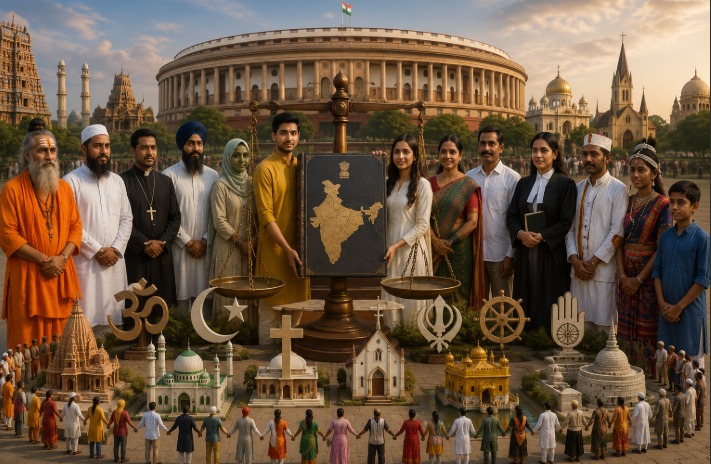
The Narendra Modi-government should come up with a draft uniform civil code at the earliest to ensure that it serves as a model for states and reinvigorates the debate which could help giving a final shape to the Bill to be presented in Parliament.
By Gyanant Singh
The introduction of Uniform Civil Code (UCC) is now hardly an option for the Centre if the objective of the constitution-makers is to be fulfilled. With multiple uniform civil codes coming up with states enacting their own law to replace personal laws, the solution itself has turned out to be a problem. Now, Parliament alone can ensure a uniform civil code governing marriage, divorce and inheritance for people of all communities across India.
The idea behind doing away with personal law of various religious communities was to ensure that the same law is applied to all citizens. And this is reflected in Article 44 of the Constitution of India which enjoins upon the government to secure “a uniform civil code throughout the territory of India”.
The Narendra Modi-government should come up with a draft uniform civil code at the earliest to ensure that it serves as a model for states and reinvigorates the debate which could help giving a final shape to the Bill to be presented in Parliament.
A serious debate over having a uniform civil code started over 76 years ago at the time of the framing of the Constitution. While a consensus could not be reached all these years, the issue has been alive with an unending debate on the matter in the society, courts and legislature.
While successive governments at the Centre remained indecisive, several state governments have now taken the lead. The introduction of a uniform civil code by Madhya Pradesh is in the offing. Assam’s code is pending assent by the Governor. Gujarat has already enforced its code. Uttarakhand was the first state to enact its own uniform civil code.
This may have compounded the problem. The object was not just to do away with personal laws, which are discriminatory against women, but to have a common law governing civil relationships of people of all communities living across India. Such a law, which is applicable to all citizens throughout the territory of India, can only be enacted by the Parliament.
The very purpose of having a uniform civil code gets frustrated when states enact separate ‘uniform’ civil codes. With several states having come up with their own uniform civil codes, the need for an intervention by the Centre for introducing a uniform civil code has never been felt as strongly ever before.
The state legislatures are competent to enact laws on subjects like marriage, divorce and succession, which fall in the concurrent list of the Seventh Schedule to the Constitution on which both Parliament and state legislatures can enact laws. Article 254 of the Constitution clarifies the position in case both state legislature and Parliament enacts a law on the same subject. The law enacted by the state is deemed void to the extent of repugnancy.
The uniform civil codes enacted by states are likely to create confusion and clog court dockets with complex legal questions. The application of such a law being confined to the territorial limits of a state, there would be problems in resolving cases where parties are from two different states and marriage ceremonies take place in two or more states.
Further, such separate codes will adversely affect the migrant population, which predominantly comprises illiterate people. There would be cases in which different marriages in the family would be governed by different laws. Such a scenario is illogical when India has a single citizenship with the fundamental right to move and settle anywhere in the country.
Given the fact that uniform civil code is likely to benefit women, there is no reason as to why the benefit should not accrue to all women with a Central law applicable throughout the country.
Dr. B R Ambedkar had supported uniform civil code and opposed personal law as it was discriminatory against women. The Constituent Assembly specifically rejected a proposal to incorporate ‘freedom to follow personal law’ as a fundamental right with opposition from Dr. Ambedkar who stressed that “such a saving clause” would come in way of introducing social reforms through law. “After all, what are we having this liberty for? We are having this liberty in order to reform our social system, which is so full of inequalities, discriminations and other things, which conflict with our fundamental rights,” he said.
The drafting committee of the Constituent Assembly strongly defended incorporation of Uniform Civil Code as a directive principle. “We want to divorce religion from personal law,” K M Munshi, a member of the drafting committee, said. Dr. Ambedkar backed him saying it was wrong to suggest that personal law was linked to freedom of religion which was protected as a fundamental right.
The view held by Dr. Ambedkar subsequently echoed in several authoritative pronouncements by the Supreme Court. In fact, the Muslims in North-West Frontier Province were not subject to Shariat law till 1935 but they followed the Hindu law in succession and other matters. Further, Muslims in the United Provinces, the Central Provinces and Bombay were governed by the Hindu law in the matter of succession till 1937 when the Muslim Personal Law (Shariat) Application Act came into force.
Lord T B Macaulay, who chaired the first law commission in British India, saw vast diversity in India as a challenge for drafting law. But he steered through with his policy which was simple – ‘uniformity where you can have it; diversity where you must have it’.
The historical evidence and law indicate that a uniform civil code for all religious communities in India is possible and we can have it.
About the Author:
Gyanant Singh is a Supreme Court advocate, legal commentator, and columnist who writes on constitutional and legal issues for various publications and frequently appears on news channels as a legal expert.