India And Brazil Are Rewriting The South-South Script
The Slate Bureau For decades, the relationship between India and Brazil was often described as a "partnership of distance"—two giants of the Global South who shared a democratic soul but were separated by a vast ocean and even vaster indifference. However, as we stand in February 2026, the script has been flipped. The "Samba-Saffron" bridge is no longer a metaphor; it is a high-speed corridor for trade, energy, and digital sovereignty. The $20 Billion Handshake On February 21, 2026, Prime...
The Slate Bureau
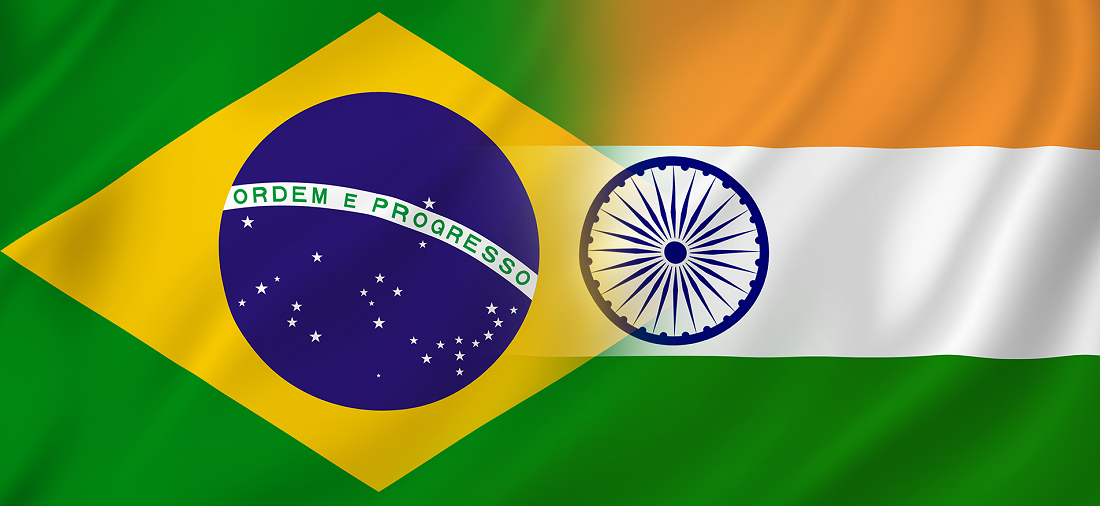
For decades, the relationship between India and Brazil was often described as a "partnership of distance"—two giants of the Global South who shared a democratic soul but were separated by a vast ocean and even vaster indifference. However, as we stand in February 2026, the script has been flipped. The "Samba-Saffron" bridge is no longer a metaphor; it is a high-speed corridor for trade, energy, and digital sovereignty.
The $20 Billion Handshake
On February 21, 2026, Prime Minister Narendra Modi and President Luiz Inácio Lula da Silva met at New Delhi’s Hyderabad House to codify a vision that was unimaginable just five years ago. Brazil has officially become India’s largest trading partner in Latin America, with bilateral trade surging past $15.2 billion in 2025. But the leaders aren't stopping there. They have set a "North Star" target: $20 billion in trade by 2030.
This isn't just about selling more sugar or soy. It is a strategic realignment. With the expansion of the India-MERCOSUR trade agreement now in its final stages, over 450 limited tariff lines are being replaced by a robust, comprehensive framework. This will allow Indian pharmaceuticals, automobiles, and IT services to flood the South American market, while Brazil’s high-grade iron ore feeds India’s infrastructure hunger.
A Digital and Green Synergy
The most original aspect of the 2026 partnership is the "Digital Partnership for the Future." India is currently establishing a Centre of Excellence for Digital Public Infrastructure (DPI) in Brazil. In a world where Big Tech often dictates terms, India and Brazil are choosing a "third way"—open-source, public-interest technology. Whether it is UPI-style payments in São Paulo or Aadhaar-inspired identity systems in Brasília, the two nations are building a "Digital Commons" for the Global South.
Simultaneously, the energy equation has shifted from crude oil to "Green Molecules." Brazil, the world’s biofuel pioneer, and India, with its aggressive E20 (20% ethanol blending) goal, are now the twin engines of the Global Biofuel Alliance. By sharing technology on second-generation ethanol and sustainable aviation fuel, they are ensuring that the Global South leads the climate transition rather than just following Western mandates.
Securing the "Critical" Future
The 2026 visit also saw a landmark MoU on Critical Minerals and Rare Earths. Brazil holds the world's second-largest reserves of rare earths—essential for the EVs, semiconductors, and smartphones of tomorrow. For India, this is a masterstroke in de-risking from China. By investing in Brazilian mining and exploration, India is securing the raw materials needed for its own "Make in India" 2.0 revolution.
"When India and Brazil work together, the voice of the Global South becomes a roar." — PM Modi, February 2026
The New Global Guardians
Beyond the balance sheets, the Modi-Lula era has birthed a new diplomatic gravity. As members of the G4 (seeking UN Security Council reform) and the IBSA (India-Brazil-South Africa) dialogue, these two nations are the self-appointed guardians of a "multipolar" world. They have moved beyond the rhetoric of the Cold War into a pragmatic "South-South" realism that prioritizes food security, health equity, and debt reform for developing nations.
The Long Game
The reinvention of the India-Brazil tie is a reminder that in the 21st century, geography is secondary to shared intent. By linking India’s "Digital Power" with Brazil’s "Resource Power," Modi and Lula have created a partnership that is resilient to global shocks and trade wars.