India–Canada Relations Significant But Fragile
The moment is best understood not as a breakthrough, but as a starting point. The reset created diplomatic space—but not trust, and that distinction will define what comes next. The challenge is to convert that space into a durable framework: one that builds steadily on present realities rather than overreaching. By Sanjay Kumar Verma Today’s diplomatic thaw runs through the shadow of the 1985 Air India bombing, which killed 329 people and remains Canada's deadliest terrorist incident....
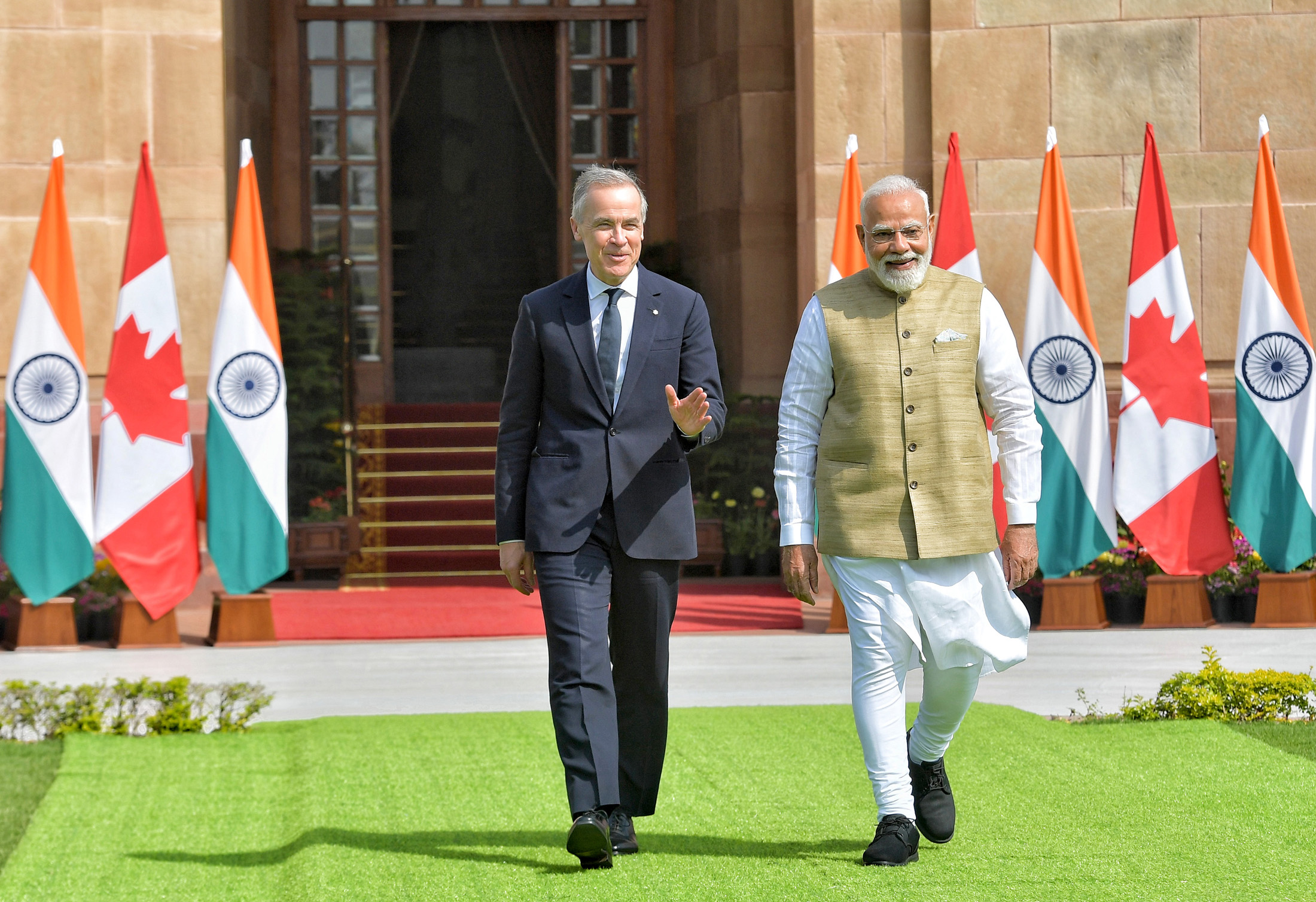
The moment is best understood not as a breakthrough, but as a starting point. The reset created diplomatic space—but not trust, and that distinction will define what comes next. The challenge is to convert that space into a durable framework: one that builds steadily on present realities rather than overreaching.
By Sanjay Kumar Verma
Today’s diplomatic thaw runs through the shadow of the 1985 Air India bombing, which killed 329 people and remains Canada's deadliest terrorist incident. Orchestrated by Canada-based Khalistani extremists, the attack began India's long suspicion that Canada tolerated citizens challenging its sovereignty, including through violence.
One pattern stands out: since the mid-1980s, Canada-based Khalistani extremists, who are also Canadian citizens, have operated from Canadian soil for promotion, fundraising, and planning violence against India. In May 2026, the Canadian Security Intelligence Service (CSIS) officially confirmed what India had long maintained: pro-Khalistan activities in Canada posed a security threat, even as the report also criticized Delhi's alleged foreign interference.
In a March 2026 interview with CTV News, RCMP Commissioner Mike Duheme stated that based on current investigations, there is no evidence linking the Indian government to transnational repression or foreign interference in Canada.
In September 2023, then-Canadian Prime Minister Justin Trudeau stated on the floor of the Canadian House of Commons that agents of the Government of India were involved in the killing of a Canadian citizen on Canadian soil. The allegation sent the relationship into its deepest crisis in decades. Yet even after more than two and a half years, no judicial conclusion to the claim has been forwarded.
The recent improvement in India–Canada relations feels significant but fragile. Modi and Mark Carney met on the sidelines of the June 2025 G7 Summit in Kananaskis, Alberta, followed by Carney's first official visit to India (February 27–March 2, 2026). Diplomatic presence is stabilizing, CEPA negotiations have regained traction, and the March 2, 2026 Joint Leaders' Statement outlines bilateral priorities.
But here's what I see: this moment is best understood not as a breakthrough, but as a starting point. The reset created diplomatic space—but not trust, and that distinction will define what comes next. The challenge is to convert that space into a durable framework: one that builds steadily on present realities rather than overreaching.
Trust Deficit
A credible future for India–Canada ties must be grounded in political trust, which remains uneven, at best. India's concerns about Canada-based extremists challenging its sovereignty continue to shape its strategic assessment. Canada treats these activities as free expression.
For India, the issue isn't expression itself, but where it intersects with intimidation, incitement, or legitimizing violence. Without clarity here, progress in other domains remains vulnerable.
Canada's concerns should be addressed. Allegations of foreign interference have become a significant domestic political issue, and Canadian institutions continue to view them through a national security lens. A durable relationship requires both governments to recognize that the other's concerns are politically and institutionally real.
CSIS continues to identify India as a source of foreign interference in Canada, although the evidentiary basis for many of its conclusions has yet to be fully disclosed in the public domain. In India, there remains a perception that assessments of this nature are shaped, at least in part, by the influence of Canada-based Khalistani networks and their ability to mobilize political and institutional attention. Whether justified or not, this perception has become an enduring feature of India's assessment of the bilateral relationship and cannot simply be wished away.
At the same time, recent remarks by the Royal Canadian Mounted Police, which acknowledged the threat posed by violent extremism and organized criminal networks while indicating no current evidence of ongoing transnational repression activities linked to India, create an opening for a more constructive approach. Rather than perpetuating competing narratives, both sides can use this moment to shift the focus toward practical law-enforcement cooperation and the shared objective of addressing genuine security threats.
Looking ahead, institutionalized law enforcement and judicial engagement would help—regular exchanges on evidentiary standards, clearer communication channels, and structured intelligence cooperation. Such mechanisms would not only address current concerns but also prevent their recurrence. India and Canada can initiate an exchange of best practices between the two judiciaries to build trust. The passage of Canadian Bill C‑9, which penalizes hate speech, intimidation, and incitement to violence, is a positive step, but enforcement consistency matters more than the legislation itself.
Enforcement credibility at the local level also matters. Incidents such as temple vandalism and targeted graffiti in Ontario and British Columbia have created a perception gap that legal frameworks cannot close alone. Consistent, visible enforcement is essential to restoring confidence among affected communities.
This extends to Indian students, who form the largest cohort of foreign students in Canada and are a key pillar of bilateral ties. Ensuring their safety and a stable community environment is therefore central to the sustainability of people-to-people links, not peripheral.
Legal cooperation on extradition and asylum will also need to become more predictable. Respect for judicial independence is not in question, but prolonged timelines and limited transparency contribute to mistrust. More structured coordination can help bridge this gap.
A "Doable" CEPA, Not a Perfect One
The economic dimension will ultimately determine whether the reset matures into a durable partnership. A new CEPA framework is being negotiated. Previous rounds of negotiations between 2010 and 2016 failed to reach an agreement. Later, negotiations on the Early Progress Trade Agreement (EPTA) were launched, only to be paused by Canada in 2023 due to political reasons. This reflects an important recognition: in politically sensitive trade relationships, incremental progress is often more sustainable than comprehensive but delayed ambition.
This logic should guide the broader CEPA process. A "doable" CEPA—one that captures achievable gains and builds momentum—is more valuable than a "perfect" agreement that risks long-drawn negotiations. Insisting on completeness can become a pathway to paralysis.
A practical approach would prioritize low-hanging fruit: tariff reductions in less sensitive sectors, services trade facilitation, and improvements in customs procedures and regulatory transparency.
Mobility is one area where targeted progress is both feasible and impactful. Facilitating movement of professionals, researchers, and business travelers is central to any modern economic partnership. Canada may consider a pilot trusted business mobility framework—limited, compliance-based, and verifiable—that could deliver immediate benefits while remaining politically manageable. India already has an eVisa regime for Canadian travelers in place.
Investment protection is another domain where early clarity would yield dividends. A balanced framework that ensures investor confidence while preserving regulatory space can unlock flows currently constrained by lack of clarity and safeguards.
In agriculture, shift from defensive positioning to predictability: transparent standards, stable procedures, and prior consultation mechanisms reduce friction even where full market access remains contested. Technological collaboration in food processing can stabilize trade.
If approached incrementally, CEPA can evolve as a layered agreement—one that deepens over time rather than attempting to resolve every issue at once.
The Immediate Opportunity
While trade negotiations proceed, energy cooperation offers the most immediate opportunity to demonstrate tangible progress.
India's growing energy demand and Canada's capacity expansion, particularly in LNG, create clear complementarity. Long-term supply arrangements can provide economic and strategic benefits, anchoring the relationship in mutual dependence.
Critical minerals represent an even more consequential frontier. Canada's reserves of potash, nickel, cobalt, and uranium align closely with India's need to secure supply chains for clean energy and advanced manufacturing. This is not simply a trade opportunity; it is a strategic partnership in the making.
Civil nuclear cooperation, including uranium supply and potential collaboration on small modular reactors, adds depth. A gradual, confidence-based approach can allow progress without overextending political commitments.
Clean energy technologies, from hydrogen to storage, offer a pathway to move beyond resource trade toward co-development. This is where the relationship can align most closely with future economic and climate priorities.
To maintain credibility, both sides should identify a small number of flagship projects implementable within a defined time-frame. Early success would reinforce the case for broader cooperation.
Institutionalizing the Relationship
A key lesson from past disruptions is that India–Canada engagement has lacked continuity. Moving forward, institutionalization must become a central objective.
Expanded Track 1.5 mechanisms can bridge this gap by providing structured space for dialogue, problem-solving, and pre-negotiation consensus building. These platforms allow sensitive issues to be addressed candidly, reducing the burden on formal diplomatic channels.
Importantly, the scope of engagement must extend beyond immediate irritants. Cooperation in artificial intelligence, space, cybersecurity, education, and Indo-Pacific strategy can broaden the relationship's base and insulate it from periodic tensions.
The Path Forward: Discipline Over Drama
The path forward for India–Canada relations does not require sweeping reinvention. It requires disciplined execution.
Over the next year, a focused set of priorities can define the trajectory: conclude a doable and pragmatic CEPA as the first step, establish structured security and legal cooperation mechanisms, and launch a handful of visible energy and technology projects.
This approach reflects a broader strategic principle. In complex relationships, progress is rarely linear or comprehensive. It is built through accumulation of small agreements, functional cooperation, and institutional habits.
India and Canada have the elements of a strong partnership—economic complementarity, shared democratic frameworks, and converging strategic interests. What they require now is a method.
The challenge before India and Canada is no longer whether they can restore dialogue. It is whether they can build enough trust to ensure that the next disagreement does not become the next crisis.
Sanjay Kumar Verma is a former Indian diplomat with nearly four decades of experience. He served as India’s High Commissioner to Canada and Ambassador to Japan, Sudan, and the Republic of the Marshall Islands. He writes on diplomacy, geopolitics, international trade, technology policy, and global security.